
By The Pulseline News Desk
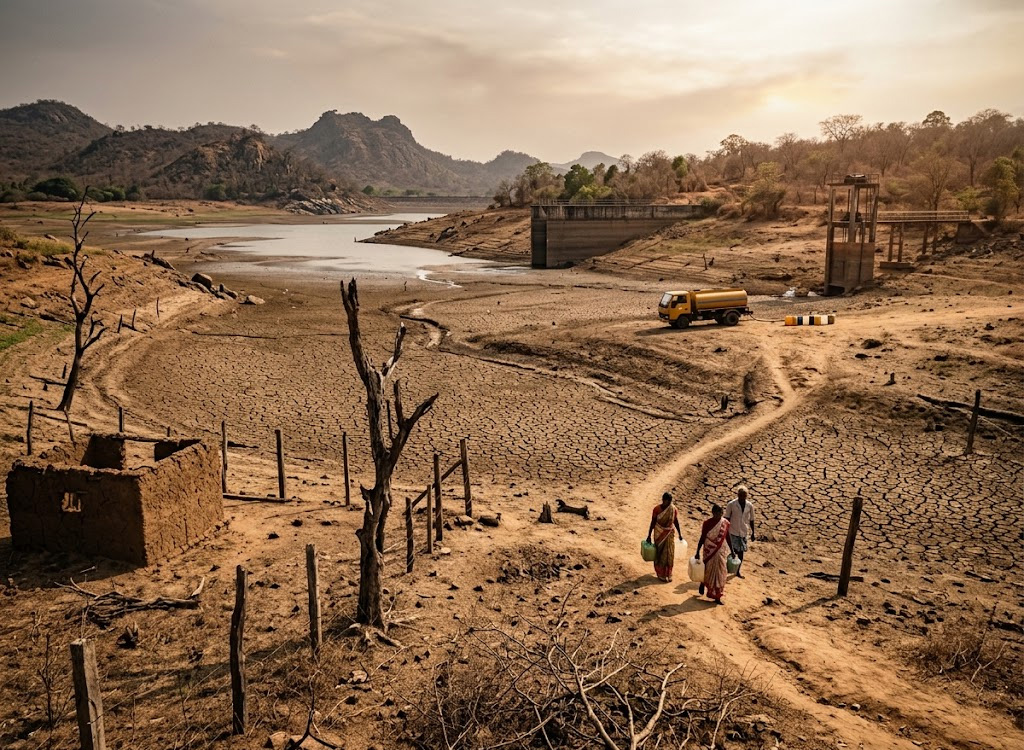
Sri Lanka’s water resources are coming under increasing pressure as a prolonged dry spell leaves several major reservoirs at critically low storage levels, raising concerns over water availability in affected districts.
The latest Irrigation Department data, covering 74 major reservoirs as of August 23, show that the reservoirs collectively hold only 35.8% of their effective storage capacity. While some tanks remain well supplied, the sharp variation in water levels highlights the uneven impact of the prevailing dry conditions.
Among the reservoirs recording the lowest effective storage are Manankattiya in Anuradhapura at just 1.5%, Muruthawela in Hambantota at 1.6%, Ethimale in Monaragala at 5.4%, and Rottikulama in Ampara at 8.1%.
In contrast, several reservoirs continue to maintain relatively high storage levels. Wan Ela is at 96.9%, Vakaneri at 96.2%, Deduru Oya at 94.6%, and Rajangana at 85.5%.
Despite the significant differences in storage levels, the Irrigation Department has reported no spilling at any of the 74 reservoirs included in its latest assessment.
The figures come as authorities step up measures to respond to the impact of the prevailing dry weather, which the Government has linked partly to the ongoing El Niño phenomenon.
Environment Minister Dammika Patabendige has said 22 Divisional Secretariat divisions across seven districts had been affected by the dry conditions, with 25,563 families, comprising 81,605 people, facing difficulties.
He has said drinking water had already been provided to around 20,000 families, following consultations with Divisional Secretaries.
The Minister has said several ministries and government departments were working together under a national operational plan to mitigate the effects of the dry spell, which is expected to continue until the end of September.
According to the Minister, rainfall is expected between October and December, with heavier-than-usual showers forecast during the second inter-monsoon period.
Authorities are also encouraging farmers to prepare for cultivation, while awareness programmes are being conducted to help communities manage the effects of the dry conditions.
However, the Government is already looking beyond the immediate crisis. Drought conditions have been forecast for February to April 2027, prompting plans to maximise water collection during rainy periods, better regulate reservoir levels and renovate tanks during dry spells.
Minister Patabendige has said the Government had not neglected the issue and called for collective action, while cautioning against exaggerating reports of a disaster situation.
He has also pointed to the influence of other climatic factors, including the Indian Ocean Dipole, which he has said had had a favourable impact on Sri Lanka.
Relief operations expand
The Disaster Management Centre (DMC) has separately confirmed that seven districts and 23 Divisional Secretariat divisions are affected by the dry weather.
Its latest figures put the number of affected people at 81,865 from 25,628 families.
Drinking water distribution has been organised in 20 Divisional Secretariat divisions, reaching 23,048 families comprising 72,153 people.
The largest relief operation is currently under way in Monaragala, where water has been supplied to 10,264 families, or 33,023 people, across seven divisions.
In Batticaloa, water has been distributed to 9,547 families involving 28,523 people across eight divisions.
A further 2,537 families, comprising 7,882 people, have received assistance in two divisions in Ampara.
The difference between the Irrigation Department’s reservoir figures and the DMC’s district-level impact figures also underlines the complexity of the situation. While some major reservoirs remain close to full capacity, communities in other areas are already experiencing shortages severe enough to require organised water distribution.
A warning for water management
With the overall storage of the country’s major reservoirs standing at just over one-third of effective capacity, the immediate challenge is not simply the quantity of water available, but where that water is located and how efficiently it can be managed.
Reservoirs at critically low levels could place additional pressure on drinking-water supplies, agriculture and other essential needs if the dry spell persists beyond current forecasts.
For now, authorities are relying on water distribution, farmer awareness programmes and closer monitoring of reservoirs and affected communities. But with another period of potential drought already forecast for early 2027, the current dry spell is also emerging as a warning that Sri Lanka’s water management and storage systems may need to prepare for increasingly uneven rainfall patterns.
The coming months, particularly the expected October-December rains, could therefore prove critical — not only for replenishing depleted reservoirs, but also for strengthening water reserves ahead of the next anticipated dry period.










Leave a comment