
By The Pulseline News Desk
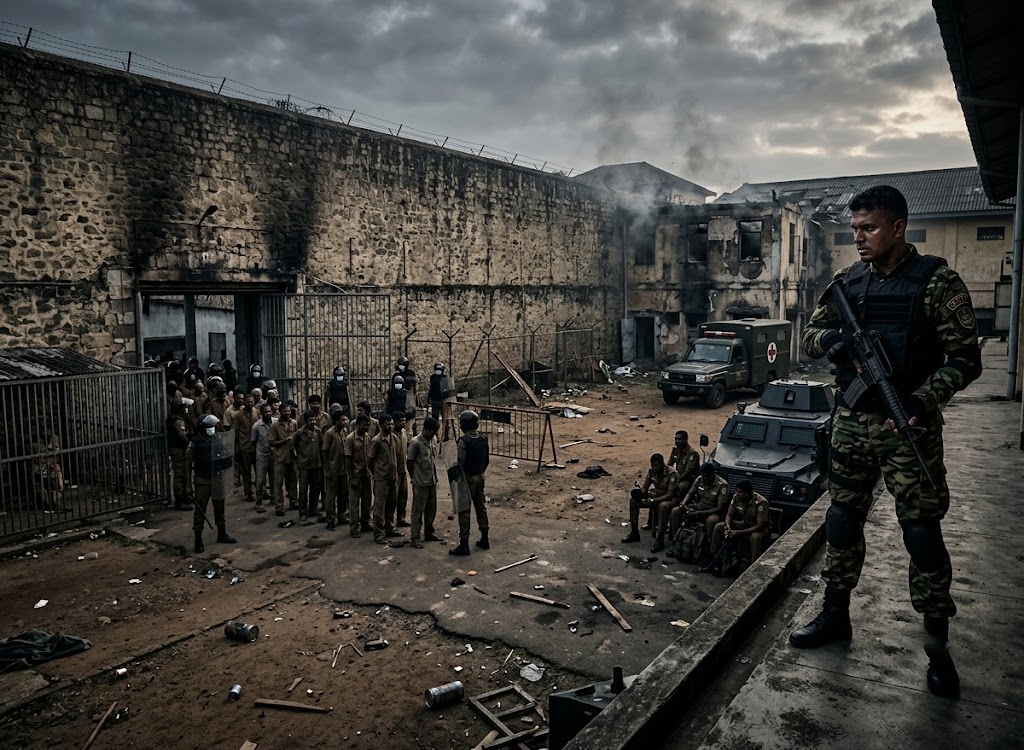
Sri Lanka’s prison system is facing renewed scrutiny after fresh unrest at Magazine Prison in Borella and Kuruwita Prison on Thursday (6) and Friday (7), extending a series of violent incidents that have shaken correctional facilities across the country.
The latest disturbances come in the wake of the deadly clashes at Negombo Prison, where more than 30 persons (inmates and prison officers) were killed and hundreds injured, and the subsequent violence at Mahara Prison that claimed the life of another inmate under State custody.
Taken together, the incidents have raised difficult questions about prison security, overcrowding, intelligence gathering and whether authorities are addressing the underlying causes of repeated unrest.
Magazine Prison unrest
A tense situation unfolded at Magazine Prison in Borella on Thursday night when a group of around 40 inmates housed in Ward ‘E’ had reportedly forced their way out of the ward and became disorderly at around 10.20 p.m.
According to initial reports, the disturbance stemmed from a dispute linked to narcotics.
Prison authorities sought the assistance of the Police, the Police Riot Control Unit and the Special Task Force (STF) to restore order. By Friday morning, officials said the situation had largely been brought under control, although eleven inmates were injured during the incident.
The deployment of the STF highlighted the seriousness of the disturbance and the pressure placed on prison authorities in responding to such incidents.
Kuruwita violence follows
Hours after the Magazine Prison unrest, another disturbance was reported at Kuruwita Prison.
Prison officials have said an initial incident that began on Thursday night had been contained. However, violence flared again on Friday morning when another group of inmates became unruly, reportedly causing extensive damage to the prison hospital.
While several inmates were admitted to hospital following the unrest, two inmates were reported dead.
Authorities have yet to disclose the full circumstances surrounding the incident or the cause of the latest violence.
Government alleges sabotage at Mahara
The latest disturbances occurred only days after the unrest at Mahara Prison, where one inmate died and several others were injured.
Unlike previous prison incidents, the Government has suggested the Mahara violence may have been the result of an organised attempt to destabilise prison administration.
Justice Minister Harshana Nanayakkara told Parliament there were clear indications of deliberate sabotage, pointing to the burning of key prison facilities, including the kitchen, infirmary and the main jailor’s office.
He questioned how nearly 1,000 inmates had mobilised within minutes and hinted at possible external involvement, promising that action would be taken if investigations uncovered a conspiracy.
Whether those allegations are ultimately substantiated will depend on the outcome of ongoing investigations.
A recurring pattern
While the immediate causes of the incidents at Negombo, Mahara, Magazine and Kuruwita appear to differ, prison experts have long warned that Sri Lanka’s correctional system suffers from chronic structural weaknesses.
Overcrowding remains one of the most persistent challenges, with prisons operating well beyond their intended capacity. Ageing infrastructure, shortages of prison staff, limited rehabilitation programmes and concerns over the continued influence of organised criminal networks have compounded the problem for years.
The alleged narcotics-related trigger behind the Magazine Prison unrest has also renewed concerns over the continued availability of drugs inside prisons despite repeated security operations.
Meanwhile, the repeated deployment of the Police and the STF to restore order has highlighted the growing difficulty prison authorities face in containing disturbances without external assistance.
Report to President
Meanwhile, the committee appointed to investigate the deadly Negombo Prison clash has submitted its report to President Anura Kumara Dissanayake, Minister Nanayakkara has told Parliament.
The report concerns the July 5 violence at the prison, which claimed the lives of 22 inmates and 10 prison officers. A further 21 prison officers and 106 inmates were injured in the incident.
Updating Parliament on the Government’s response, Nanayakkara said compensation has already been paid to the families of the prison officers who lost their lives.
He said President Dissanayake has also appointed a separate committee to consider additional relief and welfare measures for the affected officers and their families beyond the benefits available under existing public administration provisions.
According to the Minister, the committee has been tasked with making recommendations on compensation, pension entitlements and outstanding loans of the deceased officers.
It will also assess the condition of injured prison officers, including those who may have sustained permanent disabilities, and recommend appropriate assistance and support.
Calls for comprehensive reform
Each prison disturbance is expected to be investigated separately, with authorities seeking to establish the immediate causes and determine whether criminal offences were committed.
However, the succession of incidents within a matter of weeks has intensified calls for broader reforms that go beyond responding to individual outbreaks of violence.
Analysts say the Government will need to address longstanding issues including overcrowding, prison infrastructure, intelligence gathering, inmate management and rehabilitation if it hopes to prevent similar incidents in the future.
As investigations continue into the violence at Mahara, Magazine and Kuruwita, the recurring unrest has reinforced one message: restoring order after each disturbance may resolve the immediate crisis, but it does little to address the structural weaknesses that continue to make Sri Lanka’s prisons vulnerable to repeated violence.








Leave a comment