
By The Pulseline News Desk
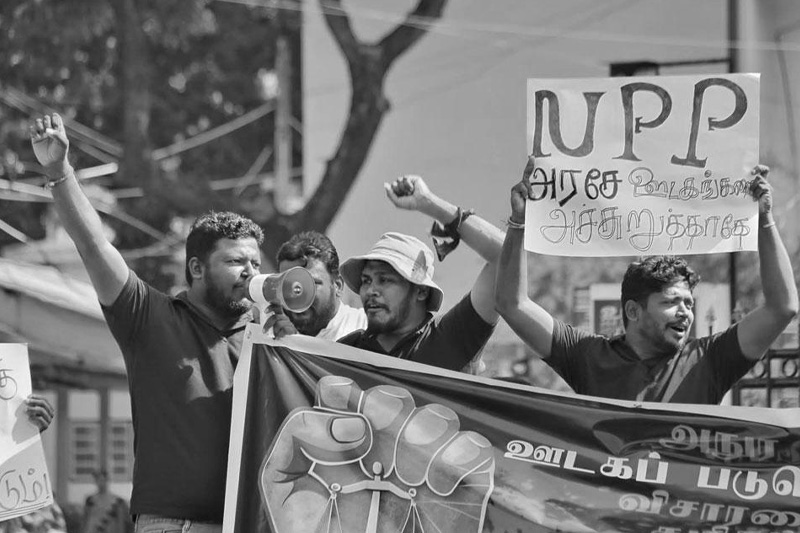
The decades-long struggle for justice over killings and attacks against journalists returned to the spotlight on Friday (31 July), as media personnel in Jaffna staged a protest demanding credible investigations into crimes against the press and boycotted an official event attended by Deputy Minister of Mass Media Kaushalya Ariyarathna.
The protest, organised by members of the Jaffna Press Club, was held in front of the Jaffna District Secretariat, where journalists called for impartial investigations into the murders, enforced disappearances, assaults and intimidation of media workers, as well as attacks on media institutions that remain unresolved despite repeated promises by successive governments.
The demonstration coincided with the Deputy Minister’s two-day official visit to Jaffna. Ariyarathna was scheduled to participate in a seminar for journalists at the District Secretariat, but members of the Jaffna Press Club chose to boycott the programme and instead assemble outside the venue to highlight what they described as the continuing failure to deliver justice.
Demand for accountability
The protesters said the passage of time should not diminish the State’s responsibility to investigate crimes committed against journalists.
Carrying placards and banners, they urged the authorities to ensure independent, impartial and credible investigations into attacks on media personnel, arguing that accountability remains essential not only for victims and their families but also for protecting press freedom and democratic governance.
The protest served as a reminder that many of Sri Lanka’s most high-profile cases involving journalists remain unresolved years after the incidents occurred.
Long shadow over press freedom
The country’s media community has endured decades of violence, particularly during the civil war and the turbulent years that followed. Journalists, editors and media workers were subjected to killings, abductions, assaults, arbitrary arrests and threats, while several media institutions were attacked or forced to shut down.
Among the most internationally recognised cases is the assassination of The Sunday Leader Editor Lasantha Wickrematunge in January 2009, a killing that became emblematic of impunity for crimes against journalists. The disappearance of cartoonist and columnist Prageeth Eknaligoda in 2010 also remains one of the country’s most closely watched unresolved cases.
Tamil journalists working in the Northern and Eastern Provinces were particularly vulnerable during the final years of the armed conflict, with many killed, abducted or forced into exile amid allegations of intimidation by multiple actors.
Although successive governments have pledged to reopen investigations and deliver justice, media organisations have repeatedly argued that progress has been slow and accountability remains elusive.
A test for the Government
Friday’s protest comes as the National People’s Power (NPP) administration has pledged to strengthen democratic institutions, protect fundamental rights and uphold media freedom.
For journalists in Jaffna, however, those commitments must be matched by concrete action.
By boycotting the Deputy Minister’s official programme, members of the Jaffna Press Club sought to send a clear message that symbolic engagements with the media are insufficient without meaningful progress in investigating past crimes.
Their protest underscored a demand that has echoed across Sri Lanka’s media landscape for years: that justice delayed should not become justice denied, and that ending impunity for crimes against journalists remains central to rebuilding public confidence in the rule of law.








Leave a comment