
By The Pulseline News Desk
President Anura Kumara Dissanayake (AKD) has pledged to place the rights, dignity and living standards of Sri Lanka’s Malayagam community at the centre of the Government’s future policy, declaring that those who have contributed to the country’s economy for generations cannot be allowed to pass the same hardships on to their children.
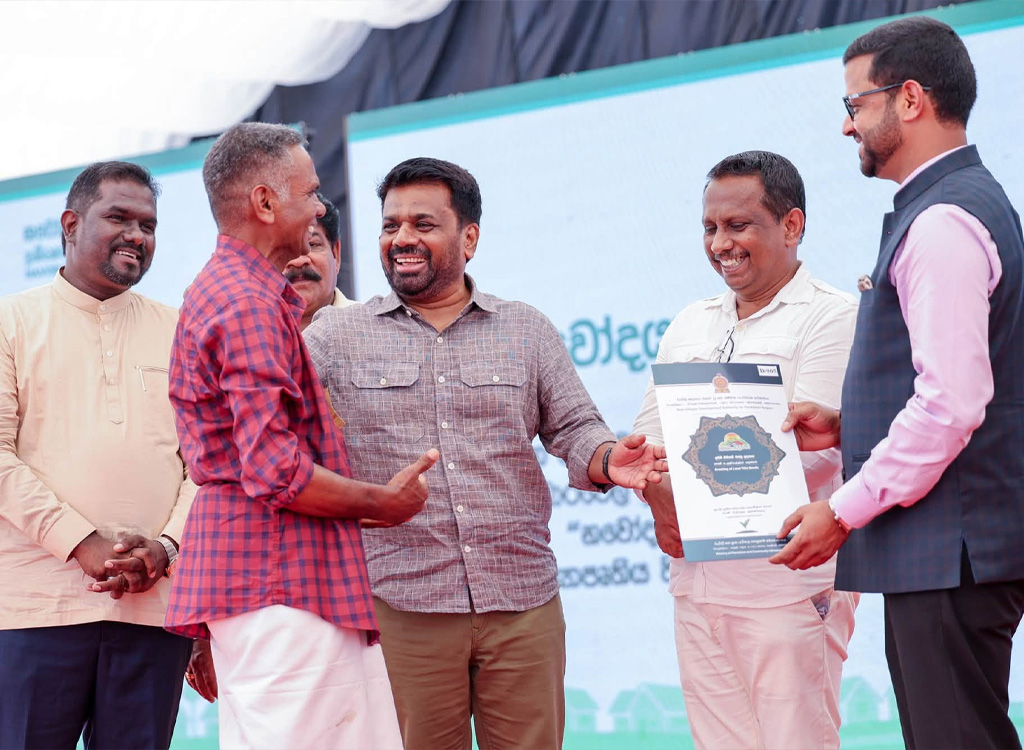
The President made the remarks while handing over the Navodayapuram Housing Project to 50 families from Poonagala and Kabaragala who lost their homes in the 2023 landslide and had been living in unsafe conditions for nearly three and a half years.
But beyond the completion of a housing project, Dissanayake used the occasion to make a broader political statement on the place of the Malayagam community in Sri Lankan society — insisting that plantation-origin Tamils are equal citizens entitled to their full rights and dignity.
He argued that it would be unjust for successive generations to inherit the deprivation and insecurity experienced by their predecessors for centuries.
The President’s remarks are significant because the question of the Malayagam community has increasingly moved beyond wages and plantation employment into wider issues of land, housing, citizenship, education, social protection and political recognition.
From plantation labour to equal citizenship
Dissanayake stressed that the contribution made by the Malayagam community to the national economy must be matched by a commitment to improving their quality of life.
The community, whose history is closely tied to Sri Lanka’s plantation economy, has long faced structural disadvantages despite its central role in the tea sector and other plantation industries.
The President’s position suggests that the Government intends to approach these challenges as matters of citizenship and rights rather than merely as welfare issues.
That distinction could become increasingly important as the Government prepares its future policies concerning plantation companies and the communities living on and around plantation lands.
Dissanayake said future agreements with plantation companies would contain provisions to safeguard the rights of the Malayagam community.
Such a move could potentially reshape the relationship between plantation companies, the State and workers, particularly in areas where access to housing and land remains closely connected to plantation ownership and employment.
Housing as a first step
The Navodayapuram project provides a tangible example of the Government’s approach.
The 50 families receiving houses had remained in unsafe conditions after losing their homes in the 2023 landslide. The project was constructed with the active involvement of the Sri Lanka Army Corps of Engineers.
While the handover addresses an immediate housing crisis, Dissanayake linked the initiative to a much larger question: whether the State can provide the Malayagam community with the same security and opportunities available to other Sri Lankan citizens.
He also said housing construction would receive priority in the forthcoming Budget, potentially signalling a wider expansion of housing interventions for vulnerable communities.
Return of those displaced by war
The President also connected the Government’s approach to the Malayagam community with the question of Sri Lankans who left the country during the war and are now living in India.
He recalled the recent Cabinet decision to remove obstacles preventing these Sri Lankans from returning to the country.
The reference was particularly relevant in the context of the plantation community, whose history has been shaped by migration, displacement and questions surrounding citizenship and belonging.
Dissanayake’s remarks therefore sought to frame the Government’s policy around a broader principle: Sri Lankans should not be excluded from their rights because of their historical circumstances, place of origin or social status.
Protecting the land that sustains the community
The President also linked the future of the Malayagam community to the protection of the Central Highlands, describing the region as the “heart of the country.”
He announced plans to introduce legislation by the end of this year or early next year to establish a Central Highlands Protection Authority with comprehensive powers.
The proposed authority would bring together responsibilities currently divided among several institutions involved in protecting the Highlands.
The environmental dimension is particularly significant for plantation communities, whose livelihoods and settlements are deeply intertwined with the fragile mountain ecosystem.
For Dissanayake, therefore, improving the lives of the Malayagam people cannot be separated from protecting the land on which they live and work.
The Navodayapuram handover consequently carried a message extending well beyond 50 new homes. It represented the Government’s attempt to present the Malayagam community not simply as a workforce supporting one of Sri Lanka’s most important export industries, but as full citizens with rights that the State has a responsibility to protect.
Whether that political commitment translates into lasting changes in land ownership, housing security, economic opportunity and social equality will be a more significant test of the Government’s pledge.









Leave a comment