
By The Pulseline News Desk
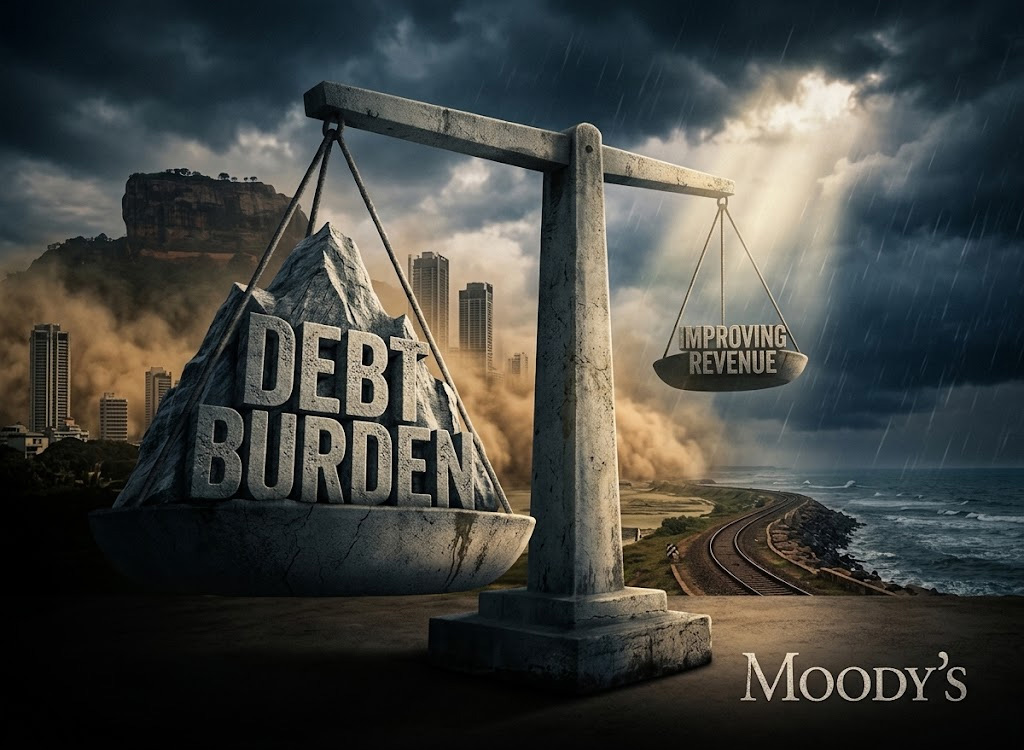
Sri Lanka’s economic recovery has strengthened its fiscal position, but persistent debt pressures, high interest costs and external financing vulnerabilities continue to weigh heavily on the country’s credit profile, according to global ratings agency Moody’s Ratings.
Moody’s has affirmed Sri Lanka’s Caa1 foreign currency long-term issuer and senior unsecured ratings, while maintaining a stable outlook, indicating that the risks surrounding the country’s current rating are broadly balanced.
The decision reflects the progress made in restoring macroeconomic stability following the 2022 economic crisis but also underscores the considerable challenges that remain before Sri Lanka can establish a more durable foundation for debt sustainability and long-term growth.
A key positive factor identified by Moody’s is the improvement in government revenue collection following fiscal reforms implemented under Sri Lanka’s International Monetary Fund (IMF) programme.
These reforms have helped the Government maintain primary budget surpluses, strengthening fiscal management and providing an important foundation for the ongoing economic recovery.
However, the improvement in the primary balance has not eliminated the pressure created by the country’s large debt stock and substantial interest bill.
Moody’s has noted that government interest costs continue to absorb more than 40% of government revenue, significantly limiting fiscal space for other priorities.
Government debt is projected to reach around 95% of GDP in 2026, while the debt burden is expected to remain equivalent to more than 580% of government revenue.
The figures highlight the extent to which Sri Lanka’s fiscal position remains vulnerable despite the progress made since the economic crisis.
External financing remains a concern
Moody’s has also flagged Sri Lanka’s continued exposure to external financing risks.
Import cover remains below three months, while the country’s external vulnerability indicator is expected to remain above 250%, pointing to elevated external financing pressures.
This leaves Sri Lanka vulnerable to external shocks at a time when the country is still rebuilding its foreign exchange buffers and strengthening its capacity to meet external obligations.
The ratings agency has specifically pointed to developments linked to the ongoing conflict in the Middle East as a potential source of pressure.
Higher global energy prices could increase Sri Lanka’s import bill and place renewed pressure on the balance of payments, while disruptions affecting tourism could weaken one of the country’s key sources of foreign exchange.
These risks underline the importance of maintaining adequate external buffers as the economy moves beyond the immediate recovery phase.
Climate risks add another layer
Sri Lanka’s exposure to severe weather events and other physical climate risks also remains a significant credit weakness, Moody’s has said.
While economic activity has recovered strongly in the near term, the agency cautioned that longer-term growth prospects remain uncertain.
Potential growth is estimated at around 4% over the medium term, with social vulnerabilities, continued emigration of skilled workers and weak private-sector investment limiting the economy’s productive capacity.
This suggests that sustaining the recovery will require more than fiscal consolidation. Improving productivity, attracting investment and retaining skilled workers will be crucial if Sri Lanka is to generate stronger and more durable growth.
The post-IMF test
Perhaps one of the most significant challenges identified by Moody’s lies beyond the current IMF programme.
Sri Lanka’s existing IMF programme is scheduled to conclude in 2027, after which the country will lose an important policy anchor and a key source of concessional external financing.
The period following the programme will therefore represent a critical test of the Government’s commitment to fiscal discipline and structural reforms.
This becomes particularly important as external debt-service obligations are expected to gradually increase from 2028.
Moody’s has said Sri Lanka’s ability to maintain reform momentum after the IMF programme ends will be an important consideration in determining whether the country’s economic recovery and improvements in debt sustainability can be sustained.
For now, the stable outlook suggests that Moody’s does not see an immediate change in the balance of risks surrounding the Caa1 rating.
But the assessment also serves as a warning that Sri Lanka’s recovery remains unfinished.
The country has made considerable progress in restoring macroeconomic stability since the 2022 crisis, but high debt, heavy interest payments, limited external buffers and relatively modest growth potential continue to constrain its economic outlook.
The real test will be whether the Government can convert the gains achieved under the IMF programme into a durable economic framework capable of withstanding external shocks and managing rising debt-service obligations after 2027.










Leave a comment