
By The Pulseline News Desk
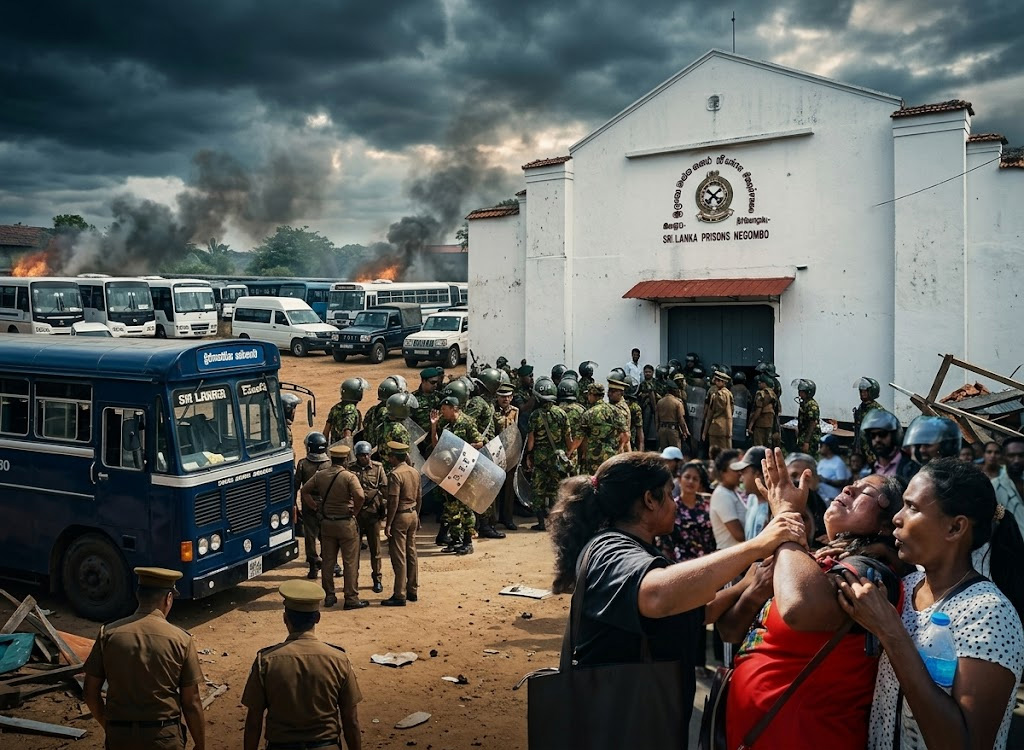
The government has acknowledged that Sri Lanka’s prison system is facing its worst overcrowding crisis in decades, revealing that the inmate population has surged to around 40,000, while promising a broad package of legal, administrative and infrastructure reforms following the deadly Negombo Prison violence that has exposed deep-rooted structural failures.
Responding to a series of questions raised by opposition member of parliament (MP) Dayasiri Jayasekara during an adjournment debate in Parliament on Wednesday (5), Justice and National Integration Minister Harshana Nanayakkara has defended the government’s handling of the crisis while outlining a multi-pronged strategy to prevent further prison violence.
The Minister’s detailed statement comes just weeks after the July violence at Negombo Prison and days after unrest at Mahara Prison, placing Sri Lanka’s prison administration under unprecedented scrutiny. Authorities have linked chronic overcrowding to growing instability inside prisons, though investigations are also examining whether organised external elements have played a role in recent disturbances.
Prison system reaches breaking point
Nanayakkara has openly conceded that overcrowding remains the prison system’s biggest challenge.
“When our government assumed office there were about 29,000 inmates. Today there are nearly 40,000,” he told has Parliament.
However, he has argued that the crisis was inherited rather than created by the present administration.
According to the Minister, successive governments over the past two decades had failed to expand prison infrastructure despite the rapidly growing inmate population, leaving the current administration to deal with decades of neglect.
“We did not create this problem. But we accept that it is our responsibility to solve it,” he has said.
His comments reflect a growing consensus that Sri Lanka’s correctional system has exceeded its operational limits. The country’s prison network currently houses almost four times the number of inmates it was originally designed to accommodate, creating severe pressure on security, rehabilitation and prison management.
Heavy toll from Negombo Prison violence
The Minister has confirmed the final casualty figures from the July clashes at Negombo Prison.
According to the government:
- 10 prison officers were killed.
- 21 prison officers were injured.
- 22 inmates lost their lives.
- 106 inmates were injured.
The incident remains one of the deadliest prison disturbances in Sri Lanka in recent decades.
Nanayakkara has said compensation has already begun for affected prison officers while a Presidential Committee has been appointed to formulate a comprehensive compensation package that extends beyond ordinary public service benefits.
The proposed package will address pensions, outstanding loans, welfare benefits, compensation for injured officers and additional payments for those who have suffered permanent disabilities.
Allowances “not enough”
The Minister has also acknowledged long-standing grievances raised by prison officers.
While confirming that officers currently receive a range of allowances – including electricity, night duty, security, risk and health protection allowances – he has admitted these benefits are inadequate.
“The allowances are paid. But are they sufficient? The answer is no,” he has told Parliament.
Discussions are currently underway to increase these allowances, with proposals expected to be considered during the upcoming Budget process.
Nanayakkara has noted that prison officers had recently met President Anura Kumara Dissanayake directly to present their concerns, describing it as the first such engagement of its kind.
Major investment in prisons
Seeking to demonstrate that reforms are already underway, the Minister has outlined a substantial investment programme aimed at improving both officer welfare and prison operations.
Construction has commenced on new accommodation barracks capable of housing 50 officers each at prisons including Welikada, Mahara, Negombo, Vavuniya, Trincomalee, Monaragala, Boossa, Pallansena and Anuradhapura.
The Department of Prisons has also expanded its transport fleet, purchasing:
- 40 buses
- 15 vans
Additional procurements planned include:
- 20 more buses
- 11 vans
- 10 staff double cabs
- Two tractors
Meanwhile, Rs. 46 million has been allocated for staff training and capacity building.
The government has also begun strengthening prison security through the procurement of body cameras, riot helmets, riot shields and batons while expanding firearms training programmes for prison officers.
Nanayakkara has said this year’s allocation represents the largest capital investment ever made for the Department of Prisons.
Multiple investigations continue
The Minister has confirmed that three separate investigations remain underway into the Negombo violence.
These are being conducted by:
- the Presidential Committee of Inquiry,
- the Criminal Investigation Department (CID), and
- the Department of Prisons.
Although the Presidential Committee has already submitted its report to President Dissanayake, the Minister has declined to disclose its contents, citing the ongoing CID investigation.
He has also confirmed that several suspects have already been arrested.
Allegations of inmate abuse under investigation
The Minister has also addressed allegations that prisoners transferred from Negombo had been assaulted or tortured after being relocated to other prisons.
Following widespread claims circulated on social media, he has said the Ministry Secretary has appointed a separate investigation committee to examine the allegations.
Hundreds of inmates were transferred to prisons across the country after the Negombo violence, including Welikada, Bogambara, Boossa, Kalutara, Jaffna, Kuruwita, Monaragala, Batticaloa and Agunakolapelessa.
International and local human rights organisations have previously expressed concern regarding the treatment of transferred prisoners and called for independent investigations into allegations of ill-treatment.
Reform agenda shifts beyond prison walls
Perhaps the most significant announcement was the government’s decision to broaden prison reform beyond infrastructure alone.
Nanayakkara has revealed that President Dissanayake has submitted a Cabinet memorandum proposing the appointment of a high-level committee to examine the structural causes of prison overcrowding.
Rather than focusing solely on prison expansion, the committee has been tasked with recommending reforms across the wider criminal justice system.
Its mandate includes:
- identifying the causes of prison overcrowding;
- expediting court proceedings involving remand prisoners;
- reducing delays in Government Analyst reports;
- reviewing bail procedures;
- expanding alternative sentencing options;
- promoting community-based rehabilitation;
- identifying necessary legal and administrative reforms; and
- recommending measures to increase prison capacity.
The committee is expected to submit its recommendations to both the President and Cabinet within a specified timeframe.
Beyond bricks and mortar
The Minister’s parliamentary statement signals an important shift in how the government is framing Sri Lanka’s prison crisis.
Rather than treating recent violence as isolated security failures, the administration is increasingly presenting overcrowding as a systemic problem rooted in delayed court processes, prolonged remand detention, forensic bottlenecks and outdated sentencing practices.
Whether the government’s promised reforms translate into measurable improvements will likely become a key test of its broader justice reform agenda.
For now, however, the deadly unrest in several prisons have reinforced one reality: expanding prison capacity alone is unlikely to solve a crisis that extends well beyond prison walls.









Leave a comment