
By The Pulseline News Desk
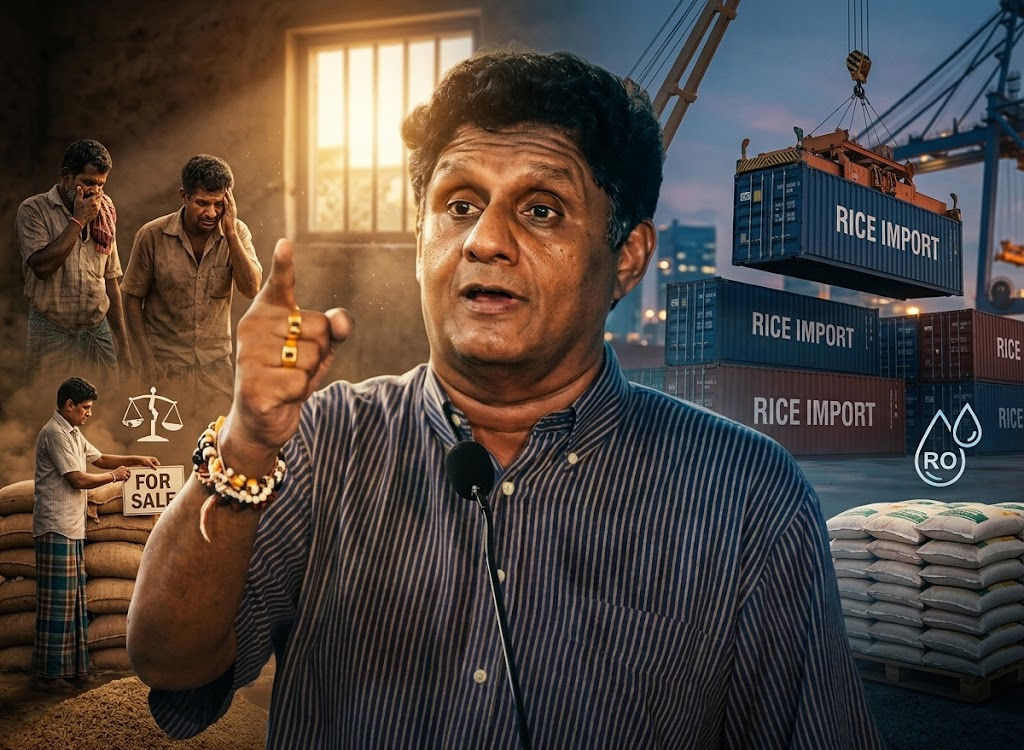
Opposition Leader Sajith Premadasa has questioned the Government’s decision to import rice despite what he described as a domestic production surplus, warning that the policy was placing further pressure on paddy farmers already struggling to sell their harvests.
Premadasa has said the Government had pledged while in opposition to introduce a legally guaranteed paddy purchase price of Rs. 150 per kilogram, but nearly two years after assuming office, the promised legislation had yet to be enacted.
He has said Agriculture Minister K.D. Lal Kantha had told Parliament that the cost of producing one kilogramme of paddy was around Rs. 137, while the guaranteed purchase price remained at Rs. 120.
“This means farmers are losing Rs. 17 on every kilogramme of paddy sold at the guaranteed price,” Premadasa has said.
He has also questioned the effectiveness of Government measures aimed at supporting the rice milling industry. Although Rs. 7.5 billion had been allocated to strengthen small- and medium-scale rice millers, he has said paddy farmers continued to face difficulties in finding buyers for their produce.
“Farmers are harvesting paddy, but the Government is not buying it, while boards saying that paddy is being purchased are being put up in villages,” he has said.
Premadasa has made the remarks while attending an event organised under the Samagi Jana Balawegaya’s (SJB) “Sathkaraya” programme in Dehuwala, Galewela, where a community organisation was provided with a water purification and reverse osmosis system valued at Rs. 1.2 million.
Questions over rice imports
Premadasa has also raised questions over the Government’s decision to import rice, arguing that the country’s domestic production was sufficient to meet annual consumption requirements.
According to Premadasa, Sri Lanka’s annual rice requirement was around 2.5 million metric tonnes, while domestic production was approximately 3.2 million metric tonnes.
Despite the reported surplus, he has said around 382,000 metric tonnes of rice had been imported.
He has questioned the rationale for importing rice while local farmers were struggling to dispose of their harvest and accused the Government of adopting a policy it had criticised while in opposition.
The Opposition Leader has said the issue was not limited to paddy farmers, with those engaged in maize and potato cultivation also facing difficulties.
He has called for stronger Government intervention to ensure farmers receive fair prices and that domestic agricultural production is properly managed before decisions are taken to rely on imports.
Climate risks add to concerns
Premadasa has also warned that changing weather patterns could create additional challenges for the agricultural sector and the wider economy.
He has pointed to the possible effects of El Niño and La Niña conditions on water resources, saying the Government should take preventive measures and provide relief to communities that could be affected by economic and climate-related pressures.
He has further claimed that poverty was increasing, with between 30% and 40% of the population facing poverty, while some factories were also closing.
At the same time, he has said the tourism sector, which was showing signs of recovery and growth, should be protected and supported.
His remarks come amid continuing debate over the Government’s management of the paddy market, rice imports and farmer support, with the opposition pressing for a stronger guaranteed price mechanism and greater protection for domestic agricultural producers.





Leave a comment