
By The Pulseline News Desk
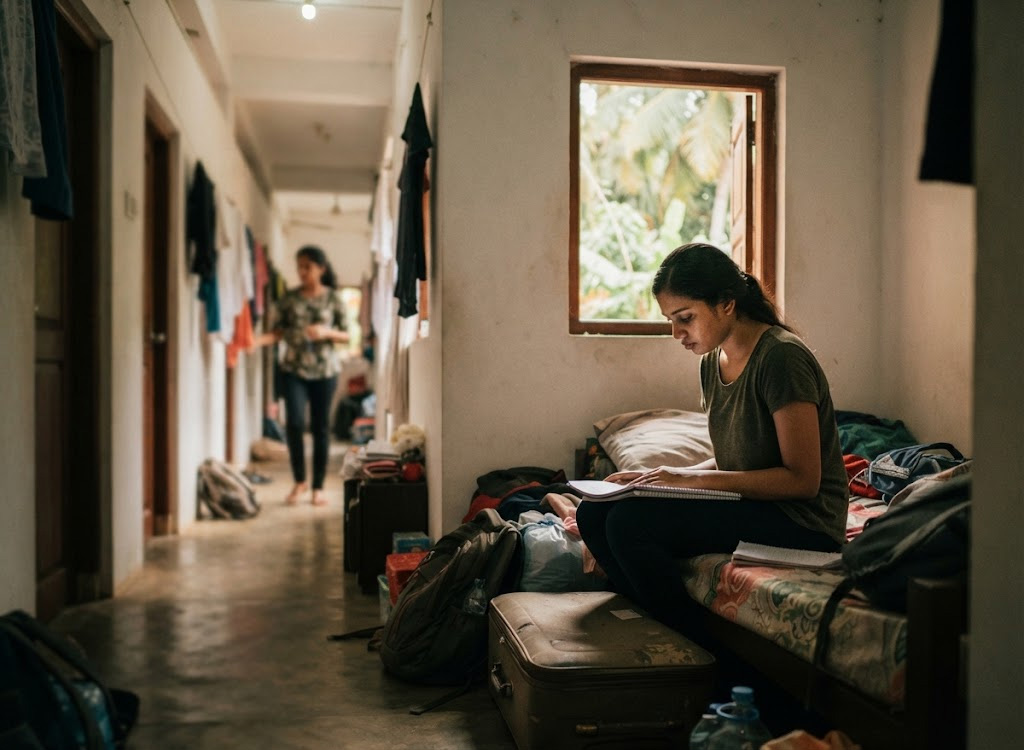
Only 42% of students enrolled in Sri Lanka’s 22 State universities operating under the University Grants Commission (UGC) currently have access to university hostel accommodation, highlighting a persistent shortage of student housing across the higher education system.
Prime Minister and Education, Higher Education and Vocational Education Minister Harini Amarasuriya told Parliament on Thursday (8) that hostel facilities were available for only 63,318 of the 150,815 students enrolled at these universities.
Responding to a question raised by Opposition Parliamentarian and attorney Chamindranee Kiriella, Amarasuriya has said the Government had launched a project to construct 55 new hostels at UGC universities, which is expected to provide accommodation for an additional 16,000 students.
The Government has allocated Rs. 1.5 billion for the construction project in 2026, while a further Rs. 853 million has been allocated under this year’s Budget for the renovation of existing university hostels.
“There is a need to improve hostel facilities across the State university system,” she has said, acknowledging the limited capacity to accommodate university students.
Shortages extend beyond UGC universities
Sri Lanka has five additional universities established under separate Acts of Parliament: the Bhikshu University, the Buddhist and Pali Studies University, the Vocational Technology University, the Ocean University and the General Sir John Kotelawala Defence University (KDU).
These institutions have a combined student population of 15,098, but hostel accommodation is available for only 1,841 students, according to the Minister.
The figures reveal significant differences in accommodation availability among the institutions.
All 465 students at the Bhikshu University have access to hostel accommodation, while 442 of the 551 students at the Buddhist and Pali Studies University have such facilities. The latter figure includes 80% of local students and all foreign students.
At the Ocean University, only 196 of its 1,516 students, or 12.92%, can be accommodated in hostels.
The situation is more restrictive at the Vocational Technology University, where hostel facilities are available for just 332 of its 4,348 students, representing approximately 7.6% of the student population. The available accommodation is exclusively for female students, with no hostel facilities provided for male students.
At KDU, only 406 of the 8,218 students, or 4.94%, have been provided with hostel accommodation.
Government plans expansion and renovations
The planned construction of 55 new hostels is intended to ease the accommodation shortage at UGC universities, with an estimated additional capacity of 16,000 students.
However, even if the project delivers the expected capacity, the existing gap between student numbers and available accommodation will remain substantial.
The Government is also allocating funds to renovate existing hostels, as part of efforts to improve facilities across the university system.
In parallel, the UGC is preparing an overarching hostel policy intended to ensure that accommodation is provided through a system that is fair, transparent, safe, affordable, accessible and inclusive.
The policy is expected to establish a broader framework for addressing student accommodation needs across State universities.
Access to higher education
The shortage of hostel accommodation remains a concern for students who must travel long distances to attend university, particularly those from lower-income households who may struggle to meet the cost of private accommodation and daily transport.
Expanding hostel capacity could help ease these pressures and improve access to university education for students from different parts of the country.
The Government’s planned investment represents a step towards addressing the shortage. However, the scale of demand across State universities highlights the need for sustained investment, effective allocation of accommodation and improved facilities to ensure that students can pursue higher education without facing excessive housing costs.












Leave a comment