
By The Pulseline News Desk
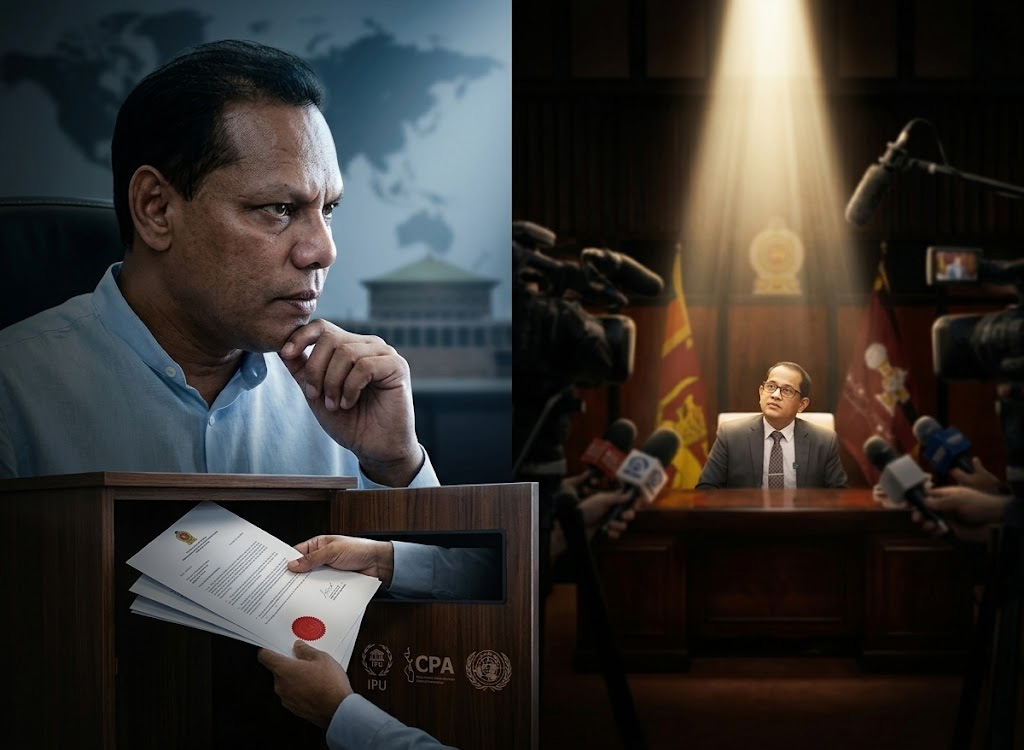
Opposition Parliamentarian Dayasiri Jayasekara has taken his dispute with Speaker Jagath Wickramaratne beyond Sri Lanka, lodging written complaints with three international bodies over what he claims is a violation of his parliamentary privileges.
Jayasekara has complained to the Inter-Parliamentary Union (IPU), the Commonwealth Parliamentary Association (CPA), and the United Nations High Commissioner for Human Rights after he was prevented from raising a privilege question in Parliament concerning the Speaker.
The dispute stems from a privilege question submitted by Jayasekara on September 10, concerning the Speaker’s continued role in Parliament and the Constitutional Council while an investigation is allegedly being conducted by the Commission to Investigate Allegations of Bribery or Corruption (CIABOC).
Alleged conflict of interest
According to Jayasekara, the CIABOC investigation relates to alleged corruption and irregularities involving the use of State resources and facilities by the Speaker in the course of performing his official duties.
The Opposition MP has argued that, under Section 107 of the Anti-Corruption Act and the Code of Ethics applicable to Members of Parliament (MPs), the Speaker should not preside over Parliament or the Constitutional Council, or continue to perform the functions of those positions, while such an investigation is pending.
The issue, however, took a different turn when Jayasekara attempted to raise the matter in Parliament.
The Speaker reportedly said he needed time to study the privilege question and did not permit it to be raised before the House. Jayasekara subsequently attempted to address the issue during the Opposition’s allotted speaking time, but the Speaker had intervened and stopped him from continuing.
Jayasekara nevertheless managed to table the relevant privilege question in Parliament during his interrupted speech.
Speaker accused of being judge in his own case
The MP has now taken his concerns to international parliamentary and human rights bodies, arguing that the incident raises broader questions about parliamentary privileges, natural justice and the independence of parliamentary proceedings.
In his complaints, Jayasekara has alleged that the right of MPs to express their views under the Parliament (Powers and Privileges) Act was itself being violated by the Speaker, who is the head of Parliament.
He has also challenged the Speaker’s decision to examine the privilege matter himself, arguing that a complaint directly concerning the Speaker should not be determined by the person whose conduct is being questioned.
According to Jayasekara, such a process raises serious concerns over impartiality and transparency and is contrary to the principles of natural justice.
From parliamentary dispute to international scrutiny
The move places what began as an internal parliamentary dispute on the agenda of international parliamentary and human rights institutions.
Jayasekara has told the IPU, CPA and UN High Commissioner for Human Rights that the Speaker’s conduct amounts to a violation of parliamentary democracy, Commonwealth parliamentary principles and the privileges afforded to elected representatives.
He has therefore called for a fair, independent and transparent inquiry into the matter.
The complaints could add another layer to the growing political debate over the role of the Speaker, the limits of parliamentary authority and the safeguards available to MPs when raising matters concerning the conduct of senior parliamentary officials.
At the heart of the dispute is a fundamental question: who should determine a privilege complaint when the complaint itself concerns the Speaker?
Jayasekara’s decision to seek international intervention suggests that the Opposition intends to keep that question alive beyond the floor of Parliament.








Leave a comment