
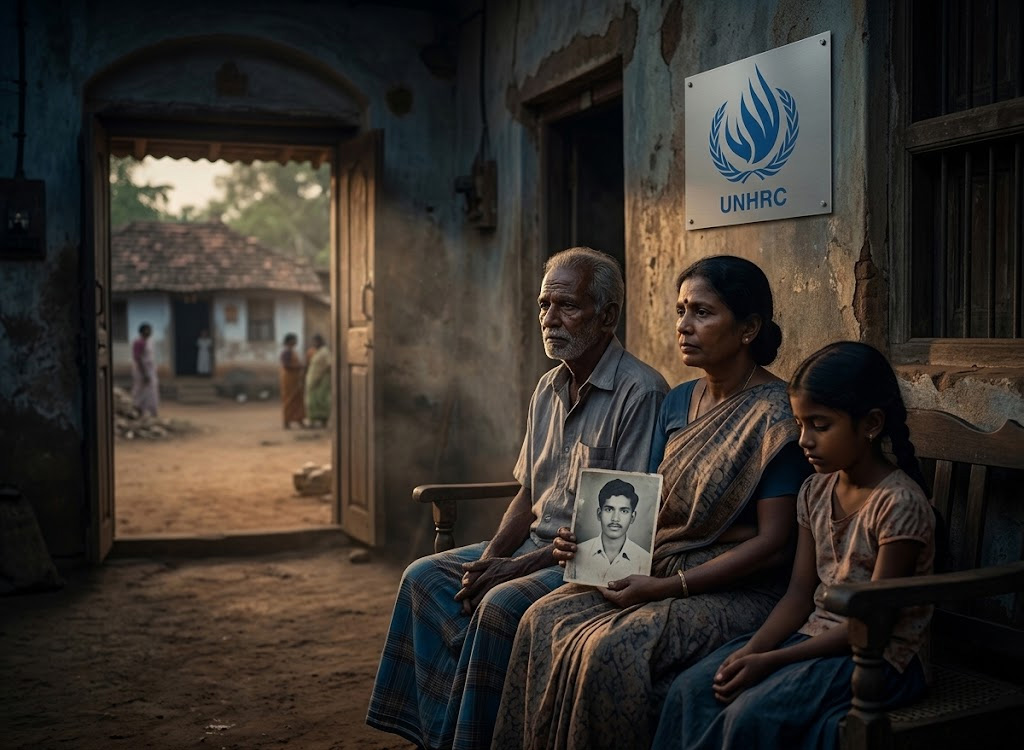
Sri Lanka’s progress on human rights, reconciliation and accountability risks losing momentum despite a series of commitments made by the National People’s Power (NPP)-led Government, the United Nations Human Rights Council (UNHRC) has warned.
In its latest report to the UN Human Rights Council, the Office of the United Nations High Commissioner for Human Rights (OHCHR) said that while the Government had taken some steps on corruption and individual human rights cases, meaningful accountability for alleged international crimes committed during the armed conflict remained largely absent.
The report, titled “Situation of human rights in Sri Lanka – Report of the Office of the United Nations High Commissioner for Human Rights” (A/HRC/63/18), was published in advance unedited form on 3 September ahead of the 63rd session of the Human Rights Council, which is scheduled to run from 7 September to 9 October 2026.
The report examines developments between October 2025 and July 2026, while also providing broader context on Sri Lanka’s human rights and reconciliation agenda.
Promises yet to translate into structural change
The OHCHR report notes that the NPP Government came to power on a platform that included significant commitments on human rights and governance.
These included pledges to repeal or reform the Prevention of Terrorism Act (PTA), strengthen the fight against corruption, establish an independent public prosecutor’s office, pursue accountability in emblematic cases such as the 2019 Easter Sunday attacks, promote national unity and introduce a new Constitution based on equality, democracy and devolution.
The Government has made progress in some areas, particularly through corruption investigations and arrests involving high-profile individuals.
However, the UN rights office cautioned that these measures had yet to translate into the deeper institutional and legal reforms required to address Sri Lanka’s longstanding human rights problems.
“Momentum for transformative change” risks stalling, the report indicates, particularly in relation to transitional justice and accountability for serious violations.
The report maintains that there has been little meaningful progress towards accountability for alleged international crimes committed during Sri Lanka’s armed conflict.
PTA still in use
One of the clearest concerns raised by the UN is the continued use of the PTA.
Despite repeated commitments to repeal or substantially reform the legislation, the PTA remains part of Sri Lanka’s legal framework and continues to be used for arrests and detention.
The report also expresses concern over legislative initiatives dealing with terrorism financing, organised crime and money laundering, warning that some proposed measures could provide authorities with broad powers without sufficient safeguards against abuse.
The Online Safety Act (OSA) also remains a concern in relation to freedom of expression.
The OHCHR further highlighted concerns over limited public consultation in the preparation of legislation, warning that meaningful participation is essential when laws have significant implications for fundamental rights.
North and East remain under scrutiny
The UN report raises continued concerns over surveillance, intimidation and harassment affecting human rights defenders, victims and civil society actors, particularly in the north and east.
It also points to limited progress on reconciliation measures, including the release of land.
The absence of Provincial Council elections is another issue highlighted in the report.
Provincial Council elections, which are linked to the devolution framework established under the 13th Amendment, have not been held since 2014.
For the UN rights office, the prolonged failure to restore elected provincial institutions remains relevant to Sri Lanka’s commitments on political participation, devolution and reconciliation.
Emergency powers and civil liberties
The report also examines the Government’s use of emergency powers following Cyclone Ditwah in November 2025.
The cyclone became one of the major humanitarian and economic shocks during the reporting period, affecting approximately 2.2 million people and causing hundreds of deaths and disappearances, while destroying or damaging tens of thousands of homes.
The disaster created substantial reconstruction and recovery requirements, estimated at several billion US dollars.
The UN acknowledged the extraordinary pressures faced by the Government, including the disaster and economic consequences arising from the conflict in West Asia, which affected energy, food and fertiliser prices.
But it stressed that emergency responses and security measures must remain consistent with Sri Lanka’s international human rights obligations.
Poverty adds pressure to rights agenda
The report places Sri Lanka’s human rights situation against a difficult socio-economic backdrop.
Poverty remained high, with estimates placing the poverty rate at around 22% in 2025. Food insecurity continued to affect vulnerable communities, while debt servicing absorbed a significant portion of Government revenue.
The UN therefore cautioned that economic recovery must be accompanied by measures that protect vulnerable groups and ensure that development gains are broadly shared.
Custody deaths, torture and prisons
The report also documents continuing concerns relating to deaths in custody, torture and ill-treatment, arbitrary arrests and prison conditions.
Particular attention is drawn to the situation in prisons, including the deadly clash at Negombo Prison.
While certain judicial decisions and institutional measures have represented positive developments — including court rulings concerning environmental and health rights and guidelines relating to arrests — the UN said these steps need to be supported by stronger accountability mechanisms.
Easter Sunday attacks among emblematic cases
Accountability for emblematic cases remains another major test for the Government.
The report refers to the Government’s stated commitment to pursue justice in cases including the 2019 Easter Sunday attacks.
While some investigations and proceedings have moved forward, the UN assessment suggests that progress has not yet reached the level necessary to establish comprehensive accountability and public confidence.
For victims and families of those affected by major human rights violations, the issue is therefore not simply whether investigations are reopened or arrests made, but whether institutions can ultimately establish the truth and deliver justice independently and transparently.
UN calls for deeper institutional reform
The report’s recommendations call on the Sri Lankan Government to translate its stated commitments into concrete reforms.
These include advancing truth, justice and reconciliation; reforming laws that have facilitated rights violations; strengthening independent institutions; protecting civic space; and ensuring accountability for serious human rights violations.
The OHCHR also calls on the international community to continue supporting human rights and accountability efforts in Sri Lanka.
The report comes at a politically significant moment for the NPP Government, which came to power promising to break from the political practices and governance failures associated with previous administrations.
The UN assessment suggests that the Government’s credibility on human rights will increasingly be measured not by the promises contained in its manifesto, but by whether those promises produce lasting institutional change.
After decades of allegations of impunity, the report effectively places the burden on the Government to demonstrate that its reform agenda will extend beyond investigations and individual arrests to the more difficult task of restructuring institutions, protecting victims and ensuring accountability.
As the UN Human Rights Council begins its 63rd session, Sri Lanka will once again face international scrutiny over whether its post-war reconciliation and accountability agenda is finally moving forward — or whether another opportunity for transformative reform is beginning to slip away.








Leave a comment