
By S. Nayanaganeshan
“I feel that before we receive financial and physical assistance to recover from Ditwah, another disaster may strike us in the near future,” says Rajasingham, 45, a resident of Badulla.
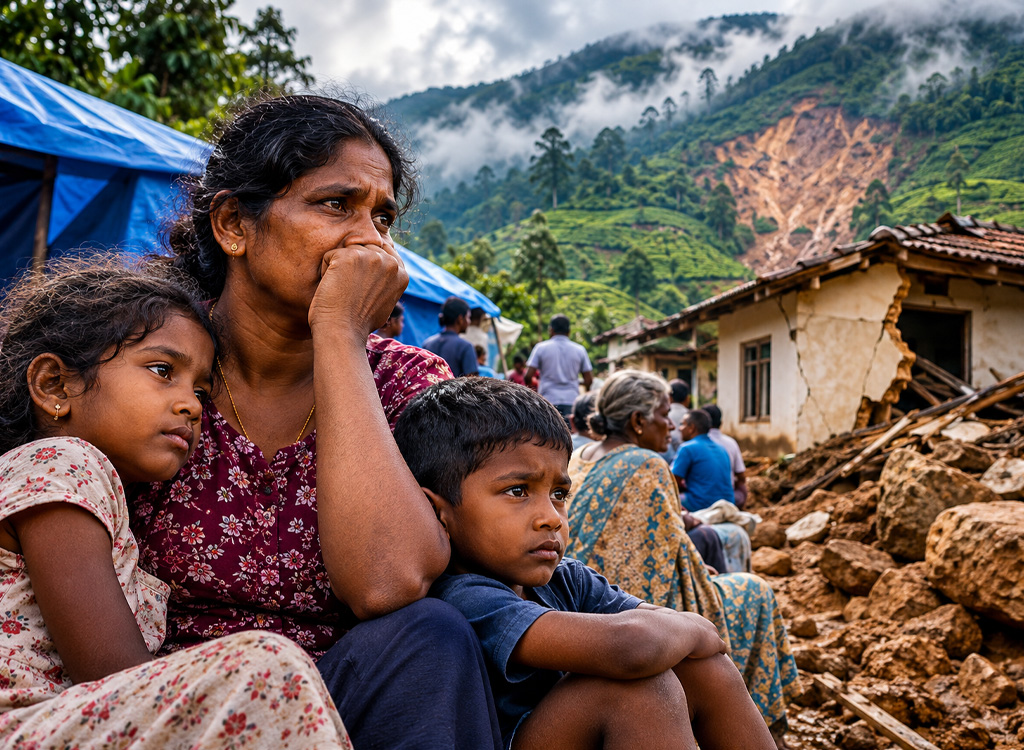
Several months after Cyclone Ditwah devastated parts of Sri Lanka’s hill country, affected communities continue to grapple with a multitude of challenges in their daily lives. During a recent visit to assess the post-disaster situation, it became evident that many families, particularly those belonging to the Malayaha Tamil community, are still struggling to rebuild their lives.
In several plantation communities, residents expressed frustration over difficulties in accessing government-announced relief and assistance. Many believe that the authorities have provided only temporary solutions rather than sustainable recovery measures. This has fuelled a growing sense of neglect and discrimination among affected families.
“I went abroad and worked to build this house. There wasn’t enough space for everyone to live in the line rooms. I saved money little by little and sent it home, and my husband completed the construction. All the major work is finished, with only a few minor things left to be done. We had planned to move into our new home as soon as I returned from abroad. But look what has happened! Now they tell us not to return to the property, warning that another landslide could occur,” says M. Manimekalai, a mother of two from Akkarathenna Estate in Badulla.
Despite many months having passed since the disaster, many affected families continue to live in temporary shelters. With inadequate basic facilities, they struggle to manage their daily lives in schools and government buildings converted into temporary accommodation. Meanwhile, others, having lost hope of receiving alternative housing, have returned to their landslide-affected homes despite the risks.
Although Manimekalai longs to return to the house she built with considerable sacrifice, hope and affection, she has refrained from doing so, prioritising the safety of her children. Nevertheless, the thought of returning to her own home remains with her every day.
For the past seven months, she and her family have been temporarily accommodated alongside other estate workers in a tea-leaf collection facility locally known as a kolunthu maduvam.
“We cannot live here. Every day feels like hell. Do you know how happy we were? Will we ever get that life back?” Manimekalai asks, her voice reflecting deep disappointment and uncertainty.
Her experience highlights the difficult reality facing displaced plantation families: the loss of homes built through years of hard work, the hardship of prolonged displacement and the uncertainty surrounding government assistance and alternative housing. (Source: Maatram – www.maatram.org)
Living under the constant fear of another landslide
“Our houses, the line rooms, are cracked. We have no choice but to leave the village where we have lived for generations. Government officers have assured us that only the cracked line rooms are at risk of being affected by an earth slip. They say that the next row of houses, just ten feet away, is not in danger. How is that possible?” asks Sivakkolunthu, 73, a resident of Ragala Estate.
For many residents, the question of safety remains unresolved. The entire village appears vulnerable to disaster, yet people have received assurances that certain houses are safe while others are at risk. Such explanations have raised concerns among residents, who question the basis on which these assessments are made.
The picturesque village, surrounded by towering mountains and massive rock formations, has become a place of anxiety following the devastating storm. Even the familiar surroundings that once offered residents a sense of tranquillity are now associated with the fear of another disaster.
Schoolchildren walk nearly six kilometres each day, travelling up and down the mountainous terrain to attend school. Their daily journey reflects the additional hardships faced by families living in this disaster-affected area.
These concerns were also reflected during a public gathering organised by the IPEN organisation in Ragala, where residents shared their experiences and grievances regarding post-disaster recovery.
According to the villagers, affected families feel that they are being treated unfairly by government authorities, particularly when it comes to identifying suitable alternative land for families displaced from plantation line rooms. Residents believe that their difficulties in securing safe land and permanent housing have not received adequate attention.
Meanwhile, IPEN has been prioritising the collection of climate-related data to better understand vulnerabilities and support measures to prevent or minimise damage caused by future climate-related disasters.
“Collecting reliable climate-related data is essential to understanding the risks faced by vulnerable communities and developing measures to prevent and minimise the impact of future disasters,” said Suresh Jeewaratnam, Director of IPEN.
As the hill country continues to recover from the devastation caused by Ditwah, the experiences of communities in Ragala and other plantation areas raise broader questions about disaster preparedness, equitable relief distribution, long-term resettlement and the protection of vulnerable communities.
For families who have already lost their homes and livelihoods, recovery is not simply about receiving emergency assistance. It is about regaining the security, dignity and stability of a life they once knew.
Disclaimer: The views and opinions expressed in this article are those of the writer and do not necessarily reflect the official position of this publication. – i need news thumbnail aspect ratio 1024x750px. make it more cinematic.








Leave a comment