
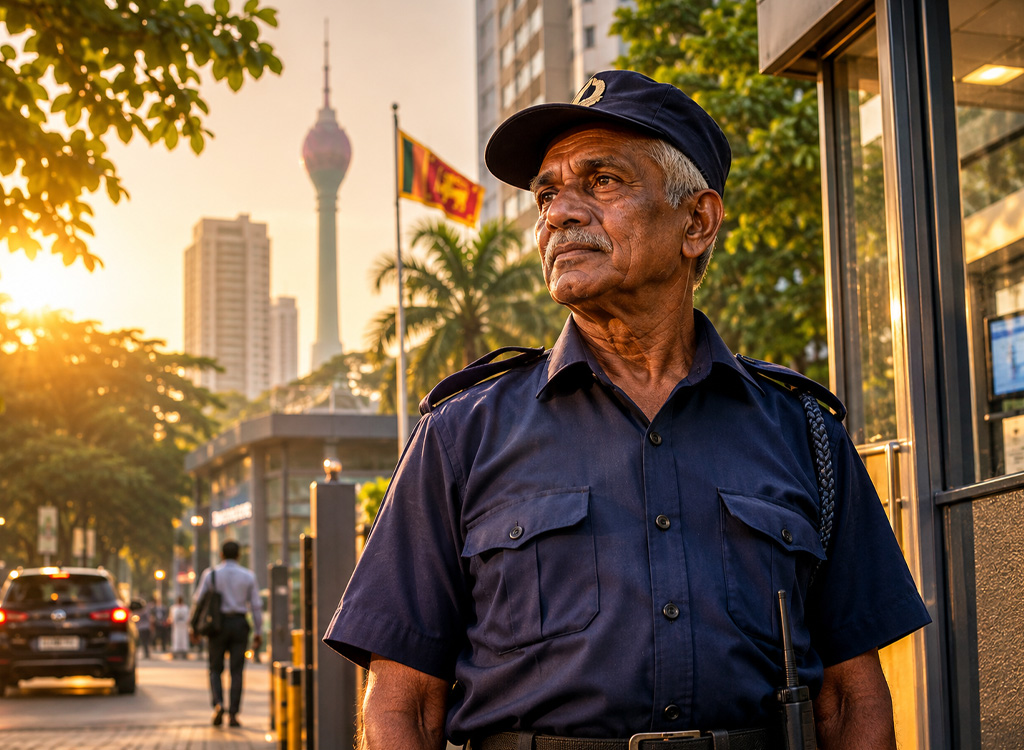
Behind every uniform is a person with a family, a working life and a story that few of us stop to hear
By Janahitha
It is 4.30 in the morning. Most of Colombo is still asleep, but an elderly man is already up, helping his wife prepare the day’s meals. She has had heart surgery and looks after the home. Their two children are married and live independently, with families of their own.
He leaves home at 6.00 a.m. with his breakfast and lunch packed. By 7.00 a.m. he is in uniform and starting a 12-hour shift as a security officer. The shift ends at 7.00 p.m., 14 and a half hours after he woke, and he still has the journey home ahead of him.
He is a retired Inspector of the Sri Lanka Police. He spent his career enforcing the law and protecting the public, and he now guards a commercial building for 12 hours at a stretch to supplement his government pension.
There is nothing undignified about the work he does. His situation does, however, raise questions about the economic system that has made it necessary.
The man behind the uniform
In Sri Lanka, older security officers are often called ‘Security Uncle’ or ‘Seeya’. The names are affectionate, but few of us know the real names of the men they describe, or what work they did before. Fewer still have stopped to ask how they are.
This man is a husband, a father and a former public servant with decades of professional experience. He raised two children and still supports a household with a wife who has needed serious medical treatment. He receives a government pension, but by his own account it does not cover what the household needs. So, instead of resting in retirement, he has gone back to work.
His story raises a fair question about what retirement means in Sri Lanka. It is supposed to be a period of rest after decades of work. For many people, it has become a move from one job to another.
Twelve hours at the gate
Many people picture a security officer as someone sitting by a gate, occasionally lifting a barrier or waving a car through. The job is a good deal more demanding than that.
During his shift, he manages the vehicles entering the premises and patrols the building and its grounds. When the power fails, he runs the generator and helps the management keep essential services going. He keeps a daily logbook of security activity and anything unusual he notices, and at the end of the shift he briefs the officer taking over, so that nothing is missed in the handover. The work calls for attention, discipline and stamina, as well as the ability to deal calmly with the unexpected.
At 7.00 p.m. he hands over and sets off home. Between waking at 4.30 a.m. and leaving work, most of his waking day goes on getting ready, travelling and doing the job. What is left has to cover time with his wife and family, his own interests, his health and his sleep. For someone who has already completed a full career in public service, that is a hard routine to sustain.
The economics of survival
Working because you want to is very different from working because you have to. Staying active after retirement can be good for people: a job can bring purpose, company, independence and satisfaction. When the job is a financial necessity, though, the picture changes.
This retired Inspector receives a pension every month, yet he has found it necessary to take on 12-hour shifts to add to it. The costs facing an elderly household in Sri Lanka help to explain why:
- Food and everyday household items.
- Electricity, water and other utility bills.
- Transport.
- Medicines, doctors’ fees and other healthcare costs.
- Upkeep of the home.
- Unexpected expenses, with no rising salary to absorb them.
Inflation and the cost of living do not stop when someone retires, and healthcare needs often grow just as earning power falls. A pension may look adequate on paper, but its real value lies in what it buys and the standard of living it supports.
He did not say how much his pension or his salary is, but his return to work tells us a good deal about whether his retirement income is enough. We should stop judging our social protection system only by how many people receive a pension, and start asking whether those pensions allow people to live with dignity.
The invisible workforce
Every morning, thousands of Sri Lankans arrive at offices, apartment blocks, hotels, hospitals, schools and shopping centres. Someone opens the gate for them, directs their car, and watches over the premises while they work and, in many places, while they sleep. These workers are an essential part of the economy, yet they are easy to overlook.
We tend to notice security staff only when something goes wrong: when the gate is slow to open, when our usual parking space is taken, or when a security check holds us up. We rarely notice them when everything runs smoothly.
There is an odd contradiction in this. We trust security personnel to protect our families, our property, our businesses and sometimes our children, but we do not always show them the courtesy that such trust ought to carry.
A person’s standing should not depend on their salary, their car, their clothes or the title on their business card. The officer at the entrance deserves the same respect as the chief executive on the top floor. Each has responsibilities, each contributes to the organisation, and each has a family and a life outside work.
The dignity of labour
Sri Lankan society places great weight on titles, positions and professional standing. We often pay close attention to what people do and very little to who they are.
A retired Police Inspector is no less of a person for having swapped a police uniform for a private security one. His experience, his intelligence and the service he gave the country are all still there.
A society that teaches its children to become successful professionals, but not to respect the people who clean their offices, tend their gardens, collect their rubbish and guard their buildings, has failed in an important way. Education is incomplete without humility, and economic growth means little if it does not come with respect for the people who make it possible.
We often speak of compassion, kindness and Buddhist values. Those values are tested less by religious ceremonies or public statements than by how we treat people who can do nothing for us. The way we speak to a security officer, a domestic worker, a street cleaner or a waiter says more about our character than the way we speak to someone with influence. Courtesy, after all, costs nothing.
Growing old in Sri Lanka
His story also raises a wider question for national policy: what kind of country are we building for our elderly?
Sri Lanka’s population is ageing. As more people retire, pensions, access to healthcare, savings and social protection will matter more and more. The state’s responsibility to its citizens does not end at retirement age. People who have given decades of work, taxes and public service are entitled to expect reasonable financial security in later life.
That does not mean raising every pension across the board; the country has to remain fiscally responsible. It does mean building a retirement framework that is better designed, sustainable and fair. Such a framework should take account of the real cost of living, access to affordable healthcare, targeted help for vulnerable elderly households, sustainable pension reform, and decent work for those who choose to stay active.
Employers have a part to play as well. Security companies, and the organisations that hire them, should ask whether their working conditions protect the health and dignity of their staff. Reasonable hours, proper rest breaks, drinking water, somewhere to sit, clean toilets, fair pay and a suitable place to eat are basic standards of employment. Older employees working long shifts need particular attention. A business cannot call itself world-class while it neglects the welfare of the people who keep it running.
What can we do?
Some of this needs government action, but a good deal of it does not. Several of the most immediate changes are in our own hands.
Learn the name of the security officer at your office or apartment building. Say good morning, ask about his family, and find out whether he has eaten. Speak to him with the same courtesy you would show your chairman, your doctor or your lawyer.
If you run a business, look at the conditions your security staff work under. Find out not only what you pay the security company but how much of it reaches the person doing the job, and make sure that cost savings are not made at the expense of someone’s dignity.
Teach your children that no honest job is beneath anyone.
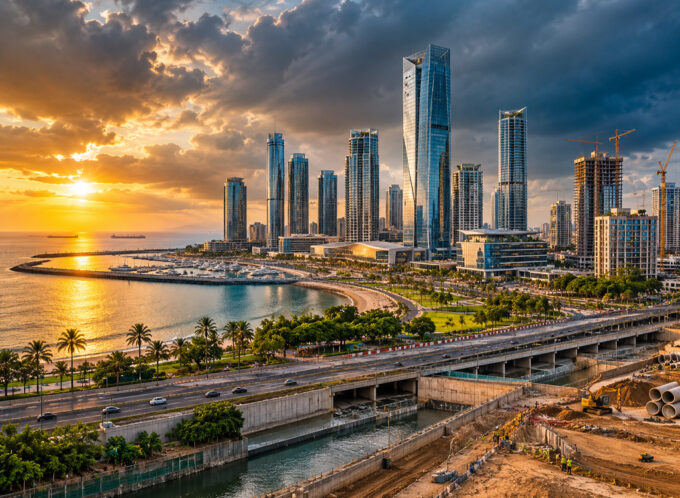
A developed country is measured by more than its tall buildings, luxury apartments, modern infrastructure and rising GDP. It is also measured by whether the people who build, clean, maintain and guard those buildings can live decent lives.
Tomorrow morning, at 4.30 a.m.
On his next working day, the retired Inspector will again wake at 4.30 a.m., help his wife prepare their food and leave home at 6.00 a.m. From 7.00 a.m. he will spend 12 hours protecting someone else’s property and making sure that other people’s working day runs smoothly. At 7.00 p.m. he will set off home.
His work will not appear in the annual report of the business he protects, and he is unlikely ever to receive an award for it. It matters all the same, and so does he.
The next time you walk past the security officer at your building, stop and say hello. He has a whole life behind that uniform, and it is worth taking the time to see the man as well as the gatekeeper.
Disclaimer: The views and opinions expressed in this article are those of the writer and do not necessarily reflect the official position of this publication.







Leave a comment