
By Vox Civis
Sri Lanka’s budget debates usually have very little to do with budget arithmetic and lots to do with everything else, with the spotlight firmly focused on what takes place inside parliament during this period. This year, however, is turning out to be different, with the spotlight about to shift outside of parliament, while the budget debate takes place within.
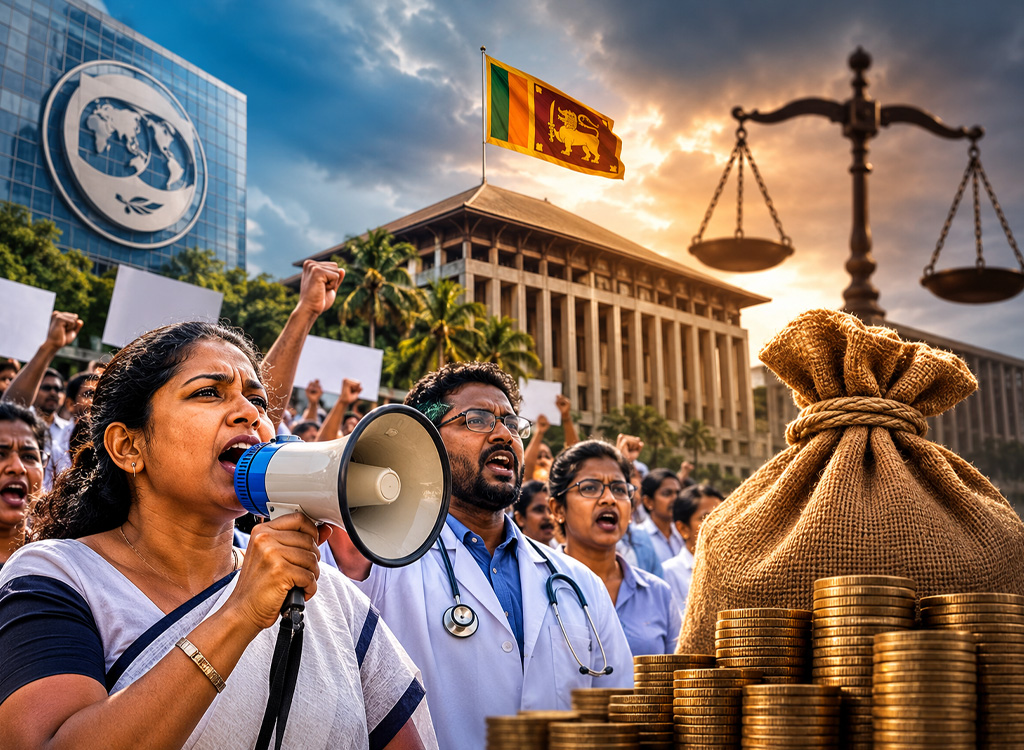
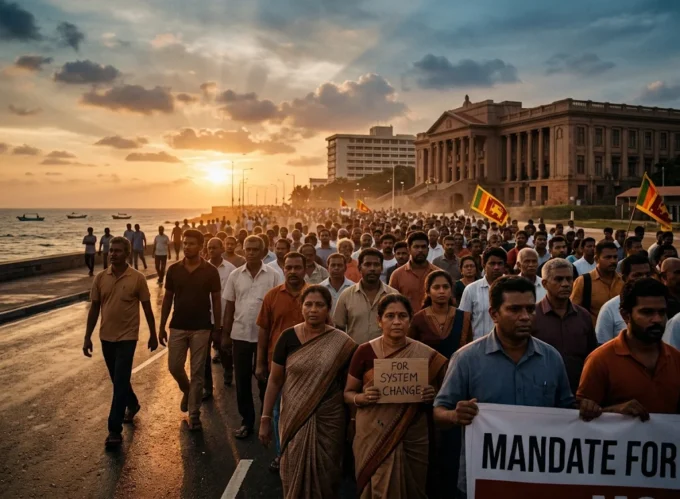
This year, the debate on Budget 2027 appears to have reached both the school and hospital gates. On Monday (30), teachers and principals plan to report sick across the island, joined by doctors of the Government Medical Officers Association (GMOA), potentially leaving both schools and hospitals paralysed. In addition, thousands of other workers in various sectors are also supposed to engage in trade union action.
The action comes one day before Parliament takes up the Education Ministry’s allocation, and 48 hours before the IMF Executive Board meets on December 2 to consider the Seventh Review of the Extended Fund Facility (EFF). That timing is deliberate. The unions have found the point where a domestic grievance meets an international deadline, and they are pressing on it. The standoff is manifesting as a duel: strikers are demanding an interim allowance of Rs. 25,000 for every state employee, and the President who campaigned against the old order, has replied that relief cannot be won by protest or “unreasonable demands.” Both sides have chosen this framing, and it conceals more than it reveals.
The arithmetic that doesn’t tally
Let’s begin with the government’s strongest argument. Sri Lanka employs roughly 1.3 to 1.4 million public servants. A flat Rs. 25,000 monthly allowance for each would cost between Rs. 390 and Rs. 420 billion a year, which is more than 1 percent of GDP. The IMF programme requires a primary surplus of 2.3 percent of GDP. An unbudgeted allowance of this size would consume close to half of that surplus in one stroke.
The Public Financial Management Act, passed to give the IMF’s guardrails the force of domestic law, caps primary expenditure at 13 percent of GDP. The Budget already sits at about 12.9 percent, leaving a margin of roughly one-tenth of a percentage point. Meanwhile, the ban on monetary financing means the Treasury cannot print its way out. Any new rupee for salaries must come from taxes or borrowing, and the government has just raised the tax-free threshold to Rs. 162,500 a month.
The wage bill is hardly stingy. The Budget sets aside Rs. 1.41 trillion for public sector salaries and wages, about 3.6 percent of GDP and nearly a quarter of recurrent expenditure. Within that sum, Rs. 110 billion is earmarked for the third and final phase of the 2025 salary restructuring, which takes effect in January 2027, plus targeted allowance increases for doctors, nurses and university academics later in the year. The 2025 reform was designed on purpose to fold scattered allowances into a transparent basic salary, to end the cycle of ad hoc “interim” payments extracted under pressure. Conceding the strikers’ headline demand would unravel the reform’s central principle.
The President is therefore right about the constraint. The IMF itself has said it will take the Seventh Review to the Board only if the 2027 Budget is in line with programme parameters, and about US$345 million in financing is at stake.
What the constraint does not excuse
But a constraint is not the same as an alibi. The government’s real difficulty is that it has used the constraint to end a conversation that the Budget itself should have started. Whether the state can afford Rs. 25,000 for everyone is a narrower question than whether the 2027 Budget distributes a tight envelope wisely. On that second question, the independent analysts who study the annexes rather than the headlines raise concerns that have received little airtime.
Start with what might be called the execution illusion. Headline figures are impressive: a combined allocation of about Rs. 1,450 billion for education and health, and an expenditure total that makes ministers proud. But what is voted in Parliament is not what is spent in the field. Independent tracking of the previous budget cycle suggests that a large share of government commitments – nearly 40 percent by one estimate – never reached implementation. Officials frightened of anti-corruption audits have grown cautious about procurement, and tender processes have stalled across ministries.
This matters for the IMF debate in a way that rarely gets said aloud. Underspending on capital projects flatters the primary surplus. Part of the fiscal stability celebrated in headlines is therefore achieved by starving the real economy of public investment that was promised and not delivered. It is hard to demand sacrifice from teachers in the name of discipline when some of that discipline is simply the absence of delivery.
The picture of social spending is similar. Ministers speak of record rupee allocations for education and health, and in nominal terms they are right, though nominal records are easy to set when prices rise. Measured against the economy, the gap to the 2024 manifesto is wide. Analysts calculate that central allocations for education stand at roughly 0.8 percent of GDP against the manifesto’s 6 percent target, and for health at about 1.5 percent against a goal of 3 percent.
Provincial Council spending, which carries much of the day-to-day cost of running schools and hospitals, narrows the gap somewhat. It does not close it. A teacher on a picket line is arguing, among other things, that a promise made to voters was never kept. For comparison, combined defence and public security allocations remain above Rs. 688 billion, with Public Security alone rising from Rs. 193 billion to Rs. 230.5 billion. Strikers who point to that arithmetic are making a point about priorities, not about the rupee.
Rhetoric of transformation
Beneath the rhetoric of economic transformation, the Appropriation Bill raises recurrent expenditure, the day-to-day cost of running the state, by roughly 20 percent while squeezing genuine capital spending. The Rs. 42 billion increase for Provincial Councils goes entirely to recurrent items. Meanwhile, the development allocation of the Department of National Budget has more than doubled, from Rs. 163.6 billion to Rs. 362.1 billion, accompanied by large increases for “digital investment.” Yet the annexes do not say which projects or ministries will receive these funds. Large, unspecified pools of discretionary money are exactly what a transparency-minded government should be reluctant to create, and exactly what its opponents will remember if the pools are ever misused.
Some figures circulating in public commentary do not appear to fit neatly, either. A total expenditure figure near Rs. 5 trillion cannot sit alongside recurrent spending of nearly Rs. 5.9 trillion, and revenue of Rs. 6.18 trillion plus a deficit of Rs. 1.75 trillion implies total outlays closer to Rs. 7.9 trillion.
Most media coverage treats the Budget as a 12-month exercise. But the four-year EFF that Sri Lanka entered in March 2023 reaches its conclusion in March 2027, barely three months into the fiscal year. The Budget does not clearly describe what follows: whether there will be a successor programme, what financing framework would support it, or how Parliament would oversee it. Nor does it say how the Treasury will manage external debt service when grace periods expire and repayments step up.
This is where Budget 2027’s optimism becomes a risk. Revenue is projected at Rs. 6.18 trillion, or 15.8 percent of GDP. Critics from the market-minded right and the socialist left rarely agree on anything, yet both have questioned how that figure will be reached without a credible plan for industry and employment to widen the tax base.
A divided labour movement
It would be a mistake to see Monday as a single, disciplined front against the government. The labour movement is fractured, and the fractures reveal a deeper irony.
The Janatha Vimukthi Peramuna (JVP) built its political muscle through public sector unions, and many of the same leaders now hold ministerial office. The party’s affiliated National Trade Union Centre is campaigning against the strike. The Ceylon Teachers’ Service Union and other JVP-aligned bodies are expected to keep some schools open, which may produce friction at school gates on Monday morning. Rank-and-file JVP loyalists find themselves in the awkward position of defending austerity on the state’s behalf against colleagues who share their history. A party that treated the picket line as a sacred ground is now compelled to treat it as a problem of public order.
The government should read this carefully. A strike that divides the ruling party’s own base is a sign of a political failure, not a union triumph. When a government of labour origins must deploy its own union wing to blunt industrial action, it has lost something that no budget line can restore, which is the presumption of shared interests between the state and those who work for it.
Grasping the problem
Some ministers appear to grasp the problem, if not yet the remedy. Agriculture Minister K.D. Lalkantha, who led the JVP’s trade union wing, acknowledged in Parliament last week the right of citizens and trade unions to protest. He then conceded the strikers’ central factual claim: the government has yet to raise salaries in line with the cost of living, and the 2027 Budget contains no such increase. The matter, he said, would have to be considered in the next Budget, adding that a Budget cannot solve every problem.
Both statements are true, and the admission is revealing. It concedes the grievance while postponing the remedy by a year. For a teacher whose bills appear every month, “the next Budget” is not a policy but a postponement. A government cannot tell its workers in the same breath that they are right and that they must wait. If relief truly cannot come in 2027, it should say when and by what measure it will come, whether through a published formula linking pay to inflation or a firm timetable at the Salaries and Pensions Commission to which ministers have urged unions to take their cases.
Some of the unions’ other demands are narrower and therefore easier to meet. The government has reportedly left a narrow window at the Committee Stage to adjust specific items, such as difficult-area allowances, without altering the headline wage bill. It should use that window, and use it generously. Conceding targeted items is the cheapest way to prove that it is listening.
The other budget: security law and price of trust
The fiscal argument has a companion that the government prefers to keep in a separate room: the legislation on security and organised crime. The opposition has begun to connect the two, and they are right to.
The government is presenting the Protection of the State from Terrorism Bill and the Prevention of Organised Crimes Bill as a modernising package, to dismantle underworld networks and repeal the Prevention of Terrorism Act (PTA), which Sri Lankans across communities have long viewed as an instrument of abuse. The goal is sound. The 2024 manifesto promised the PTA’s unconditional abolition, and no serious observer thinks the old Act should survive. The question is whether its replacements keep its worst features under a new name.
Critics, including the SJB and the SLMC, the Human Rights Commission, UN Special Rapporteurs and petitioners before the Supreme Court, argue that the Terrorism Bill retains sweeping executive detention powers, broad definitions of terrorism and subversion, and authority to declare prohibited zones. In its original form the organised crimes bill drew objections for allowing senior police officers to authorise interception of communications without a judicial warrant, for weakening protections against coerced confessions, and for pressuring journalists to reveal sources.
Here the evidence is encouraging as well as troubling. Twenty-six petitions, including from the Bar Association of Sri Lanka, were filed against the organised crimes Bill. In response, the Attorney General’s office offered substantial amendments. On November 21 the Speaker informed Parliament that the Supreme Court had found the Bill capable of passage by simple majority, subject to the Attorney General’s amendments and further changes specified by the Court, with reports indicating that more than 50 clauses must be amended and one removed entirely.
Strayed too far
The President has also said that the government would not proceed with either Bill without broader consultation. This is how a constitutional system is supposed to work. But it also shows how far the first drafts strayed, and how much depended on the vigilance of lawyers rather than the restraint of the drafters. Citizens should ask what a bill that needed this much rescue says about the instincts behind it.
The economic stakes are real. Tariff-free access to the European market under GSP+ is conditional on compliance with international conventions on human rights, labour rights and governance. UN mandate-holders have warned that PTA-style legislation could endanger it. The apparel sector, a pillar of export earnings worth billions of dollars, along with seafood and rubber, would face immediate tariffs and be priced out against Bangladesh and Vietnam.
Broadly worded provisions on racketeering, extortion and “financial association” risk turning commercial disputes and insolvencies into criminal investigations, raising the risk premium for entrepreneurs and joint-venture partners who rely on contract enforcement through courts rather than police stations. Global investors in renewable energy, ports and technology operate under ESG rules that flag jurisdictions where executives can freeze assets, declare restricted zones or detain personnel on vague security grounds.
There is a labour dimension too. Provisions that can be turned against disruptions to “essential services” chill lawful collective bargaining. Rather than producing calm, suppression of formal union channels tends to push disputes into sudden, unmanaged stoppages. If this Monday’s strike teaches anything, it is that grievances denied a hearing do not disappear.
The choice before government
The same concern extends to the government’s legal strategy towards former ministers, which could well have unintended consequences, including scaring away investors. Few Sri Lankans will weep for politicians accused of plundering the public purse, and the mandate to hold them to account was among the strongest the NPP received. But in Parliament on Thursday, an opposition MP noted that the global norm is to grant bail to those who qualify for it and argued that State institutions in Sri Lanka seem relentlessly intent on preventing it.
That is no longer only a grievance of the powerful. By this account it has become a serious crisis, not just for those already on the receiving end but for ordinary citizens hauled before the courts, who lack the lawyers and connections of a former minister and may languish in remand while cases crawl.
It is also an economic problem. Investors read a country’s courtrooms as closely as its budget, and where liberty before trial appears to be rationed by politics, cautious capital will conclude that legal exposure in Sri Lanka depends on who holds power. The accountability drive deserves to succeed, which is exactly why it must be seen to follow the book: guilt established at trial, not punishment served in advance, which is what is widely perceived as currently taking place.
The government’s dilemma is real, and it deserves some sympathy. But sympathy is not agreement. Discipline is a means, and the government risks mistaking it for an end. A state that cannot spend what it budgets, that falls short of its own manifesto on education and health while its security allocations grow, that places large unspecified sums in central pools, and that meets its servants’ grievances with a speech rather than an offer, is not showing discipline. It is showing a lack of trust, and trust is the asset that fiscal programmes spend fastest.
Disclaimer: The views and opinions expressed in this article are those of the writer and do not necessarily reflect the official position of this publication.








Leave a comment