
By Vox Civis
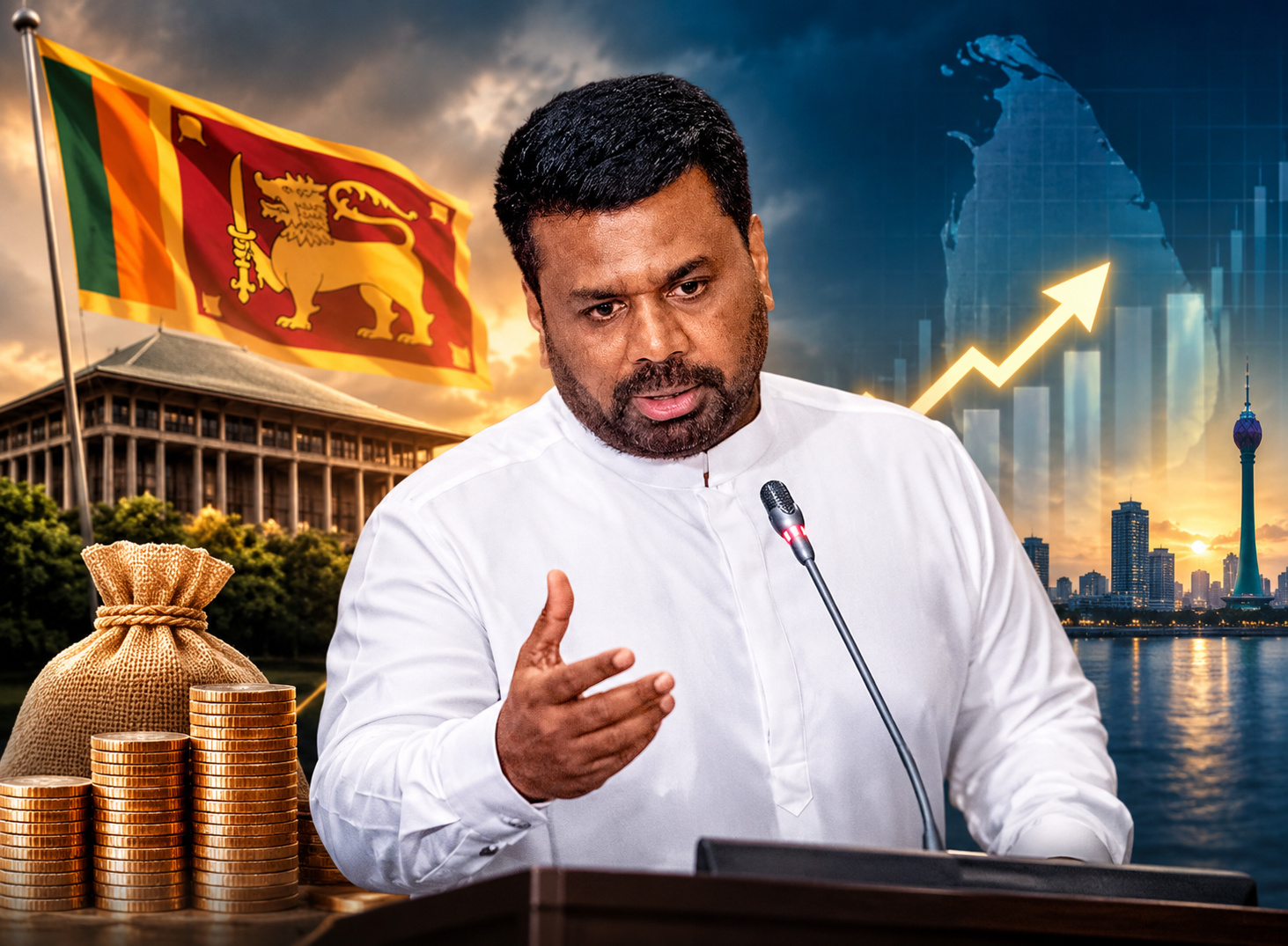
Last Thursday (12), President Anura Kumara Dissanayake, as Finance Minister, presented his government’s third budget in Parliament and, with it, a change of vocabulary. Notably, the language of ‘crisis management’ gave way to the language of ‘transformation’: a Rs. 2 trillion capital investment programme, a second round of income tax relief, higher public sector allowances and concessionary financing for business. It was well staged and, in places, genuinely welcome.
But a budget is not judged by the ambition of its speech – check last year’s one for confirmation. It is judged by whether the arithmetic beneath it can bear the weight placed upon it. Read closely, that arithmetic raises more questions than the marathon four hour plus long speech, actually answered.
Credit first, because it is due. Sri Lanka’s recovery from the 2022 collapse is real. Government revenue has climbed from 8.4 per cent of GDP in 2022 to roughly 16.7 per cent in 2025, the economy grew by 5 per cent last year, and the government projects public debt falling to 92.9 per cent of GDP from 114.2 per cent at the depth of the crisis.
Yet the foundations of this stabilisation were laid before the present administration took office, and stability is a precondition for prosperity, not a substitute for it. The harder task, the one Budget 2027 claims to take up, is to turn a balanced ledger into higher output, better jobs and fuller pay packets. On that, the evidence so far is thin. Growth slowed to 4.2 per cent in the second quarter from 5.0 per cent a year earlier, and the IMF expects only about 3 per cent for the year.
A surplus built on unspent money
The government is celebrating a Rs. 22.3 billion budget surplus for the first nine months of 2026, a reversal of the Rs. 441 billion deficit of a year earlier. The number is real, and the primary surplus behind it, at Rs. 1.84 trillion, is already five times the full-year target. But what a surplus signifies depends on how it was achieved.
Revenue grew by 20 per cent to Rs. 4.6 trillion, already 87 per cent of the annual estimate. Capital expenditure and net lending, meanwhile, reached only Rs. 543 billion, or 31.6 per cent of the Rs. 1,719 billion allocated for roads, irrigation, schools, hospitals and the rest. More than two-thirds of the investment budget remained unspent with just a quarter of the year to go.
Fairness requires a caveat. Capital spending in Sri Lanka is habitually back-loaded, and the Treasury credits the turnaround to the rationalisation of expenditure as well as to revenue. But the pattern is not new. In 2025, the IMF noted that a primary surplus of 5.4 per cent of GDP, against a target of 2.3 per cent, owed something to lower-than-planned capital spending.
Sri Lanka or any country for that matter, cannot save its way to growth. A surplus manufactured partly by not building is a loan from the future, repaid later in the bridge not constructed, the school not extended and the factory not financed. September carries a warning of its own: the month recorded a Rs. 13.1 billion deficit, the first since July, as revenue growth eased and spending accelerated.
This is the context in which to read the Rs. 2 trillion capital allocation, equal to 5.12 per cent of GDP and described by the President as roughly 40 per cent higher than this year’s. The Appropriation Bill, it should be noted, lists capital expenditure at Rs. 1.753 trillion, a 24.7 per cent rise, so the headline and the legislation do not quite match. More important than either figure is a simple question: if the state cannot spend Rs. 1.7 trillion, why should an allocation of Rs. 2 trillion change anything? Money not spent builds nothing, and money spent on poorly appraised projects builds liabilities.
The real reform lies not in the allocation but in the machinery behind it: project selection, procurement, and the discipline to finish what is started. Until the government publishes quarterly execution targets and the economic returns it expects from these projects, the figure remains an aspiration rather than a policy.
Revenue base is narrower than it looks
The surplus also rests on a particular kind of revenue. Customs and the Inland Revenue Department each accounted for roughly 47 per cent of tax collections in the first nine months, and the Finance Ministry itself names motor vehicle imports as the principal source of the growth. Vehicle excise alone raised Rs. 381 billion and VAT on imports Rs. 690 billion.
Economist Premachandra Athukorala estimates that vehicle taxes added about 2.3 percentage points of GDP to the 2025 primary surplus; strip them out and the underlying figure is closer to 3.2 per cent. That is a windfall from pent-up demand after import restrictions were eased, not a tax base. And the windfall is fading: vehicle registrations fell 12.1 per cent in October from September, to 47,628 units, according to JB Securities.
The Budget seems to concede the point. Government revenue is projected to slip to 15.8 per cent of GDP next year from 16.7 per cent in 2025, even as the government commits to a primary surplus of 2.3 per cent and a deficit of 4.5 per cent. The gap must be closed by better collection, tighter spending or both, and neither is assured.
More worrying is who pays. In 2025 the ratio of direct to indirect taxes stood at roughly 23 to 77. The World Bank has warned that the VAT increases pushed more Sri Lankans into poverty, and the poorest tenth of households pay about 11 per cent of their pre-tax income in indirect taxes against 8 per cent for the richest tenth. Into this system the Budget introduces income tax relief: the monthly tax-free threshold rises from Rs. 150,000 to Rs. 162,500 from April, worth between Rs. 750 and Rs. 15,750 a month to each taxpayer. It is welcome, if modest beside the Rs. 200,000 that ministers had floated beforehand.
But it is relief for the salaried, the one group the tax authorities already have firmly in hand, and it lowers the direct-tax share at a time when that share needed to rise. The withholding tax on interest income, meanwhile, sits at 10 per cent, and the informal economy and concentrated wealth remain lightly touched. A government elected to rebalance the burden towards those best able to bear it has delivered, so far, a trim for the middle class and no structural shift in who funds the state. That, rather than the size of the threshold, is the missed opportunity.
Consumers feel the same tilt at the pump. Petrol 92 now costs Rs. 424 a liter after a Rs. 10 increase on 1 November, up from Rs. 294 at the end of last year, as the war involving Iran pushed Brent above $116 in late October. The pricing formula is monthly, so it lags: Brent then fell about 16 per cent in the week to 9 November, its sharpest weekly drop since the pandemic. December will show whether savings reach motorists as promptly as costs did.
Thin cushions, and a Federal Reserve that is not waiting
Official reserves stood at a headline $7.09 billion at the end of October. Yet the Central Bank’s own data show $5.75 billion of expected short-term outflows, covering the forward legs of currency swaps and loan servicing. Subtraction is a crude exercise, but it leaves little more than $1 billion of genuinely free cushion.
The IMF does not count the People’s Bank of China swap among usable reserves, net international reserves were estimated to have turned negative in June, the programme’s year-end target of $8.6 billion is out of reach, and import cover is 3.2 months. The rupee, at Rs. 332.61, has lost 6.8 per cent against the dollar this year. Blaming the Central Bank’s dollar purchases for that slide, as some critics do, misreads the cause. The bigger culprit is the oil bill: Sri Lanka spent $4.4 billion on fuel in nine months, as much as in all of 2025.
Into this thin margin comes the US Federal Reserve. It raised rates by a quarter point in September, its first increase in three years, taking the range to 3.75–4.00 per cent, and markets put the probability of another quarter-point rise in December at around 80 per cent, with more priced in for 2027. A half-point move is not the base case, and transmission is never mechanical. But the direction is unmistakable.
A stronger dollar and higher global yields raise the rupee cost of every dollar of oil, medicine and debt service, and make more expensive the return to international markets that the government hopes for after the IMF programme expires in March. The sovereign remains rated CCC+, one analyst puts the likely cost of a new Eurobond at 8 to 10 per cent, no successor programme has been lined up, and large repayments fall due from 2028. The public deserves to be told whether the Treasury has stress-tested this Budget against a tightening Fed, a weaker rupee and oil at $100.
Reading the debt honestly
Gross public debt stood at Rs. 32.977 trillion at the end of June, against about Rs. 31 trillion when the government took office, a rise of roughly 6 per cent. Critics call this proof of failure; ministers will say the stock is under control. Both are too simple. In rupee terms the stock has grown, but the rupee has weakened; in dollar terms public debt fell from $103.9 billion at the end of 2025 to about $98 billion in June. Interest payments are down 5 per cent so far this year and the debt-to-GDP ratio is falling. The claim that debt is compounding faster than the economy is not borne out by current figures.
Nor is there room for complacency. Debt works out at roughly $4,500 a person in a country where GDP per head is about $5,000. Interest still absorbs 45 per cent of recurrent spending. At the end of 2025, nearly a quarter of domestic debt fell due within a year. And the IMF framework, which aims to bring public debt below 95 per cent of GDP by 2032, cannot be met on stabilisation alone; it requires an economy that grows faster than its liabilities.
Households, meanwhile, are borrowing to get by rather than to build. Personal loans rose 35 per cent between December 2024 and March 2026, and bank lending against gold climbed Rs. 212 billion in the first half of this year to Rs. 1.11 trillion, now the third-largest segment of bank credit. When families pawn jewellery to cover consumption while the state underspends its investment budget, productive investment is not what is absorbing the credit.
What the country should demand
Budget 2027 will be judged by what follows the speech, and five tests are worth applying. First, execution: what share of the Rs. 2 trillion is spent by year-end, project by project, with published results rather than press releases. Second, revenue quality: how quickly the state can replace one-off vehicle taxes with income from a wider direct-tax base, including capital income and the informal economy, instead of leaning ever harder on consumption. Third, external resilience: how reserves will be rebuilt, and what framework, whether a successor IMF arrangement or something else, will anchor policy once the current programme ends in March. Fourth, transparency on debt: a clear decomposition of what drove the change in the stock, and a published schedule of repayments through 2030. Fifth, and most important, growth that people can feel: exports, foreign investment and jobs, measured against targets announced in advance.
None of this requires pessimism. Sri Lanka has done something difficult, and the government deserves credit for it. But a country that has stopped falling has not yet started climbing. Stability bought this government a hearing. It has not yet bought it a verdict.
Disclaimer: The views and opinions expressed in this article are those of the writer and do not necessarily reflect the official position of this publication.










Leave a comment