
By The Pulseline News Desk
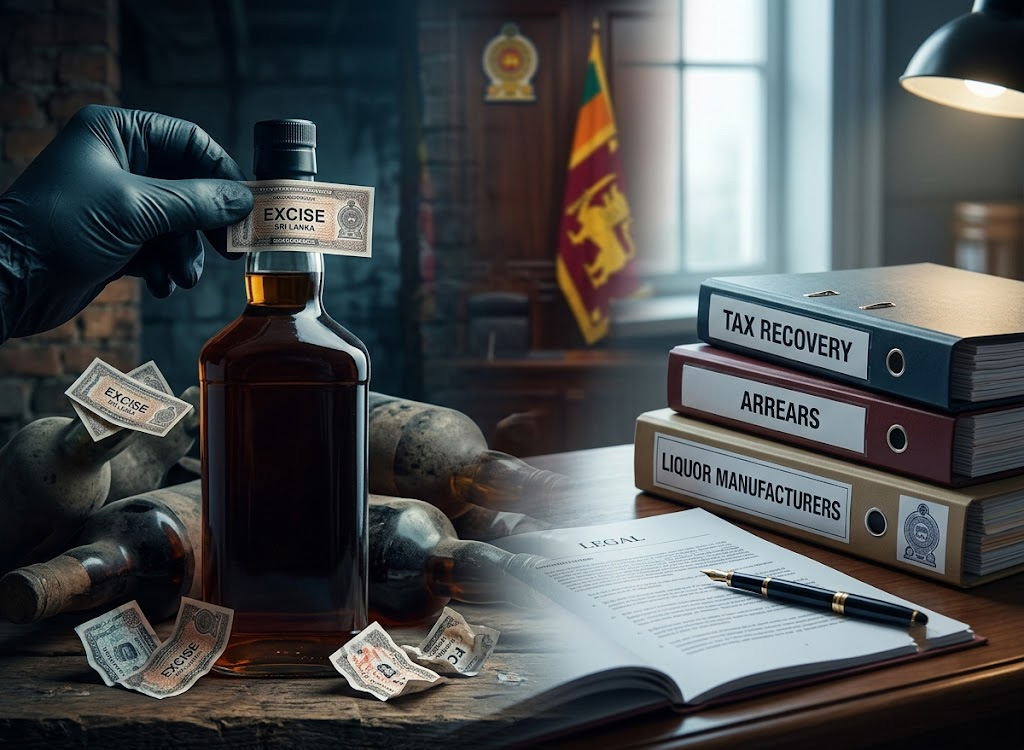
Sri Lanka’s liquor industry has once again come under intense scrutiny following allegations that a large-scale tax fraud involving counterfeit excise stickers is costing the State billions of rupees annually, while authorities simultaneously move to recover more than Rs. 6 billion in unpaid taxes from several liquor manufacturers.
The issue gained renewed attention after Chairman of the Committee on Public Finance (COPF), MP Harsha de Silva, claimed that the financial losses linked to illicit liquor production are enormous, estimating that they are worth “eight times more” than the Government’s annual expenditure on the Suwaseriya 1990 ambulance service.
Speaking to the media, de Silva questioned assurances previously given by officials responsible for producing excise security stickers.
“I asked the officers responsible for the production of stickers during the COPF meeting, and they assured that there was no issue and that everything was under control. However, the recent raid where illegal liquor was uncovered proved that there is a scam involving the production of false stickers,” he said.
Counterfeit stickers and lost revenue
Excise stickers serve as one of the Government’s primary tools for verifying that alcohol sold in the market has been legally manufactured and that all applicable taxes have been paid.
According to de Silva, the discovery of counterfeit stickers during recent law enforcement operations suggests that illicit manufacturers have been able to bypass this safeguard, enabling illegal liquor to enter the market disguised as legitimate products.
He illustrated the scale of the alleged losses using a bottle of old arrack.
While the excise tax component on a bottle amounts to approximately Rs. 1,600, the Government ultimately loses around Rs. 3,600 per illegally produced bottle, he said. The losses extend beyond unpaid excise duties to include other taxes and unreported income that escapes the tax system entirely.
“The producers of false arrack do not pay any taxes, and their income is not accounted for,” de Silva said.
His comments point to a broader concern that illicit alcohol production not only deprives the Treasury of revenue but also creates an uneven playing field for legitimate manufacturers that comply with tax regulations.
A long-standing challenge
Sri Lanka’s excise sector has historically been one of the Government’s largest sources of tax revenue. Excise duties on liquor and tobacco contribute tens of billions of rupees annually to State coffers.
However, authorities have long struggled to curb the illicit liquor trade, which ranges from the production of illegal spirits to tax evasion through counterfeit labels and forged excise stamps.
Experts say the profit margins are substantial because producers who evade taxes can sell products at significantly lower prices while earning higher profits than licensed manufacturers.
Beyond the financial impact, illegal alcohol production also poses significant public health risks, as unregulated products may contain unsafe ingredients or fail to meet quality standards.
Separate battle over tax arrears
The allegations surrounding counterfeit excise stickers come as the Attorney General’s Department informed the Supreme Court recently that legal action will be initiated to recover outstanding tax arrears owed by liquor manufacturing companies.
Additional Solicitor General Nerin Pulle made the disclosure when a Fundamental Rights petition filed by 17 social activists was taken up before a two-judge bench comprising Chief Justice Preethi Padman Surasena and Justice Arjuna Obeyesekere.
The petition seeks an order directing relevant authorities to take immediate action to recover billions of rupees in unpaid taxes allegedly owed by several liquor manufacturers.
According to the petitioners, outstanding tax liabilities had reached Rs. 6.221 billion as of June 15, 2023.
The respondents include the Commissioner General of Excise, the State Minister of Finance, the Auditor General and several liquor manufacturing companies, including W.M. Mendis & Co. Ltd., Wayamba Distilleries (Pvt) Ltd., Globe Blenders and Bottlers Lanka (Pvt) Ltd., McCallum Brewing Co. (Pvt) Ltd., Kalutara Co-operative Distilleries Society Ltd., Finland Distilleries Corporation (Pvt) Ltd., Synergy Distilleries (Pvt) Ltd., Randenigala Distilleries Lanka (Pvt) Ltd., Hingurana Distilleries (Pvt) Ltd. and Royal Ceylon Distilleries (Pvt) Ltd.
The Supreme Court has fixed the matter for further hearing on November 16.
Calls for stronger oversight
The developments have intensified calls for stronger oversight of Sri Lanka’s excise administration, particularly the systems governing tax collection, sticker production and distribution.
MPs and civil society groups argue that weaknesses in enforcement have allowed tax leakages to persist for years, depriving the Government of revenue at a time when public finances remain under pressure following the country’s economic crisis.
The allegations also raise questions about accountability within regulatory institutions responsible for monitoring excise collections and preventing fraud.
If investigations confirm widespread counterfeiting of excise stickers, authorities may face renewed pressure to introduce more secure digital tracking systems, strengthen supply chain monitoring and improve coordination between the Excise Department, law enforcement agencies and tax authorities.
For a country seeking to rebuild its fiscal position under an IMF-supported reform programme, plugging revenue leakages has become a national priority. Whether through recovering unpaid taxes from licensed manufacturers or dismantling illicit production networks, the outcome of these investigations could have significant implications for Sri Lanka’s efforts to strengthen tax administration and restore confidence in public finances.









Leave a comment