
By The Pulseline News Desk
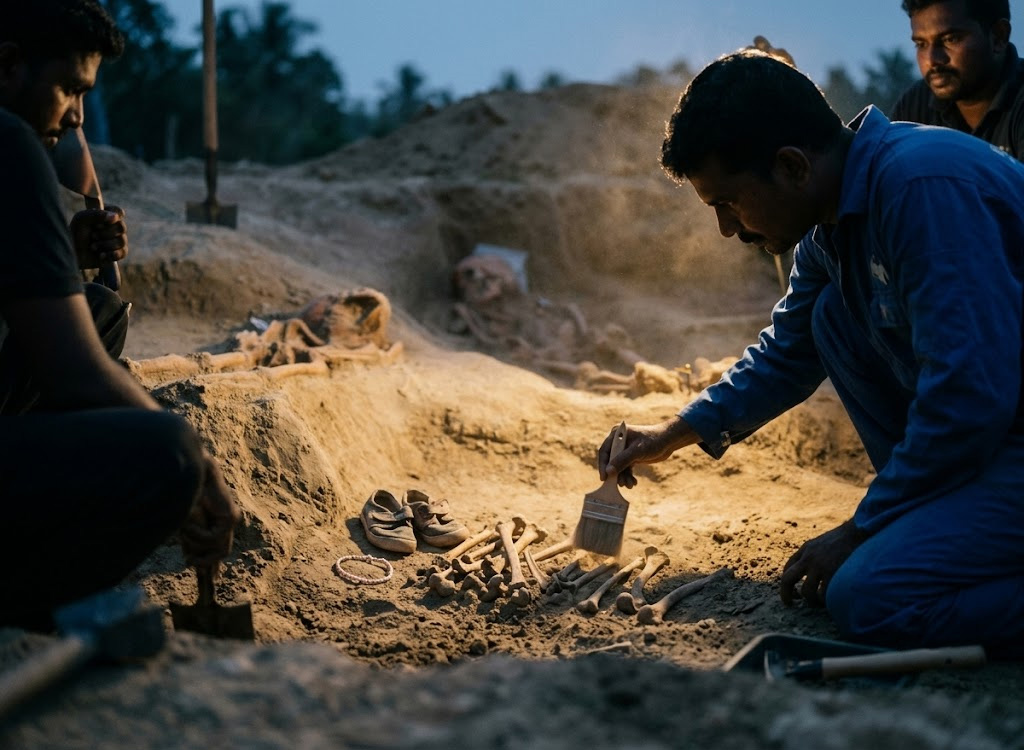
Excavations at the Chemmani Siththupaththi mass grave in Jaffna resumed on Tuesday (15) after a three-week suspension, with investigators uncovering the remains of two more children, adding a poignant dimension to one of Sri Lanka’s most significant ongoing forensic investigations into wartime disappearances.
Lawyer V.S. Niranjan, who represents families of the missing and victims, has said two additional body accumulations were identified on the first day after excavation work resumed. The latest findings bring the total number of body accumulations discovered at the site to 29.
Officials involved in the excavation have said that 409 bodies have so far been exhumed, while a total of 414 sets of human remains have been recovered over 87 days of excavation.
The work is being carried out under the supervision of Jaffna Magistrate Selvanayagam Leninkumar, with archaeological investigations led by Professor Raj Somadeva and forensic examinations conducted by Judicial Medical Officer Dr. Selliah Piranavan.
The excavation had been temporarily suspended on June 23 to provide the excavation team with a scheduled break before resuming this week.
A site of national significance
The Chemmani Siththupaththi mass grave has emerged as one of the largest mass grave investigations undertaken in Sri Lanka since the end of the country’s civil war in 2009.
Excavations began on May 15, 2025, after human skeletal remains were discovered during development work in the Chemmani area, located on the outskirts of Jaffna town. Subsequent judicial orders led to a systematic archaeological and forensic excavation, which has proceeded in three phases.
As the excavation progressed, investigators uncovered multiple body accumulations, including the remains of infants and young children. Personal effects such as clothing, school-related items and jewellery have also been documented, providing potential clues to the identities of the victims and the circumstances surrounding their deaths.
The discovery of children’s remains has heightened concerns among victims’ families and human rights organisations, which have repeatedly called for an independent, transparent and scientifically rigorous investigation.
Chemmani’s long history
The Chemmani name has long been associated with allegations of secret wartime burials.
In the late 1990s, the area came under international attention after allegations that civilians who disappeared during the conflict had been buried in mass graves. Limited excavations conducted in 1999 led to the recovery of several skeletons, but broader investigations were never fully pursued, leaving many questions unanswered.
For decades, families of those who disappeared during the civil war have maintained that many victims remain buried in undiscovered graves across the Northern Province. The renewed excavations at Chemmani have therefore revived longstanding demands for truth, accountability and the identification of those who remain missing.
Search for answers
The current excavation is being conducted using archaeological methods designed to preserve evidence and document the precise location and condition of each set of remains before removal. Forensic specialists are expected to conduct detailed examinations to determine age, sex, possible causes of death and, where feasible, establish identities through scientific analysis, including DNA testing if available.
Legal representatives for victims’ families have stressed the importance of ensuring that all evidence is properly preserved and that relatives are kept informed throughout the investigation.
The discovery of additional children’s remains has further underscored the humanitarian significance of the excavation, highlighting the continuing impact of Sri Lanka’s decades-long conflict on families still searching for answers about loved ones who disappeared.
As excavations continue, each new discovery adds to the growing body of evidence emerging from the Chemmani Siththupaththi site. For many families who have waited decades for information, the painstaking forensic process represents not only an effort to recover human remains but also a search for truth, dignity and, ultimately, closure.










Leave a comment