
By Chanakya
Two years ago, Sri Lankans did not simply vote for a new government. They voted to dismantle a political and economic order they believed had driven the country into its worst crisis since independence.
The fuel queues, prolonged power cuts, shortages of essential medicines, the collapse of the rupee, the destruction of household savings, and the extraordinary spectacle of a sitting President fleeing the country convinced millions that the old political establishment had exhausted its legitimacy.
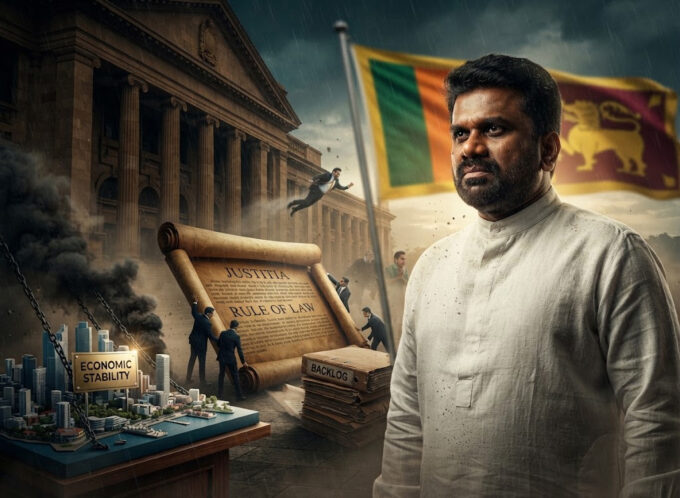
The Janatha Vimukthi Peramuna (JVP)-led National People’s Power (NPP) swept into office on a promise unlike any before it. It did not merely pledge better governance. It promised system change – a complete overhaul of the institutions, networks and practices that had enabled corruption, patronage and economic mismanagement for decades.
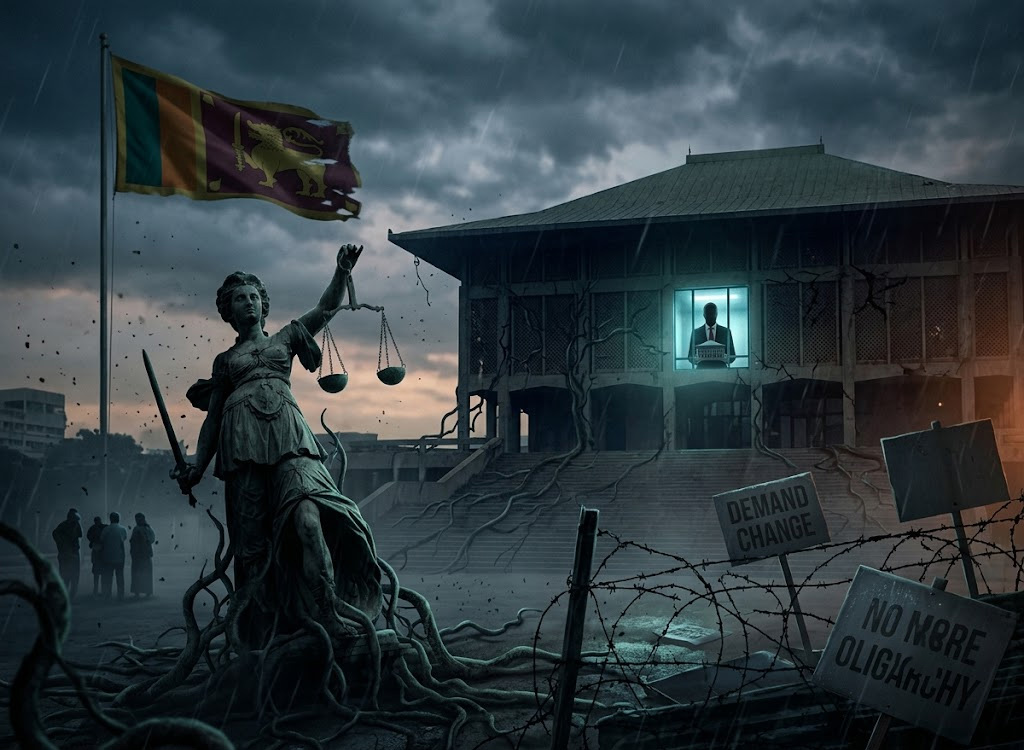
Nearly two years later, the faces in power have undoubtedly changed. But the more important question is whether the system itself has changed, or whether Sri Lanka is witnessing the emergence of something equally troubling: the gradual consolidation of an oligarchy in which political authority increasingly intersects with concentrated corporate influence.
To be fair, the Government deserves credit in several areas.
Despite enormous economic challenges, Sri Lanka has broadly remained on course with its International Monetary Fund (IMF) programme. The administration has also shown greater willingness than many of its predecessors to pursue corruption investigations involving politically influential figures, including the unprecedented legal proceedings against a former President. These are significant departures from a political culture where accountability was long considered impossible.
Yet macroeconomic stabilisation was never the promise that inspired the electorate.
The mandate of 2024 was about rebuilding institutions, restoring meritocracy, dismantling patronage networks and ensuring that public policy served the broader national interest rather than a privileged few.
Measured against those promises, progress appears considerably less convincing.
The Executive Presidency remains intact despite repeated commitments to abolish or substantially reform it. Electoral reforms remain elusive. Constitutional changes that featured prominently during the election campaign have yet to materialise. Laws such as the Prevention of Terrorism Act (PTA), which was once fiercely criticised by those now in government, continue to remain in force, while long-promised Provincial Council elections have quietly slipped from the political agenda.
Perhaps even more concerning is the growing perception that political influence is becoming increasingly intertwined with corporate power.
Across several strategically important economic institutions, senior executives and influential individuals associated with some of Sri Lanka’s largest private conglomerates have assumed advisory and decision-making roles. Individually, many of these appointments can be defended. A country emerging from bankruptcy undoubtedly requires experienced professionals capable of navigating complex economic reforms.
Emerging oligarchies
But competence alone cannot eliminate concerns about conflicts of interest.
When individuals with significant commercial interests participate directly in shaping policies affecting their own industries, questions inevitably arise about independence, transparency and accountability. Even where no wrongdoing exists, public confidence depends upon clear safeguards against undue influence.
This is often how oligarchies emerge.
Rarely do they seize power through dramatic constitutional crises or military coups. More commonly, they develop gradually through the fusion of political authority, economic influence and privileged access, all justified in the language of expertise, efficiency and national recovery.
The concern is therefore not any single appointment but the cumulative concentration of influence among a relatively small circle whose access to power appears largely unaffected by electoral outcomes.
One criticism increasingly heard across political divides is that while governments come and go, the same corporate interests continue to enjoy extraordinary access to the highest levels of decision-making.
This perception is reinforced by the slow pace of accountability.
Successive governments have promised to recover stolen public assets, prosecute corruption and dismantle entrenched patronage networks. Yet investigations continue for years, commissions produce reports that often gather dust, and accountability still appears selective.
Broken promise of meritocracy
Meanwhile, the promise of meritocracy remains unfulfilled.
Political appointments continue across important institutions while thousands of highly qualified professionals continue leaving Sri Lanka in search of better opportunities abroad.
The urgency that characterised opposition politics has also faded considerably since assuming office.
Timelines have increasingly been replaced by explanations. Responsibility has often given way to blame. Meanwhile, ordinary citizens continue carrying the overwhelming burden of economic adjustment.
Income taxes remain historically high. Electricity tariffs continue placing pressure on household budgets. Fuel costs remain elevated. The overall cost of living continues to erode purchasing power even as wages struggle to keep pace.
Headline inflation rose to 6.8 percent in June 2026, while non-food inflation climbed to 8.4 percent and food prices accelerated once again. For households already coping with stagnant incomes, every increase in essential living costs represents another decline in real purchasing power.
Burden of adjustment
The middle class, once considered the backbone of Sri Lanka’s economic stability, is steadily shrinking, while many lower-income families survive primarily through limited welfare assistance that barely covers basic necessities.
Adding to the contradiction is the Government’s own fiscal outlook.
According to the Ministry of Finance’s Fiscal Strategy Statement 2027, total government revenue, including grants, is projected to decline from 16.7 percent of GDP in 2025 to 15.8 percent in 2026 despite significantly higher taxation. The ministry attributes this partly to the normalisation of revenue following the resumption of vehicle imports and warns that global economic uncertainty may place further pressure on public finances.
This inevitably raises uncomfortable questions.
If citizens are paying substantially more in taxes, why is government revenue expected to fall?
If higher taxation cannot sustainably strengthen public finances, should greater emphasis instead be placed on expanding productivity, improving efficiency, eliminating waste and broadening the tax base rather than relying so heavily on salaried employees and consumers?
The burden of adjustment continues falling disproportionately upon the middle class, small businesses and wage earners.
Meanwhile, Sri Lanka has yet to seriously debate broader structural reforms such as wealth taxation or inheritance taxation that could ensure those with the greatest capacity contribute proportionately to national recovery.
This imbalance reinforces a perception that while ordinary citizens are asked to justify every tax payment and every financial transaction, many associated with major financial controversies continue operating without meaningful consequences.
Whether that perception is entirely accurate matters less than the damage it causes.
Democratic institutions and public trust
Confidence in democratic institutions depends as much upon public trust as legal outcomes.
Perhaps the greatest concern is therefore the remarkable continuity of influence enjoyed by a relatively small network of powerful individuals whose proximity to government appears to transcend changes in political leadership.
Stories continue circulating of influential figures associated with previous administrations resurfacing in advisory and decision-making positions under the present Government. Allegations persist regarding individuals linked to controversial privatisations, procurement decisions, tax policy and state enterprise restructuring continuing to exercise influence irrespective of election results.
Whether every allegation can ultimately be substantiated is rightly a matter for independent investigations and the courts.
The broader issue is institutional credibility.
If citizens increasingly believe that real power resides outside democratic institutions – in boardrooms rather than Parliament – then democracy itself begins to weaken.
State capture rarely begins with spectacular corruption scandals.
It begins when procurement becomes less transparent, regulatory decisions increasingly favour those with privileged access, public policy becomes indistinguishable from private interest and influential networks continue flourishing regardless of who wins elections.
Ironically, that is precisely the system Sri Lankans believed they were rejecting.
Oligarchy seldom replaces democracy outright.
Instead, it gradually colonises democratic institutions. Political dynasties give way to corporate dynasties. Family patronage evolves into boardroom influence. Elections continue, governments change, but the underlying networks remain remarkably constant.
Sri Lankans did not endure bankruptcy, lose their savings and sacrifice their livelihoods simply to replace one privileged elite with another.
The mandate of 2024 was not merely about electing new leaders. It was about fundamentally redefining the relationship between political power, economic privilege and the State.
There is still time for the Government to honour that promise.
It enjoys a commanding parliamentary majority, relative political stability and a public that, despite growing frustration, has not entirely abandoned hope.
But meaningful system change requires more than economic recovery. It requires institutions that are stronger than individuals, accountability that outweighs political loyalty and transparency that prevails over privilege.
Until those foundations are firmly established, Sri Lanka risks continuing the familiar cycle of changing governments without ever changing the system. And if enough citizens eventually conclude that one oligarchy has merely replaced another, history suggests they may once again seek change beyond the ballot box.
Disclaimer: The views and opinions expressed in this article are those of the writer and do not necessarily reflect the official position of this publication.











Leave a comment