
By The Pulseline News Desk
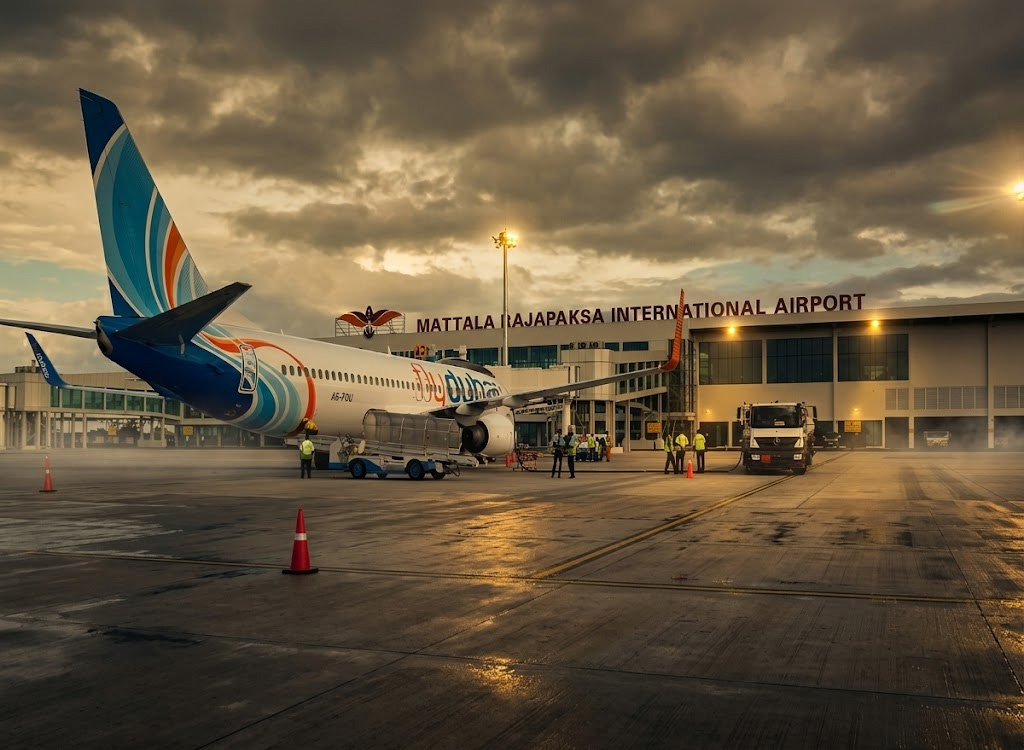
Sri Lanka’s second international airport continues to impose a significant financial burden on the State, with Mattala Rajapaksa International Airport (MRIA) recording daily losses of between Rs. 6 million and Rs. 7 million – equivalent to nearly Rs. 4 billion a year.
The figures were presented to President Anura Kumara Dissanayake during a high-level review of the Ministry of Ports and Civil Aviation held at the Presidential Secretariat on Wednesday (15), where officials outlined the financial performance of key state-owned institutions and the Government’s plans for future infrastructure development.
Officials informed the President that investment proposals aimed at reviving Mattala Airport have already been called, with the selection process expected to conclude by 2027.
The disclosure once again places the spotlight on an airport that has long symbolised the challenges of large-scale public infrastructure projects struggling to attract sufficient commercial activity.
A costly aviation asset
Located in Sri Lanka’s southern Hambantota District, MRIA commenced operations in 2013 with the ambition of becoming a major regional aviation hub. Its strategic location near the country’s southern coastline was expected to complement Colombo’s Bandaranaike International Airport (BIA) while supporting tourism, cargo operations and regional connectivity.
However, passenger traffic remained well below initial projections, with many international airlines discontinuing services after limited commercial demand. Although the airport has occasionally handled charter flights, cargo operations and aircraft parking, utilisation has remained low compared to its design capacity.
The latest figures indicate that maintaining airport operations continues to generate substantial financial losses, reinforcing successive governments’ efforts to attract private investment and identify alternative commercial uses for the facility.
Officials told the President that proposals from potential investors are currently under evaluation as part of a long-term strategy to improve the airport’s financial sustainability.
Broader review of ports and aviation
The discussion formed part of a comprehensive review of the Ministry of Ports and Civil Aviation’s progress during 2026 and preparations for budget allocations for 2027.
The meeting assessed the performance and future plans of several state institutions, including the Sri Lanka Ports Authority (SLPA), Airport and Aviation Services (Sri Lanka) Ltd. (AASL), SriLankan Airlines, SriLankan Catering, the Civil Aviation Authority, the Ceylon Shipping Corporation, the Merchant Shipping Secretariat, Port Management and Consultancy Services, and Jaya Container Terminals (JCT).
Officials also briefed the President on several major infrastructure projects under the Sri Lanka Ports Development Programme, supported by the World Bank, the Asian Development Bank and the Government of India.
Among the initiatives reviewed were the rehabilitation of Kankesanthurai Port, the proposed Logistics Park at the Port of Colombo, the extension of the southern breakwater, the second phase of the Western Container Terminal and the ongoing digitalisation of port operations.
Expanding Sri Lanka’s main gateway
While attention focused on Mattala’s financial challenges, officials also outlined ambitious plans to expand BIA to meet the country’s long-term aviation requirements.
The Government’s development strategy projects that BIA will be capable of handling approximately 24.2 million passengers annually by 2055, more than doubling its current capacity.
The second phase of the airport’s expansion, scheduled for completion in 2027, includes the construction of a new passenger terminal, expansion of arrival and departure facilities and upgrades to supporting infrastructure.
President Dissanayake also emphasised the need to improve passenger transport services surrounding the airport to enhance the overall travel experience.
In parallel, airport authorities are working with the Ministry of Digital Affairs to introduce fully digitalised airport services, with the aim of improving operational efficiency and passenger convenience.
Regional airport development continues
Beyond Colombo and Mattala, the Government is continuing efforts to strengthen regional aviation infrastructure.
Officials reported progress on development work at domestic airports, including Hingurakgoda, where the President instructed relevant agencies to improve coordination with the Sri Lanka Air Force to facilitate civil passenger operations.
Upgrading works are also underway at Jaffna International Airport, including improvements to its passenger terminal and associated facilities, as part of broader efforts to strengthen connectivity between the Northern Province and regional destinations.
Focus on financial sustainability
The review concluded with President Dissanayake stressing that state-owned institutions must place greater emphasis on financial discipline and efficient management of public resources.
He said future infrastructure investments should generate tangible economic returns, contribute positively to the State Treasury and avoid placing additional financial burdens on taxpayers.
For MRIA, the challenge remains finding a viable commercial model capable of transforming one of Sri Lanka’s largest aviation investments from a persistent financial liability into a productive national asset.









Leave a comment