
By The Pulseline News Desk
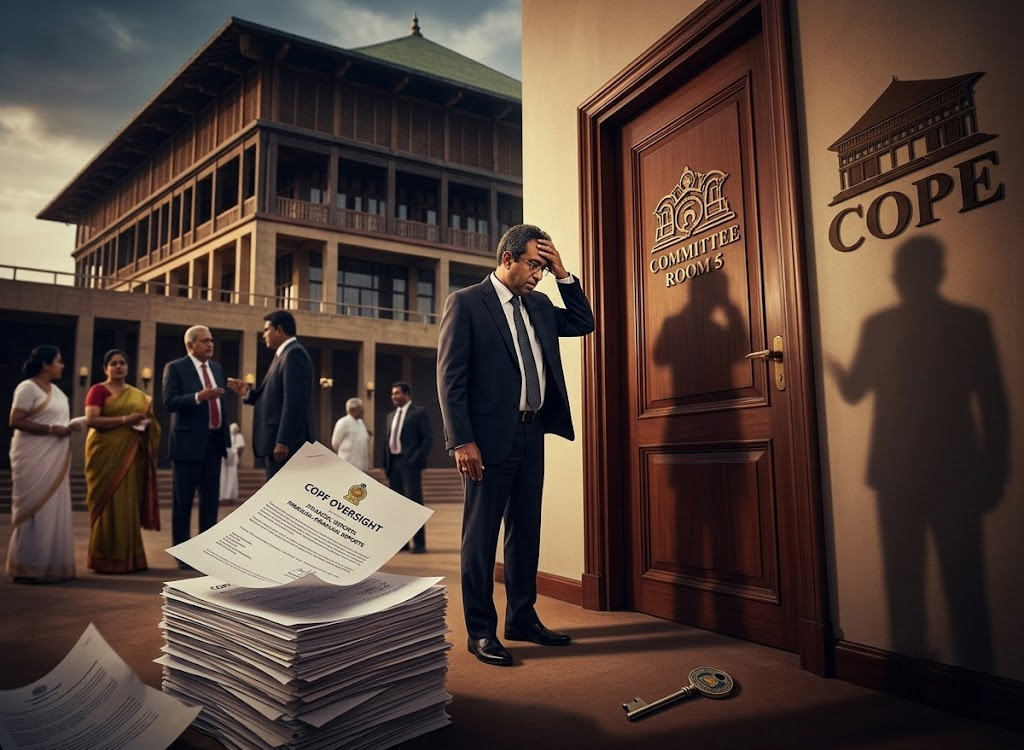
A dispute over access to parliamentary committee room facilities has sparked a broader debate about the role and importance of legislative oversight in the country, after the Chairman of the parliamentary Committee on Public Finance (COPF), MP Harsha de Silva, warned that the committee may no longer be able to function effectively under current arrangements.
Speaking in Parliament, de Silva has expressed concern over what he described as a sudden decision to allocate a key committee room exclusively to the parliamentary Committee on Public Enterprises (COPE), potentially disrupting the work of other parliamentary committees.
The disagreement, while centred on the allocation of physical space, has drawn attention to larger questions about how parliament’s oversight mechanisms are supported and whether key committees are being given adequate resources to carry out their responsibilities.
A clash over resources
Addressing Parliament, de Silva said an order had been issued allocating Committee Room No. 5 to COPE from Tuesday through Friday, from 8 a.m. to 5 p.m.
According to him, no formal written communication had been provided regarding the change, despite a longstanding practice of committees sharing available facilities.
“We had been sharing the room and conducting our work accordingly,” he had told Parliament.
The remarks came amid concerns that COPF could face practical difficulties in scheduling meetings and continuing its oversight activities.
The issue gained further attention when de Silva had referred to comments made in parliament suggesting that COPF was no longer necessary.
Importance of financial oversight
COPF plays a critical role in scrutinising government finances, taxation measures, public expenditure, and fiscal policy proposals before Parliament.
In recent years, the committee has been at the centre of discussions on economic reforms, tax policy, state revenue, public debt management, and the implementation of agreements with international financial institutions.
De Silva had highlighted the committee’s workload, noting that it had convened 87 times during the 10th parliament, compared with 33 meetings held by COPE during the same period.
The figures were cited to emphasise the committee’s active role in parliamentary scrutiny and its continued relevance within the legislative process.
Observers note that COPF has become increasingly prominent since the country’s economic crisis, as parliament has sought greater oversight of fiscal management and economic policy decisions.
Balancing parliamentary priorities
The dispute also reflects the challenges parliament faces in accommodating multiple committees with overlapping schedules and growing workloads.
COPE, one of parliament’s most influential oversight bodies, is responsible for examining the performance and accountability of state-owned enterprises and public institutions.
Alongside COPF, it forms part of a broader framework designed to ensure transparency and accountability in government operations.
As oversight responsibilities have expanded, demand for committee facilities, technical support, and administrative resources has also increased.
Parliamentary analysts say the effectiveness of committees often depends not only on their legal powers but also on the practical resources available to conduct inquiries, hold hearings, and engage with officials.
Speaker seeks resolution
Responding to the concerns raised by de Silva, the Speaker of Parliament had indicated that the matter would be discussed at the Advisory Committee and resolved through consultation.
The intervention suggests an effort to prevent the dispute from escalating while ensuring that all parliamentary committees are able to continue their work.
While the immediate issue relates to committee room allocation, the debate has highlighted the growing significance of parliamentary oversight institutions at a time when public scrutiny of government finances and public-sector performance remains high.








Leave a comment