
By The Pulseline News Desk
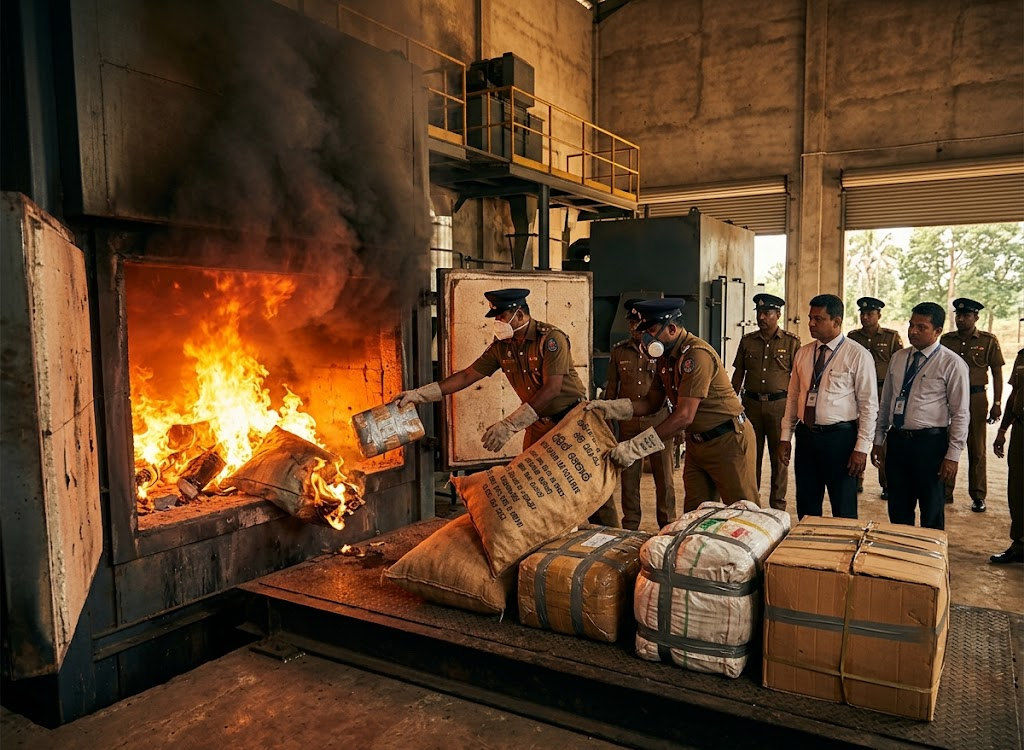
Authorities have incinerated a significant drug haul recently. More than 62 kilograms of narcotics, the bulk of it the synthetic drug known as “Kush,” were destroyed at a specialised drug destruction facility in Laktota, Wanathawilluwa, Puttalam, using high-temperature industrial furnaces. The operation had brought to a close a chapter that began on the streets — with raids carried out by the Police Narcotic Bureau — and ended, as it must, only after the courts had finished with the evidence.
What went into the furnace
The breakdown of what was destroyed tells its own story about the current drug landscape in the country. Kush — the synthetic cannabinoid that has surged in prevalence in recent years — dominated the haul at 39.710 kilograms, nearly two thirds of the total weight. Alongside it, authorities had destroyed 14.097 kilograms of ice (crystal methamphetamine), 4.139 kilograms of cannabis and hashish, 2.030 kilograms of cocaine, 1.200 kilograms of MDMA, 1.002 kilograms of heroin, and 26,262 drug pills.
The range of substances reflects a market that is both diversifying and escalating — from traditional narcotics like heroin to high-volume synthetics like Kush and ice that have increasingly dominated seizure statistics in recent years.
Process built around accountability
The destruction was not carried out quietly or without oversight. The entire process was conducted under the direct supervision of the Additional Magistrate of Negombo, alongside officials from the Government Analyst’s Department, the National Dangerous Drugs Control Board, and the Police Narcotic Bureau.
That multi-agency oversight matters. Drug destruction processes in many jurisdictions have historically been vulnerable to diversion and corruption — substances disappearing before or during destruction. The presence of judicial and independent scientific oversight is designed to close that gap and ensure what is ordered destroyed is actually destroyed.
The Kush factor
The sheer volume of Kush in this particular haul is worth pausing on. The synthetic drug has become a growing concern for Sri Lankan law enforcement, public health officials, and communities alike, particularly among younger and economically vulnerable populations. At nearly 40 kilograms in a single destruction batch, the figures point to both the scale of the enforcement effort and the scale of the problem that enforcement is trying to contain.
The recent destruction removes this particular batch from any possibility of re-entry into circulation. But for authorities, it is one operation in what remains a long and ongoing campaign.












Leave a comment