
By The Pulseline News Desk
Senior officials from across the country’s education establishment met at the Presidential Secretariat recently to do something that does not always happen in government — sit down together, check the scoreboard, and ask honestly whether the work is on track.
The meeting, convened under the guidance of Presidential Secretary Nandika Sanath Kumanayake and attended by Education Ministry Secretary Nalaka Kaluwewa along with heads of institutions under the Ministry, was focused on one central question: is Sri Lanka ready to roll out its new education reforms to Grade 6 students next year? The answer, officials indicated, is yes.
A reform built on five pillars
The overhaul being pushed through is not a cosmetic rebranding of the existing curriculum. It rests on five key pillars — though the specifics of each were not publicly detailed — and comes with a governance structure designed to actually hold people accountable for delivery.
Five separate committees have been appointed to oversee implementation, each aligned with the reform’s core areas. Above them sits a monitoring committee chaired by the Minister of Education, whose job is to track whether those five groups are doing what they said they would. The architecture, at least on paper, reflects a more serious attempt at coordination than Sri Lanka’s education reform efforts have sometimes managed in the past.
Both the National Institute of Education and the National Education Commission are embedded in the process, providing ongoing technical guidance rather than simply signing off at the beginning and disappearing.
Starting small, then scaling
The current reform cycle began with Grade 1 students in 2026. Officials at the recent meeting had described that rollout as proceeding in a systematic and effective manner — encouraging words, even if the true test of any curriculum reform lies in what happens years down the line when those students progress through the system.
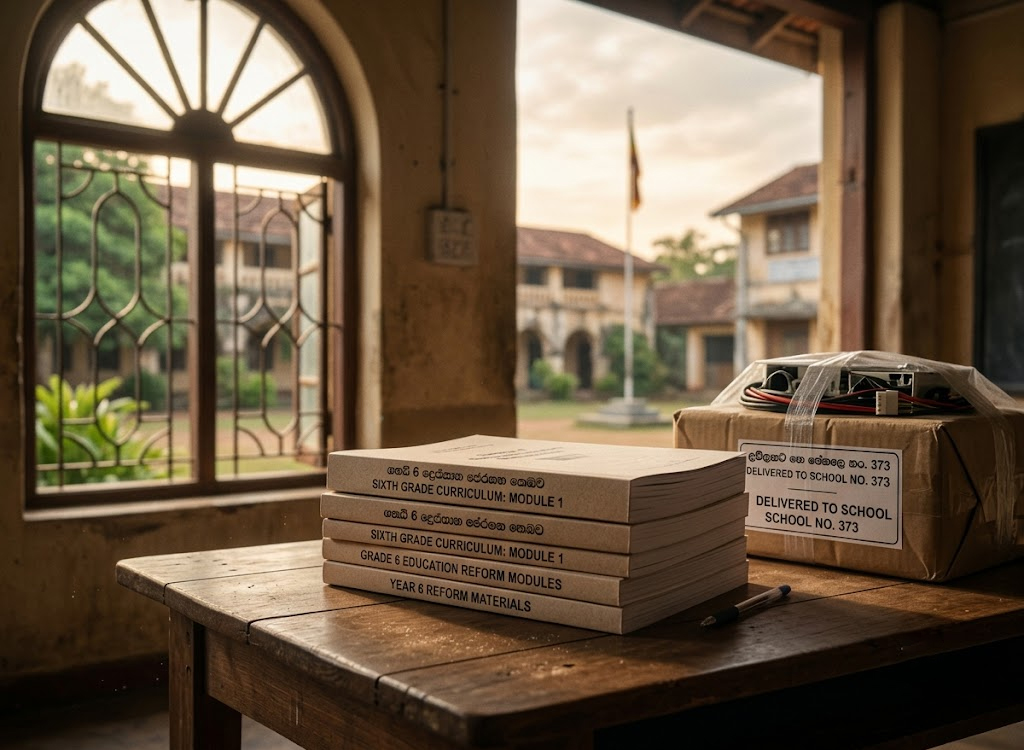
Grade 6 is the next frontier, and the preparation work is already well advanced. Modules for the first school term have been printed, incorporating revisions recommended by the expert committee guiding the process. Rather than distributing them in stages, the plan is to release first and second term materials together — a practical decision that gives schools and teachers more lead time to prepare.
The Educational Publications Department is handling the development of these materials, keeping production within the government’s own institutional framework.
Reaching every school
Perhaps the most logistically significant detail to emerge from the discussions is that all equipment required for the reforms has now been delivered to all 6,500 secondary schools across the country. In a nation where the gap between policy announced in Colombo and reality experienced in a rural school can be wide, that kind of on-the-ground reach matters.
Officials also acknowledged that not every school is starting from the same place. Some 373 institutions have been identified as requiring special development support, and upgrade work at those schools is currently underway. It is a recognition that a uniform national reform cannot be applied uniformly without first addressing the inequalities in the system it is reforming.
Keeping the momentum
One of the quieter but more important outcomes of the meeting was the decision to reconvene in three months to review progress. It is a small commitment on the surface, but in the context of Sri Lankan public administration — where reform momentum can dissipate between meetings — a built-in accountability checkpoint carries real significance.
The reforms are not finished. The harder work — training teachers, changing how learning is assessed, persuading parents and students that something genuinely new is happening — still lies ahead.










Leave a comment