
By The Pulseline News Desk
The latest fuel price increase announced by the Ceylon Petroleum Corporation (CPC) has once again brought into focus the difficult balancing act facing the government as it seeks to maintain economic reforms under the International Monetary Fund (IMF) programme while trying to minimise additional hardship for millions of citizens still recovering from the country’s worst economic crisis.
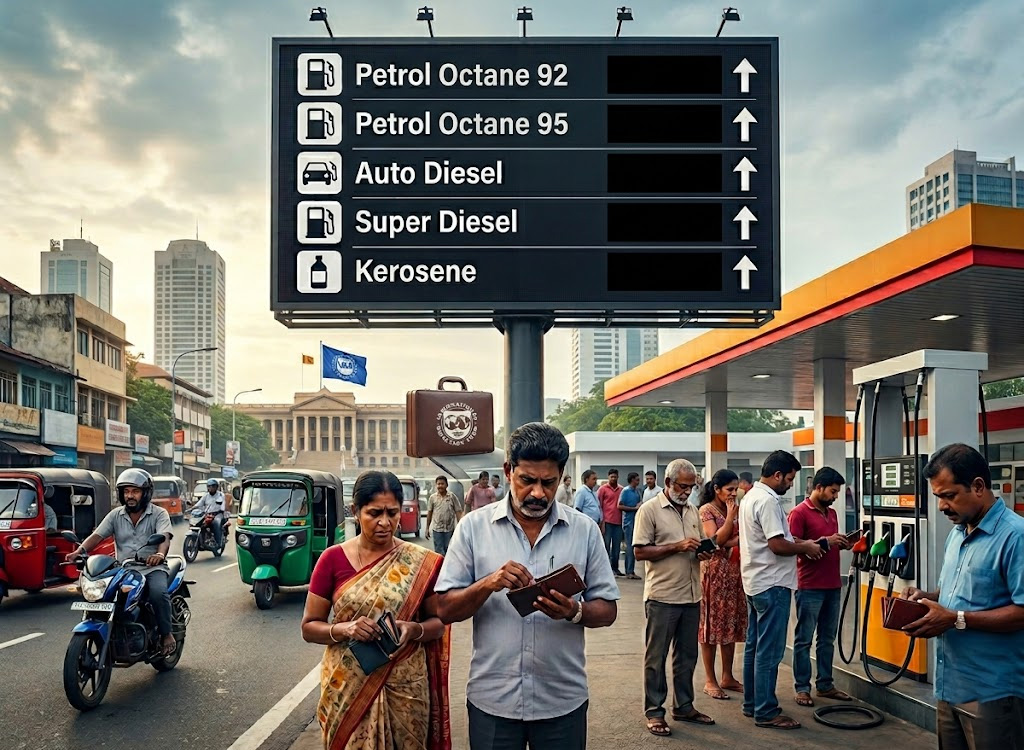
With effect from midnight on Saturday (30 May), Petrol Octane 92 was increased by Rs. 24 to Rs. 434 per litre, Petrol Octane 95 by Rs. 25 to Rs. 495 per litre, Auto Diesel by Rs. 15 to Rs. 407 per litre, Super Diesel by Rs. 20 to Rs. 478 per litre, and Kerosene by Rs. 20 to Rs. 285 per litre.
While the increases are significant, economic analysts note that the revisions appear to reflect a carefully calibrated approach aimed at balancing two competing priorities: protecting consumers from a sharper shock and ensuring that CPC does not return to the massive losses that contributed to Sri Lanka’s financial collapse.
Protecting CPC’s financial stability
The fuel pricing formula introduced as part of broader economic reforms was designed to prevent state-owned enterprises from accumulating unsustainable losses through politically driven subsidies and below-cost pricing.
Before the economic crisis, CPC often sold fuel at prices that did not fully reflect international oil prices and exchange rate movements. The result was mounting debt, heavy borrowing requirements and growing pressure on public finances. During the 2022 crisis, these losses became one of several factors that strained the country’s foreign exchange reserves and contributed to fuel shortages.
The latest increase is expected to improve CPC’s revenue position and help the corporation recover rising import costs associated with global petroleum prices and currency fluctuations.
Financial experts say the revision is likely to reduce the risk of operational losses and strengthen CPC’s cash flow. However, the increase alone is unlikely to eliminate all accumulated liabilities. The corporation continues to manage substantial debt obligations built up over many years, and its financial performance will remain vulnerable to volatility in global energy markets and exchange rates.
Nevertheless, maintaining cost-reflective fuel pricing is viewed as a key requirement under Sri Lanka’s IMF-supported reform agenda, which places strong emphasis on reducing fiscal risks arising from loss-making state-owned enterprises.
Delicate political and economic challenge
At the same time, the government faces a difficult political reality.
Fuel prices directly influence the cost of transportation, food distribution, manufacturing and virtually every sector of the economy. Any sharp increase can quickly trigger public dissatisfaction and place additional pressure on household budgets.
The latest revision suggests authorities may be attempting to strike a middle ground rather than fully passing on all potential cost increases to consumers at once.
Economists point out that while CPC requires sufficient revenue to remain financially viable, policymakers are equally conscious that excessive fuel price hikes could undermine the broader economic recovery by fuelling inflation and reducing consumer spending power.
This balancing act has become one of the central challenges of the country’s post-crisis economic management. The government must demonstrate to international lenders and investors that reforms are being implemented consistently, while also ensuring that citizens do not bear an unbearable share of the adjustment burden.
Impact on households and businesses
For ordinary Sri Lankans, however, the immediate concern is the impact on daily living costs.
Higher petrol prices will increase commuting expenses for private vehicle owners, while the diesel increase is likely to affect public transport, logistics and commercial operations. Transport operators and freight companies may seek fare and service charge revisions in the coming weeks, potentially pushing up the prices of goods across the country.
The increase in kerosene prices is expected to be particularly challenging for lower-income households and sections of the fishing community that continue to rely on kerosene for domestic and economic activities.
Business groups also warn that higher fuel costs could increase operating expenses for agriculture, manufacturing and distribution sectors, potentially creating renewed inflationary pressures if costs are passed on to consumers.
IMF reforms and public expectations
The latest fuel price adjustment underscores the broader dilemma confronting Sri Lanka’s economic reform programme.
The IMF framework requires greater fiscal discipline, improved governance of state-owned enterprises and the elimination of structural losses that have historically burdened taxpayers. Yet the success of these reforms ultimately depends on maintaining public support during a period when many families are still struggling with high living costs, elevated taxes and reduced disposable incomes.
Government policymakers therefore face a constant trade-off: keeping fuel prices low may provide short-term relief to consumers but risks undermining CPC’s financial health, while fully cost-reflective pricing strengthens public finances but can intensify economic pressures on households and businesses.
The latest revision appears to represent an attempt to navigate this narrow path – allowing CPC to improve its financial position and remain aligned with IMF reform commitments, while limiting the magnitude of the increase to avoid a more severe impact on the public.
As global oil prices, shipping costs and exchange rate movements continue to fluctuate, fuel pricing is likely to remain one of the most closely watched indicators of both Sri Lanka’s economic recovery and the government’s ability to balance financial stability with social welfare.












Leave a comment