
By The Pulseline News Desk
In a significant move aimed at strengthening accountability within the Buddhist clergy, the Department of Buddhist Affairs has reportedly initiated steps to amend the Buddhist Temples and Devalagam Act, introducing stronger legal mechanisms to address disciplinary violations by members of the Maha Sangha.
Commissioner General of Buddhist Affairs Gamini Senarathna has noted that the proposed amendments are intended to ensure that monks found guilty of serious breaches of monastic discipline can be subjected to effective disciplinary action, irrespective of their rank or status within the Buddhist establishment.
The move comes amid growing public concern over the ability of existing religious and legal structures to deal with disciplinary misconduct within the clergy.
According to Senarathna, special recommendations have been requested from the secretaries of the Maha Sangha Councils of the three nikayas, with the report expected to be submitted within days. Those recommendations will form the basis of a revised legislative framework designed to address shortcomings in the current system.
At present, disciplinary measures imposed by individual Sangha Councils often lack legal force beyond the ecclesiastical sphere. As a result, monks who have been subjected to disciplinary proceedings frequently continue to wear robes and engage in public religious activities despite sanctions imposed by their respective chapters.
Officials believe the proposed amendments could change that reality.
Among the key reforms under consideration is the establishment of a formal “Sangha Tribunal” or similar judicial mechanism empowered to hear disciplinary matters and impose enforceable penalties on offenders. Authorities argue that such a structure would provide a stronger and more transparent process for addressing allegations of misconduct while preserving the integrity of the Buddhist monastic order.
The Commissioner General has revealed that extensive consultations have already taken place between his department and the Attorney General’s Department. Several points of agreement have reportedly been reached regarding the legal framework required to support the reforms.
“We have already communicated the agreements reached with the Attorney General to the secretaries of the Maha Sangha Councils,” Senarathna has said. “After obtaining the views and proposals of the Mahanayake Theros and the relevant Sangha Councils, we will prepare legislation suitable for contemporary circumstances.”
Once the recommendations are received, the Department of Buddhist Affairs plans to submit the final draft amendment bill to the Legal Draftsman’s Department for formal preparation.
Malwathu Chapter Acts
The government’s efforts to strengthen monastic discipline come at a time when one of the country’s most prominent Buddhist prelates is facing intense scrutiny.
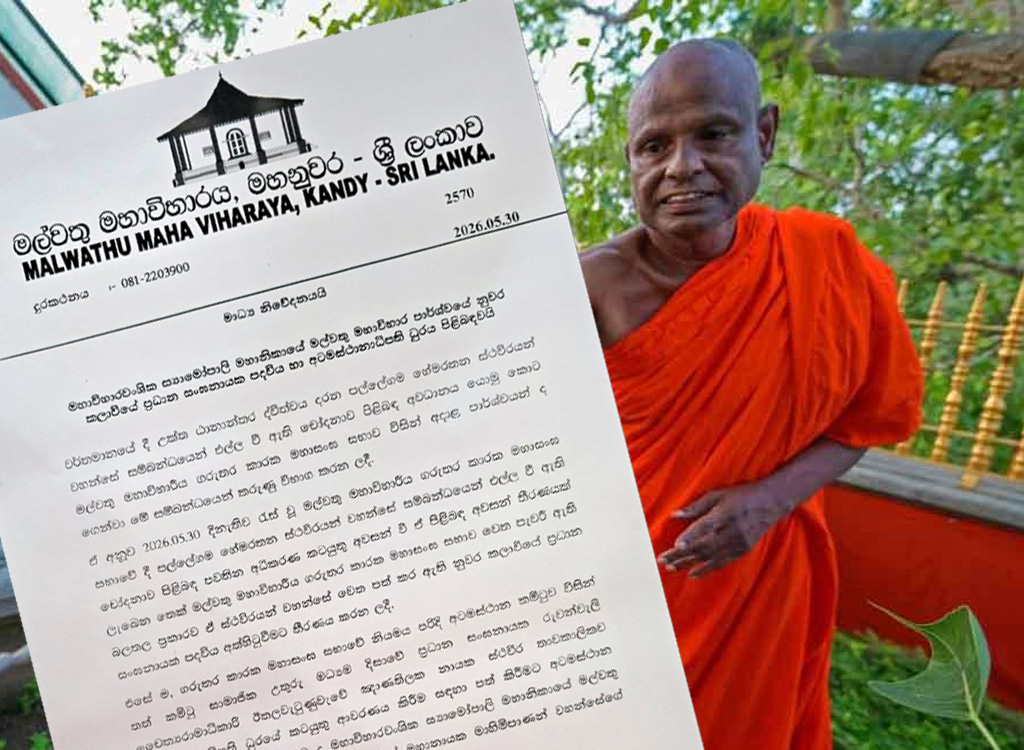
The Working Maha Sangha Council of the Malwathu Chapter has unanimously decided to temporarily suspend, with immediate effect, the title of Chief Sanghanayake of Nuwara Kalaviya previously conferred upon Ven. Pallegama Hemarathana Thera, citing the seriousness of allegations currently under judicial consideration.
The decision was announced in a special media statement issued on Saturday (30 May) under the signature of Ven. Pahamune Dharmakeerthi Sri Saranankara Sumangala Nayaka Thera, Secretary of the Malwathu Chapter, acting on the direct instructions of the Most Ven. Mahanayake Thero.
Ven. Hemarathana Thera, who serves as both Chief Sanghanayake of Nuwara Kalaviya and Atamasthanadhipathi of Anuradhapura, has recently been the subject of widespread public discussion following allegations of sexually abusing a minor that have attracted considerable media attention.
The Malwathu Chapter stated that it had conducted a detailed examination of the matter, including consultations with relevant parties, before reaching its decision.
According to the statement, the suspension will remain in effect until ongoing court proceedings are concluded and a final legal determination is reached.
The Sangha Council emphasised that the action was taken under the authority vested in it and was intended as a temporary measure pending the outcome of the legal process.
Interim appointment
In order to prevent disruption to the administration of the sacred Atamasthana institutions in Anuradhapura, the Atamasthana Committee has also moved swiftly to appoint an interim administrator.
The committee has selected Ven. Ethalawetunuwewe Gnanathilaka Nayaka Thera, a senior member of the Atamasthana Committee, Chief Sanghanayake of the North Central Province and Chief Incumbent of the Ruwanwelisaya, to temporarily oversee the duties of Atamasthanadhipathi.
The appointment is intended to ensure the uninterrupted management of the religious, administrative and ceremonial responsibilities associated with one of Sri Lanka’s most revered Buddhist institutions.
Defining moment
The proposed legal reforms and the unprecedented disciplinary action taken by the Malwathu Chapter have together placed the issue of accountability within the Buddhist clergy firmly at the centre of national discussion.
Supporters of the reforms argue that stronger disciplinary mechanisms are essential to preserve public confidence in the Sangha and protect the reputation of the Buddhist order. Critics, however, are expected to closely examine how any new powers are structured and implemented to ensure fairness, due process and respect for the autonomy of religious institutions.
As lawmakers, legal authorities and senior members of the Maha Sangha continue consultations, the coming months may prove pivotal in shaping a new framework for monastic governance in Sri Lanka – one that seeks to balance tradition, accountability and public trust.










Leave a comment