
By The Pulseline News Desk
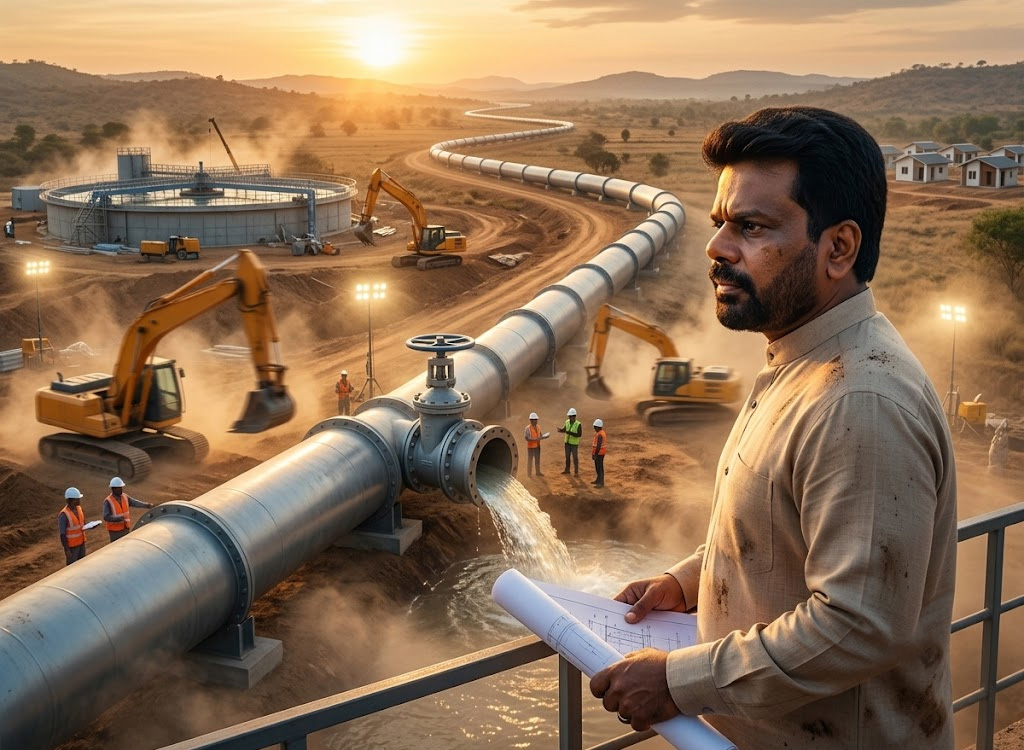
Access to safe drinking water has long remained an uneven reality across Sri Lanka, with thousands of rural families facing chronic shortages despite decades of investment in water infrastructure. Now, the government says it intends to tackle the issue through what it describes as the largest financial commitment ever made to the sector.
President Anura Kumara Dissanayake announced on Wednesday (8) that the 2027 Budget will prioritise long-term, sustainable solutions to the country’s drinking water challenges, with record allocations planned for projects aimed at expanding access to clean and reliable water supplies.
Speaking at the Presidential Secretariat during a progress review of projects funded under the 2026 Budget for the Ministry of Housing, Construction and Water Supply, the President said future investments must focus on lasting outcomes rather than temporary interventions.
Investing in essential infrastructure
The review examined the progress of several large-scale infrastructure projects expected to strengthen water security across the country.
Among the projects discussed were the Kandy-Northern Integrated Water Supply Project, the Greater Colombo Wastewater Management Project, the Ambatale Water Supply Project and the Anuradhapura-Northern Water Supply Project, all of which form part of broader efforts to improve water distribution, sanitation and urban infrastructure.
The President indicated that these initiatives would continue to receive priority as the government prepares the 2027 Budget.
For many communities, particularly in the dry zone, access to reliable drinking water remains closely linked to public health, agriculture and economic development, making investment in water infrastructure a key national priority.
Reforming public institutions
Alongside infrastructure spending, President Dissanayake called for structural reforms within the public sector, arguing that inefficiencies caused by overlapping institutions continue to place unnecessary pressure on state finances.
He instructed officials to identify and abolish agencies that no longer serve productive functions, saying public resources should be directed towards services that deliver tangible benefits to citizens.
The emphasis on institutional reform reflects the administration’s broader agenda of improving efficiency while reducing recurrent Government expenditure.
Housing and post-war resettlement
The discussion also extended beyond water infrastructure to two other major policy areas – housing and post-war resettlement.
The President instructed officials to accelerate programmes aimed at resettling communities displaced by Sri Lanka’s civil conflict, while also moving forward with assistance for low-income families whose houses remain only partially completed.
Officials reviewed the progress of the Government’s housing programme and examined budgetary provisions required to continue the initiative into 2027.
Housing assistance remains a significant challenge in many parts of the country, where rising construction costs have left thousands of low-income households unable to complete homes begun under earlier schemes.
Development and quality of life
The meeting underscored the Government’s effort to integrate infrastructure investment with broader social development objectives.
Improving access to safe drinking water, expanding sanitation services, supporting affordable housing and completing post-war resettlement are increasingly being viewed as interconnected priorities that directly influence public health, economic productivity and living standards.
By committing unprecedented funding to water infrastructure while seeking to streamline state institutions, the government is signalling a shift towards longer-term planning rather than short-term project implementation.
Whether the ambitious plans outlined for the 2027 Budget translate into faster project delivery and measurable improvements for communities will depend not only on funding but also on the effective coordination of agencies responsible for implementing some of the country’s largest public infrastructure programmes.











Leave a comment