
By The Pulseline News Desk
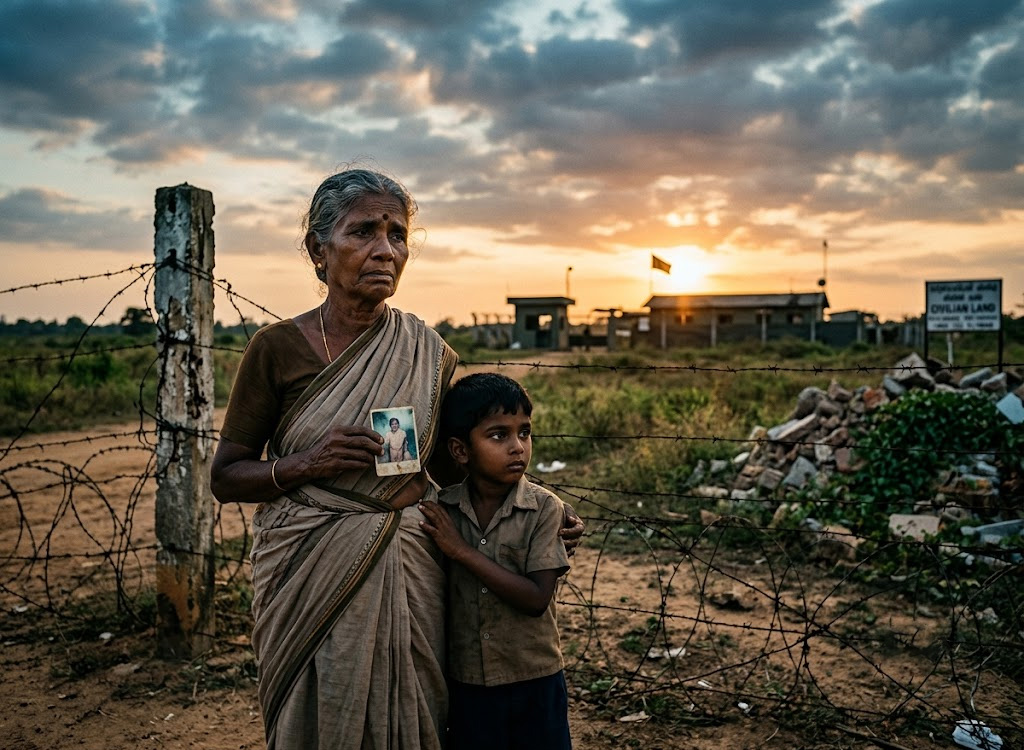
Seventeen years after the country’s civil war ended, the question of civilian lands occupied by the military remains one of the most visible symbols of the country’s unfinished reconciliation process.
Raising the issue in Parliament on Wednesday (8), Batticaloa District member of parliament (MP) Shanakiyan Rasamanickam urged the Government to accelerate the release of privately owned lands in the Northern and Eastern Provinces, arguing that communities displaced by the conflict have waited far too long to return home.
While welcoming the recent release of two military camps in Batticaloa, the opposition legislator maintained that progress has been uneven and insufficient to address longstanding grievances.
“The affected communities have waited long enough,” Rasamanickam told Parliament, calling on the Government to honour its election commitment to expedite land releases and facilitate permanent resettlement.
A lingering legacy of war
Although the country’s three-decade civil conflict ended in May 2009, thousands of acres of privately owned land continue to remain under military occupation, particularly in the Northern and Eastern Provinces where fighting was most intense.
Successive governments have returned portions of occupied land over the years, yet residents in several areas continue to stage protests demanding the restoration of their homes, livelihoods and places of worship.
For many families, the issue extends beyond property rights. It represents the ability to rebuild lives interrupted by decades of conflict and displacement.
Progress, but at a slow pace
Rasamanickam acknowledged the Government’s recent decision to release two military camps in Batticaloa following concerns raised at the Parliamentary Consultative Committee on Defence, chaired by President Anura Kumara Dissanayake in his capacity as Minister of Defence.
However, he argued that isolated land releases do not address the broader problem.
He said military deployment in civilian areas should be progressively reduced – except where there are genuine national security requirements – to levels comparable with the rest of the country.
According to the MP, continued military occupation undermines reconciliation efforts, delays resettlement and limits economic recovery in communities still recovering from the war.
Communities still waiting
The MP pointed to continuing peaceful protests in Palaly, Myliddy and Keppapilavu, where residents have for years demanded the return of lands acquired during the conflict.
He noted that the ruling National People’s Power (NPP) won a local government ward in Palaly largely on its promise to release civilian lands, arguing that voters now expect the Government to fulfil that commitment.
“The people who placed their trust in that promise now deserve to see it fulfilled,” he said.
Rasamanickam highlighted several unresolved cases that, he said, continue to affect hundreds of families.
In Myliddy, around 556 acres belonging to approximately 700 families remain under occupation. In neighbouring Palaly, another 556 acres owned by about 300 families have yet to be returned. He also cited land required for the expansion of the Karaichchi Public Library and the continued occupation of land belonging to the Iranamadu Agricultural Research Institute.
In Keppapilavu, he said 59.5 acres remain under military control, while displaced families have been provided with only temporary plots instead of being allowed to return to their original lands.
Rejecting claims that residents had been permanently resettled elsewhere, Rasamanickam said only a limited number of families had received temporary land allocations.
Calls for greater transparency
Beyond accelerating land releases, the MP urged the Government to provide Parliament with a comprehensive district-by-district account of lands still occupied by the military.
He called for details on the extent of land released since the current administration assumed office, together with a clear timetable for returning the remaining properties to their civilian owners.
Such information, he argued, would improve transparency and enable Parliament to monitor progress on one of the Government’s key reconciliation commitments.
A broader reconciliation challenge
Land restitution has long been regarded as a cornerstone of post-war reconciliation in Sri Lanka.
For displaced families, regaining access to ancestral lands is closely linked to restoring livelihoods, rebuilding communities and recovering a sense of normalcy after years of conflict.
While the Government has taken steps to release some occupied lands, the pace of implementation remains a source of frustration among affected communities and civil society organisations.
As Sri Lanka enters its 18th year of peace, the continued military occupation of civilian lands remains both a practical challenge and a powerful reminder that the legacy of the war has yet to be fully addressed.








Leave a comment