
By Vox Civis
Few governments in Sri Lanka’s modern history have landed in office with a stronger moral mandate or a more emphatic promise of economic competence than the National People’s Power (NPP). For years, its parent party, the Janatha Vimukthi Peramuna (JVP) built its political identity around the simple proposition that previous governments had failed because they were corrupt, incompetent, compromised, or indifferent to the suffering of ordinary people. The implication was equally clear. If only honest and capable people were placed in charge, Sri Lanka’s economic problems could be solved differently, better, and quickly too. Today, that elaborately constructed narrative is colliding head-on with reality.
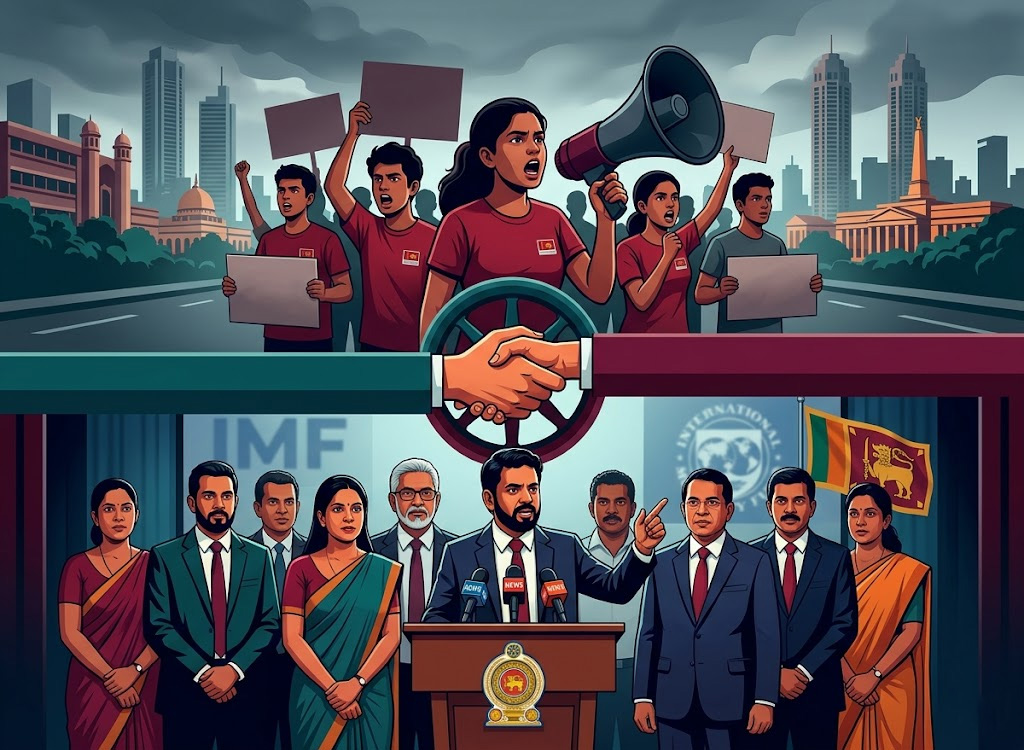
The current economic challenges confronting Sri Lanka have turned much of the NPP’s election campaign into a political boomerang from which it may struggle to escape. The party that spent the better part of its existence screaming from megaphones condemning governments over foreign policy, currency depreciation, food imports, foreign debt, International Monetary Fund (IMF) conditions, fuel pricing formulas, taxation, vehicle duties, the cost of living, and pretty much everything else, seem to be struggling to come to terms with the fact that they are now on the other side of the fence. Today the wheel has turned full circle and it is none other than the NPP that is defending the very same policies of previous regimes under the banner of ‘economic reality.’
This ongoing transformation is perhaps the most compelling political development of the country’s post-crisis period. For years, the political messaging was straightforward and emotionally persuasive: if the rupee depreciated, it was government failure; if taxes increased, it was anti-people; if rice had to be imported, it was betrayal; if fuel prices were adjusted according to a formula, it was evidence of surrendering sovereignty; if an IMF agreement was signed, it was portrayed as treason against the nation.
Dramatic change
But today, the vocabulary has changed dramatically. All of a sudden, fiscal discipline has become responsible governance. IMF conditionality has become necessary stability. Import controls have become economic protection. Currency management has become a delicate balancing exercise, which the regime has mastered. Long-term structural reforms now require patience and sacrifice. The list goes on. So, what changed?
The answer is not that economics suddenly became complicated after the NPP came to power. Economics was always complicated. Debt obligations existed before. Foreign reserve constraints existed before. IMF benchmarks existed before. Exchange rate pressures existed before. The difficult trade-offs between growth, inflation, taxation and fiscal stability existed before. For past governments, all of these had to be tackled while also dealing with a long drawn-out costly war, multiple insurrections, natural disasters like the tsunami and other exigencies like the global pandemic that cost the country dearly. Those past regimes hardly grumbled when it came to matters economic and got on with the job at hand.
The difference is that the NPP is now facing the music of governance for the first time and appears to be finding things rather overwhelming. Governance has delivered a painful but necessary crash course on the realities of reserves, debt repayments, fiscal discipline, external vulnerabilities, monetary policy, import management and macroeconomic stabilization. The loudest critics of what it called “system failure” are now discovering the hard way, how the system actually works, while the country braces for the fallout.
This is not to suggest that previous governments were beyond criticism. Far from it. Sri Lanka’s economic collapse in 2022 remains one of the most catastrophic policy failures in the country’s history. Mismanagement, corruption, policy inconsistency and political short-sightedness all contributed to that disaster. However, acknowledging those failures does not automatically erase contradictions in the present administration. A government can inherit a crisis and still be held accountable for the promises, narratives and slogans it used to gain power.
Familiar explanations
The central political problem confronting the NPP today is not that economic recovery has become difficult. The problem is that it spent decades arguing that economic recovery was simple – something that could even be done in six months, to quote the current leadership during the campaign trail. For years, the JVP and later the NPP implied that previous governments failed primarily because of corruption, incompetence or betrayal. Rarely was there acknowledgment that economic management involves difficult trade-offs, unpopular decisions, IMF pressures, debt servicing obligations, reserve shortages and external shocks. Now suddenly, the explanations sound remarkably familiar.
These days the government speaks of system constraints. It speaks of global realities, of long-term recovery, and of difficult but necessary reforms. It is asking citizens to be patient while structural adjustments take effect. These are precisely the arguments previous governments made when implementing painful economic measures. The irony, therefore, is impossible to ignore.
Institutions that were previously portrayed as instruments of foreign influence are being cited as validators of sound economic management. Fiscal discipline that was routinely condemned as neoliberal orthodoxy is being celebrated as responsible governance. IMF compliance denounced as surrender is being presented as proof of credibility.
But nothing illustrates this transformation more clearly than Sri Lanka’s continuing IMF programme. The IMF’s latest assessment presents a sobering picture. While approving another tranche of approximately US$ 695 million under Sri Lanka’s Extended Fund Facility (EFF) programme last week, the IMF simultaneously warned that the country’s recovery is beginning to lose momentum.
Sharp drop in growth
The institution projects economic growth to slow sharply from 5 percent in 2025 to just 3 percent in 2026. The reasons however, are not entirely domestic. Rising global oil prices, the continuing conflict in the Middle East, disruptions to tourism earnings and the aftermath of Cyclone Ditwah have all complicated Sri Lanka’s recovery trajectory, coupled with governance inertia.
According to IMF Deputy Managing Director Kenji Okamura, higher oil prices will increase inflation while weakening the current account. Lower tourism earnings are expected to add further pressure while the uncertainty surrounding the duration and intensity of geopolitical instability in the Middle East continues to cast a shadow over the country’s outlook.
Yet, what is particularly significant is that despite these concerns, the IMF continues to describe Sri Lanka’s programme implementation as generally strong. In other words, the government is largely continuing the same broad economic stabilization framework established under the previous Ranil Wickremesinghe administration. This fact matters politically because it reinforces the reality that many voters are beginning to recognize, that there was never a radically different economic path readily available.
The Economic Transformation Act passed in 2024 provides perhaps the strongest evidence of this continuity. The legislation was arguably the most consequential economic law enacted in Sri Lanka since the crisis. Enacted during the last stages of the Wickremesinghe led administration, the Act sought to lock future governments into a long-term framework for debt sustainability, fiscal discipline and structural reform. Its purpose was straightforward; Sri Lanka’s economic recovery could not be left vulnerable to election cycles and changing political preferences. Therefore, key recovery targets were codified into law.
Keeping to the roadmap
The Act mandates reducing public debt below 95 percent of GDP by 2032. It establishes ceilings on gross financing requirements. It sets limits on foreign debt servicing obligations and requires annual economic growth of at least 5 percent by 2027. It seeks to reduce multidimensional poverty while transforming Sri Lanka into an export-driven economy capable of attracting significant foreign investment. This Act, basically sets the economic targets any subsequent government must strive to achieve.
The legislation also created entirely new institutional structures aimed at increasing competitiveness, productivity and investment attraction. In effect, it represents an attempt to legally bind future governments to a reform path consistent with IMF objectives and long-term economic sustainability.
Yet, reality has intervened. The IMF’s latest projections indicate that Sri Lanka is unlikely to meet some of the medium-term benchmarks envisioned under the Act, at least in the immediate future. Growth is expected to slow to 3 percent rather than move toward the targeted 5 percent trajectory. Import restrictions have reappeared despite commitments to greater openness and fiscal targets are being temporarily softened to accommodate emergency spending associated with external shocks and disaster recovery.
However, this does not necessarily indicate policy failure. What it demonstrates is something more important: laws cannot legislate away economic reality. The Economic Transformation Act can establish ambitious targets, but it cannot control wars in the Middle East, prevent global oil price spikes and cannot stop climate-related disasters. It cannot guarantee tourism inflows either.
Fundamentals intact
The gap between statutory ambition and economic reality reflects the limitations of policy rather than the failure of the reform programme itself. Indeed, the IMF’s willingness to release another US$ 695 million last week suggests that the foundational direction remains intact despite short-term setbacks. Yet the challenges ahead remain formidable.
One of the most politically sensitive issues involves the government’s temporary subsidy programme. Faced with soaring global energy prices and the economic consequences of Cyclone Ditwah, authorities introduced an emergency relief package worth approximately Rs.100 billion. The programme includes fuel support, electricity assistance, fertilizer subsidies and expanded Aswesuma welfare payments.
The measure provides temporary relief, but it also highlights a fundamental dilemma confronting every Sri Lankan government; how does a country emerging from sovereign default balance immediate human suffering against long-term fiscal sustainability? The IMF’s position is clear. Temporary assistance is acceptable but permanent subsidies are not. Once the Rs.100 billion ceiling is exhausted, the expectation is that Sri Lanka will return to cost-reflective pricing mechanisms.
That Rs. 100 billion cushion is fast depleting and the transition will be painful. Fuel prices could once again rise significantly in the near term. Consequently, transport costs will increase and food prices will come under pressure. Farmers and fishermen will face higher production costs. Welfare recipients may find themselves confronting higher inflation with reduced assistance. For ordinary citizens, these adjustments will be felt deeply.
Yet from a macroeconomic perspective, the alternative is equally dangerous. Subsidies financed through borrowing contributed significantly to the distortions that eventually culminated in the 2022 crisis. The IMF’s insistence on fiscal discipline is intended to prevent Sri Lanka from repeating that cycle. The problem however in this instance is that fuel has allegedly been purchased at exorbitant costs and coal purchases to generate electricity have been found to be inferior, leading to more coal being used for power generation while the output deficit is being covered through thermal generation. Both of which are costing the exchequer dearly.
Monetary policy shock
This brings us to another difficult reality now confronting the government’s monetary policy. The Central Bank’s decision to raise its benchmark policy rate by 100 basis points to 8.75 percent represents one of the most aggressive tightening measures since the height of the economic crisis. The rationale, however, is understandable. Inflation has accelerated and the rupee has come under severe pressure while global energy prices have increased dramatically. Currency stability has obviously become a priority.
Higher interest rates help reduce excess liquidity, discourage speculative behaviour and support the exchange rate. Indeed, following the rate hike, the rupee stabilized after experiencing significant depreciation pressures. That stability however appears to have been short-lived with the rupee losing ground once again on Friday (29).
But monetary policy always involves trade-offs. While higher rates may support the currency, they also slow economic activity. Businesses will now face higher borrowing costs, consumers will likely reduce spending, investment decisions may be postponed, all leading to weakened economic growth. In essence, policymakers have chosen to sacrifice short-term growth in order to preserve macroeconomic stability.
This is not unique to Sri Lanka. To be fair, it is standard economic practice. Yet it is also precisely the type of decision that opposition politicians traditionally criticize and governing politicians eventually defend. That pattern – which the JVP/NPP thrived on in the past – is now unfolding before the public in real time. This is why it can be said that the broader lesson emerging from Sri Lanka’s current situation extends beyond the fortunes of any individual government, for it concerns the nature of political accountability itself.
For too long, Sri Lankan politics has been dominated by simplistic explanations for complex problems. Every crisis was attributed to corruption, every unpopular policy was portrayed as betrayal, and every economic difficulty was presented as evidence of incompetence, mostly by the very party that is now in office.
Difficult trade-offs
Corruption certainly matters. Competence matters. Governance quality matters. But economics is not governed solely by morality. A government can be honest and still confront impossible trade-offs. A government can be competent and still face external shocks. A government can possess good intentions and still be forced to implement unpopular measures.
The JVP/NPP is now learning this lesson in the harshest possible environment: while managing a post-default economy amid geopolitical instability, climate-related disruptions and ongoing IMF oversight. Therefore, the challenge is not simply economic, it is also political. The party must explain why policies it routinely condemned are now being steadfastly defended. It must explain why IMF conditions it rejected as recently as in August 2024 are suddenly being embraced. It must explain why taxes remain high, why fiscal discipline remains necessary, why subsidies cannot continue indefinitely and why economic recovery requires patience.
In short, it must reconcile governing reality with opposition rhetoric. That is not an easy task for any political party, least of all the JVP/NPP. The coming months will determine whether the JVP/NPP can successfully make that transition. If it can, it may evolve into a mature governing force capable of balancing ideals with pragmatism. If it cannot, it risks becoming another example of a political movement that spent decades criticizing problems it never really understood.
All things considered, Sri Lanka’s recovery remains fragile but intact, for now. The IMF programme continues and foreign reserves are projected to improve, albeit slower than anticipated. Structural reforms are moving forward, although haphazardly, consolidating the foundation laid during the stabilization period.
The country’s long-term success will depend not merely on meeting numerical targets or securing IMF disbursements. It will depend on whether political leaders can finally abandon the comforting fiction that economic management is easy. The greatest irony is that the JVP/NPP’s most important economic education – radically pivoting away from its Marxist roots – did not come from opposition benches, campaign platforms or ideological manifestos, but from governing. And that education is proving far more expensive than any election promise ever suggested.
Disclaimer: The views and opinions expressed in this article are those of the writer and do not necessarily reflect the official position of this publication.








Leave a comment