
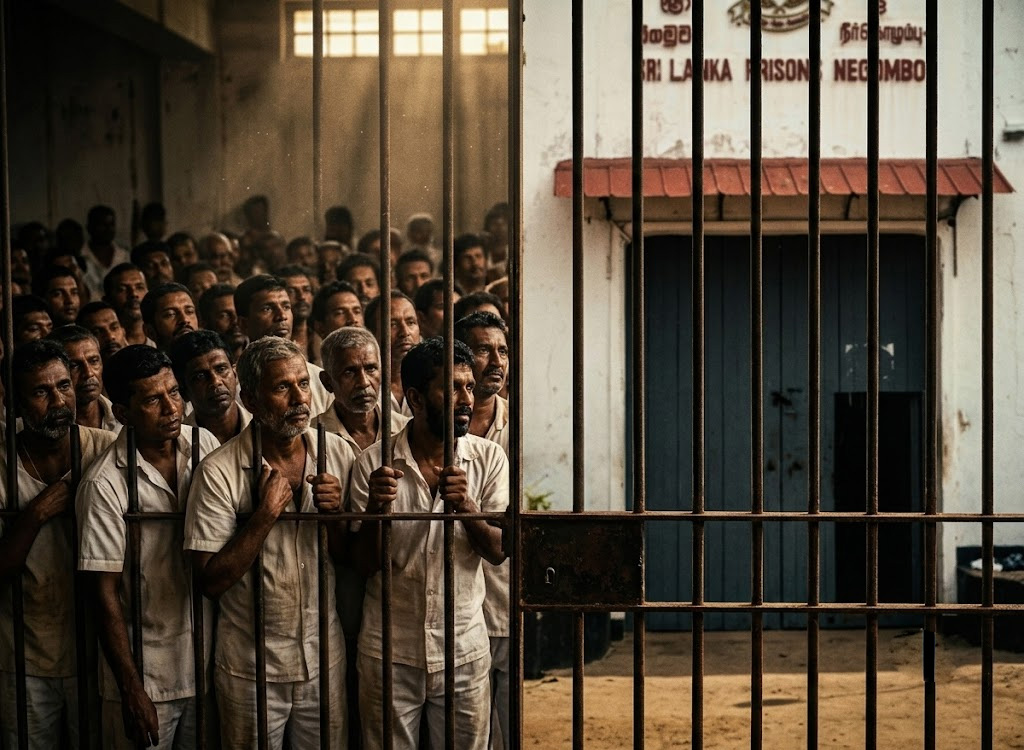
Official prison statistics reveal that poverty, not just crime, is driving prison overcrowding, with unpaid fines, drug offences and repeat offenders placing growing pressure on Sri Lanka’s correctional system
By The Pulseline News Desk
Sri Lanka’s overcrowded prison system is increasingly being shaped by poverty, with official statistics showing that tens of thousands of people are imprisoned each year simply because they are unable to pay court-imposed fines.
An analysis of annual Prison Department reports from 2013 to 2023 reveals that fine defaulters consistently account for more than half of all convicted admissions, highlighting the extent to which financial hardship contributes to incarceration.
The findings, published in the media, show that in 2023 alone, 31,822 people were admitted to prison after failing to pay fines imposed by the courts. They accounted for 67.8% of all convicted admissions that year, making unpaid fines one of the leading causes of imprisonment in the country.
The trend has remained largely unchanged over the past decade. Even during the COVID-19 pandemic, when overall prison admissions declined, the proportion of fine defaulters reached its highest level, accounting for 73.8% of convicted admissions in 2020.
Poverty and imprisonment
The statistics also point to a strong link between poverty and imprisonment. Prison records indicate that many inmates come from extremely low-income households, with a significant number reporting monthly earnings below Rs. 3,000 or no income at all. The data suggest that many offenders are jailed not because they committed serious crimes, but because they lack the means to settle relatively small financial penalties.
The figures further reveal what observers describe as a “revolving door” prison system. In 2023, nearly 20,000 convicted prisoners – 19,756 to be exact – were released after eventually paying their fines. This means thousands of people enter already overcrowded prisons, remain in State custody for varying periods and are released once the fines are settled, placing additional strain on prison resources and public finances.
Overcrowding
The latest available Prison Department report paints a grim picture of overcrowding. Although Sri Lanka’s prisons have an authorised capacity of just 10,395 inmates, the average daily prison population stood at 27,562 in 2023, resulting in an occupancy rate exceeding 265%.
Drug-related offences
While poverty continues to drive a significant portion of prison admissions, drug-related offences have emerged as the fastest-growing category of convicted prisoners. Convictions for narcotics offences nearly tripled over the past decade, rising from 10,448 admissions in 2013 to 29,192 in 2023.
Cannabis and heroin accounted for the overwhelming majority of these cases, representing nearly 90% of all convicted drug admissions. The data also reveal that repeat offenders dominate this category, with almost two-thirds of those imprisoned for drug offences in 2023 having previous convictions or having served prison sentences before.
The statistics suggest that imprisonment alone has done little to break the cycle of repeat offending, particularly among younger offenders from disadvantaged educational and economic backgrounds. Most convicted drug offenders are between 22 and 40 years old, while the majority left school before completing Grade 10.
Remand prisoners
Remand prisoners continue to account for nearly three-quarters of Sri Lanka’s prison population. Although more than 138,000 people entered the remand system in 2023, many spent relatively short periods in custody. Nearly half were released within a month through bail or other legal processes, helping to prevent prison populations from rising even further.
However, prolonged detention remains a concern. More than 3% of remand prisoners had remained in custody for over two years in 2023, while a smaller number had spent more than three years awaiting the conclusion of their cases.
The offence profile also reflects changing trends in Sri Lanka’s criminal justice system. Drug offences remained the single largest cause of imprisonment, accounting for more than 62% of all convicted admissions in 2023. Property offences – including theft, burglary and housebreaking – formed the second-largest category, followed by illicit liquor-related offences.
Meanwhile, serious crimes such as murder, grievous assault and sexual harassment accounted for comparatively few convicted admissions during the year.
The statistics also reveal a troubling gap in child protection cases. While convictions for child abuse-related offences remained relatively low, prison records show dozens of suspects continued to be held on remand for offences including child pornography, the sale of children and using children for drug trafficking, suggesting that many of these cases remain before the courts.
Criminal justice policies
The findings have renewed debate over Sri Lanka’s criminal justice policies, with legal experts and prison reform advocates arguing that expanding alternatives to imprisonment, improving access to legal aid and reviewing the use of custodial sentences for fine defaulters could significantly ease overcrowding while reducing the financial burden on the State.
As pressure mounts on Sri Lanka’s correctional system, the latest prison statistics suggest that addressing overcrowding will require more than expanding prison capacity. They point instead to broader reforms aimed at tackling poverty, reducing repeat offending and ensuring imprisonment remains a last resort rather than a consequence of financial hardship.













Leave a comment