
By Vox Civis
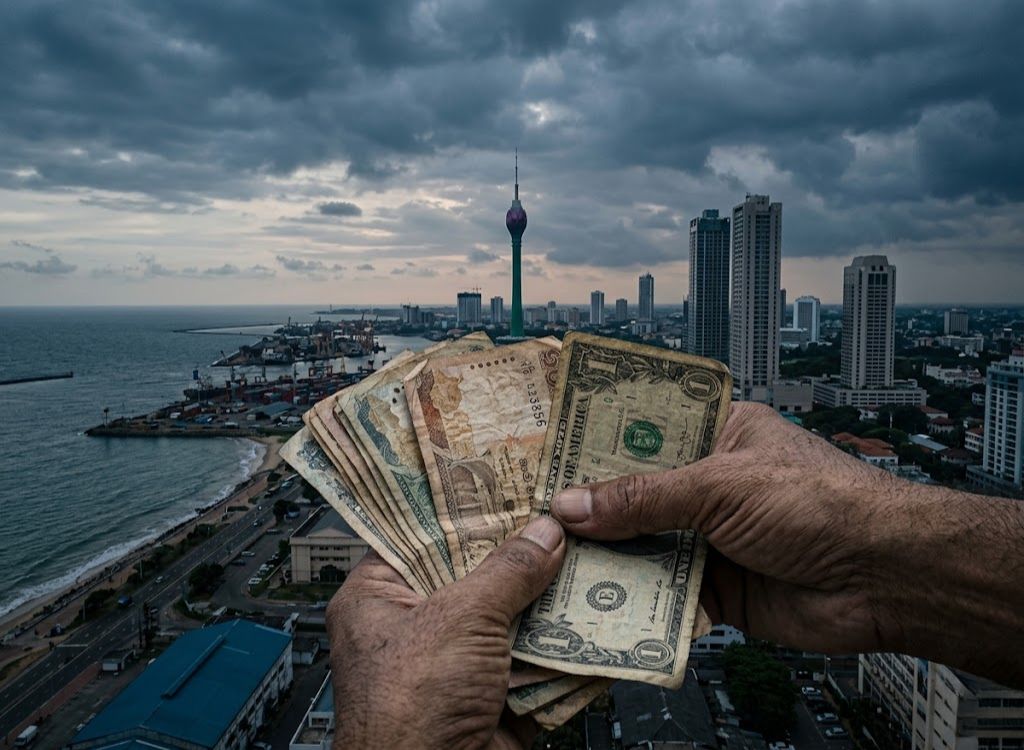
When the Sri Lankan rupee depreciated to near record-breaking levels last week, touching around Rs. 354 against the U.S. dollar, a prominent government minister offered what may become one of the defining responses of the governing National People’s Power (NPP) regime. When asked how the exchange rate would be brought down to more manageable levels, Deputy Finance Minister Dr. Anil Jayantha did not point toward domestic reforms, industrial policy, export expansion, productivity improvements, or structural transformation as one would have expected. Instead, he pointed toward money expected to arrive from abroad – money that was promised since last December but yet to materialise.
According to him, the combined fifth and sixth tranches under Sri Lanka’s ongoing International Monetary Fund (IMF) programme would bring approximately USD 700 million into the country, while multilateral institutions and affiliated development partners were expected to provide an additional USD 200 million or so for development and reform projects. After more than one and a half years of NPP governance, the Deputy Minister’s expectation was that these inflows would strengthen foreign exchange availability and calm the market. For the record, the IMF has indeed reached a staff-level agreement that could unlock around USD 700 million upon Executive Board approval.
The problem is not whether this money arrives – it should have months ago. The problem is that this appears to be the only remedy currently visible on the table. The statement is important not because the Deputy Minister is wrong; the funds will provide breathing space, but the more important question is why, thus far, that appears to be the principal solution on the table. Because if the immediate answer to a weakening currency is yet another incoming foreign lifeline, then Sri Lanka may have stabilized itself financially without fundamentally strengthening itself economically. This is the dilemma now confronting the country.
Unaddressed structural weaknesses
IMF support and selective restrictions on imports may provide temporary relief, but neither addresses the deeper structural weaknesses that created Sri Lanka’s vulnerabilities in the first place. Sustainable stability comes from stronger value-added exports, diversified foreign exchange earnings, productive industries, healthy external reserves, and consistent long-term policy direction. Economies do not become resilient by surviving one crisis after another by depending on the bailouts of bilateral agencies. They become resilient by reducing their dependence on the forces that repeatedly create those crises.
Yet dependence appears to be the recurring theme of Sri Lanka’s recovery story. Dependence on tourism. Dependence on worker remittances. Dependence on imports. Dependence on external financing. Dependence on IMF programmes. Most strikingly, dependence on the very institution that the ruling NPP spent years condemning.
Sustainable recovery demands productive industries. It requires competitiveness and confidence. And confidence today may be the most fragile commodity in Sri Lanka. Given the Deputy Finance Minister’s remedy for the depreciation woes, many analysts increasingly argue that the present concern is not simply about the rupee’s slide. It is about whether the governing establishment itself still possesses a coherent economic vision; and the more fundamental question of whether it has the capacity to deliver what it promised.
The NPP government came into office promising a grandiose vision and quick delivery. Its extensive manifesto presented an ambitious framework of economic transformation built around self-sufficiency and domestic capability. It argued repeatedly that Sri Lanka could build a home-grown economic model without dependence on external institutions. People invested their votes in that promise.
No reasonable citizen expects miracles overnight. After all, governments inherit realities they did not create and economic crises cannot be repaired in a matter of months. But exactly one-third of the NPP’s term has now passed, and while no one expects completion, people do expect direction. And, direction remains difficult to identify, which is what constitutes the root cause for the growing concern.
From criticism to dependence
Instead, what appears increasingly visible is dependence on the very institutions that the JVP and NPP spent decades criticising. The irony cannot be dismissed that easily because the IMF has consistently been portrayed by the very party as the architect of Sri Lanka’s suffering and external domination. However, once in government, the same IMF appears indispensable to the administration’s own economic survival.
Opposition Leader Sajith Premadasa recently warned that growing concerns over the economy should not be treated as a partisan issue and called for a broader national response to warning signs surrounding the rupee and the wider economy. President Anura Kumara Dissanayake responded by assuring the public that Sri Lanka would not return to a crisis similar to 2022, while arguing that many present difficulties stem largely from external factors, including tensions in the Middle East.
There is merit to that argument. External shocks are real and rising global oil prices affect every oil-importing nation while regional instability affects tourism flows. Stronger US monetary conditions appear to be influencing emerging-market currencies and Sri Lanka is not operating in isolation. But external factors alone cannot explain domestic vulnerabilities. A rapidly weakening rupee, rising living costs, declining purchasing power and increasing dependence on external financial support raise painful questions regarding whether sufficient use has been made of the breathing space offered by the IMF programme since the NPP took office 18 months ago.
Sri Lanka’s recovery strategy, according to critics, made one major assumption: that macroeconomic stability itself would eventually generate broader economic strength. But stability and growth are not identical concepts. The IMF programme unquestionably succeeded in restoring a degree of macroeconomic order after the catastrophic collapse of 2022. Foreign reserves improved, inflation initially moderated, debt restructuring progressed, and international confidence partially returned. However, critics argue that these gains came with significant costs.
Multiplying debt
Sri Lanka remained heavily exposed to global dollar movements while operating under a largely market-driven exchange framework. As the US dollar strengthened internationally, pressure on the rupee intensified. The effects are now visible. Businesses dependent on imported raw materials faces increasing costs while families have been forced to absorb price increases in food, medicine, fuel and essential goods.
A weaker rupee is not merely a financial statistic. It means billions more in debt repayments when measured in local currency terms. It means fuel is becoming more expensive. It means electricity costs are rising. It means milk powder, rice, sugar, onions, potatoes, canned fish, garlic and countless other essentials becoming more difficult to afford. For citizens on fixed incomes, exchange-rate fluctuations become kitchen-table realities.
Meanwhile, reserve rebuilding itself creates a complicated paradox. The Central Bank, under IMF programme requirements and debt repayment pressures, continues accumulating reserves by purchasing dollars from the domestic market. As reserves rise, rupees enter circulation. Some analysts argue this itself can exert downward pressure on the exchange rate. More critically, investor confidence also remains uncertain. While macroeconomic indicators have improved compared with 2022, foreign inflows into government securities and equity markets remain weak. These are not isolated factors. They reinforce one another.
Some critics argue that Sri Lanka’s recovery strategy itself contains a structural flaw. They suggest that the country maintained excessive dependence on a dollar-centric framework while ignoring alternative currency arrangements more aligned with emerging regional realities. India and China are now among Sri Lanka’s largest trading partners, lenders and investors. Yet Sri Lanka continues functioning overwhelmingly through a dollar-based system.
New settlement arrangements
Critics ask why policymakers never seriously explored diversified settlement arrangements involving the Indian rupee, Chinese yuan or broader basket frameworks. Such arrangements are not theoretical fantasies. Kuwait operates through a currency basket. Morocco uses a euro-dollar arrangement. China references basket structures in managing its currency. The IMF itself recognises such systems.
Yet Sri Lanka has pursued a strategy heavily centered on dollar stability and market-based exchange management. The criticism is not necessarily that the IMF programme itself was wrong. Without IMF intervention, Sri Lanka almost certainly would have faced deeper economic collapse after the country had defaulted on debt and had lost credibility internationally.
The IMF programme helped restore stability. It supported reserve rebuilding and improved fiscal discipline. Growth strengthened and reserves rose to around USD 7 billion by March 2026. But critics increasingly ask whether stabilisation came at the expense of economic sovereignty. Critics argue that Sri Lanka missed an opportunity to build a framework more suited to emerging regional realities. Others counter that there was no realistic alternative after sovereign default because international credibility needed restoration and confidence needed rebuilding. That argument also carries weight. But the deeper question remains unresolved: was Sri Lanka rescued financially only to become more vulnerable monetarily?
Rising global crude prices have increased demand for dollars. Imports have expanded faster than exports. Vehicle imports surged following the easing of restrictions while tourism, which was expected to be a major stabilizing force, has weakened amid global instability. Foreign investor sentiment remains cautious and capital outflows continue to exert pressure. Some analysts also argue that reserve rebuilding measures themselves may create temporary exchange-rate pressures. Many of these factors are understandable individually; collectively they become dangerous.
Recent market movements also reveal something important about confidence. The expectation of approximately USD 700 million in IMF funds itself appears to have shifted market behaviour. If market participants believe substantial inflows are imminent, banks and private holders may sell dollars at elevated prices while importers delay purchases in anticipation of future declines. Consequently, supply rises and demand falls leading to a temporary improvement in the exchange rate as witnessed on Friday (22). But this is essentially psychology, and not structural strength as made out to be.
Noting the distinction
A currency becoming stronger because markets expect assistance is fundamentally different from a currency becoming stronger because the economy itself is generating value. And this distinction matters. The Governor of the Central Bank says he is not directly responsible for currency depreciation while others are distancing themselves from various economic controversies. Meanwhile the President, who usually engages actively on public issues, has remained comparatively restrained on these recent concerns.
Businesses dependent on imported inputs are struggling with price volatility. Small and medium enterprises remain squeezed between borrowing costs and weakened demand as pointed out by the opposition in parliament last week. Families who barely survived the collapse of 2022 are once again watching their purchasing power erode.
The deeper issue seems to be over-dependence. Over-dependence on the dollar, on imports, on external prescriptions, and on reserve management rather than production. A weaker rupee is therefore not merely an exchange-rate problem, it is also a production problem, an export problem, an investment problem, and a governance problem. And perhaps most importantly, it is a confidence problem; one that the NPP appears to be struggling with.
There is another uncomfortable irony in all of this. No recent government has inherited conditions as politically favourable as those enjoyed by the NPP today. There is no civil war, there is no pandemic, there are no Easter bombings and there are no mass daily protests paralysing the country. Previous governments governed amid these extraordinary crises. But this administration inherited relative calm. Yet relative calm has not necessarily translated into transformative momentum.
There was a time when the IMF was portrayed as unnecessary, harmful and even exploitative. Seminars were held arguing that the economy could be fixed without external intervention. Promises were made of dramatic price reductions and fundamentally different economic outcomes. Today the same institution has effectively become indispensable to the very party that routinely condemned it; the uncomfortable reality of governance itself.
Fundamental difference
Being in opposition and being in government are fundamentally different exercises. Opposition allows the luxury of identifying problems. Governance demands solutions. Reality rarely respects campaign rhetoric. Today, notwithstanding the latest crisis, the NPP remains obligated to debt repayments while fiscal space remains constrained and external pressures remain unavoidable. To be fair, there are signs of movement on accountability and anti-corruption measures. But those initiatives will ultimately be judged not by announcements but by consistency.
Given this backdrop, there are also questions for the opposition. Merely conducting meetings or creating images of activity without presenting a coherent alternative could become counterproductive. People increasingly expect the opposition not merely to criticise but to produce an alternate, workable economic framework of its own and work towards implementing it. Otherwise, the accusation of being “talkers rather than doers” may eventually apply equally across the political spectrum. Sri Lanka ultimately requires more than arguments between continuity and criticism. It requires a credible governing alternative.
Speaking in Parliament recently, Sajith Premadasa urged the government to consider moving toward a successor IMF programme after the current arrangement concludes in March 2027. That possibility carries immense symbolism. The IMF has entered Sri Lanka repeatedly over the past decades. Yet many previous programmes never ran their full course. They were abandoned midway when temporary improvements appeared.
IMF legacy
If this programme completes successfully, it would itself be a historic development. If Sri Lanka subsequently enters another IMF successor programme under a Marxist administration that spent decades condemning the institution, history may record an irony that is impossible to ignore.
But beyond irony lies a more serious question. The IMF is not a charity organisation, neither is it a development agency. For practical purposes it is a lender of last resort. Its role is to restore stability and creditor confidence. It cannot build Sri Lanka’s productive economy. It cannot create export industries. It cannot reduce import dependence. It cannot design long-term national development strategy. That responsibility belongs entirely to the government of Sri Lanka.
The real question therefore is not whether the IMF is right or wrong or whether the Central Bank Governor is right or wrong. The real question is whether Sri Lanka used the breathing space provided by the IMF to build a stronger economy, or whether it merely bought time until the next shock arrived. Surviving and recovering after all, are not the same thing. And the distinction between those two words may determine Sri Lanka’s future.
Disclaimer: The views and opinions expressed in this article are those of the writer and do not necessarily reflect the official position of this publication.









Leave a comment