
By Chanakya
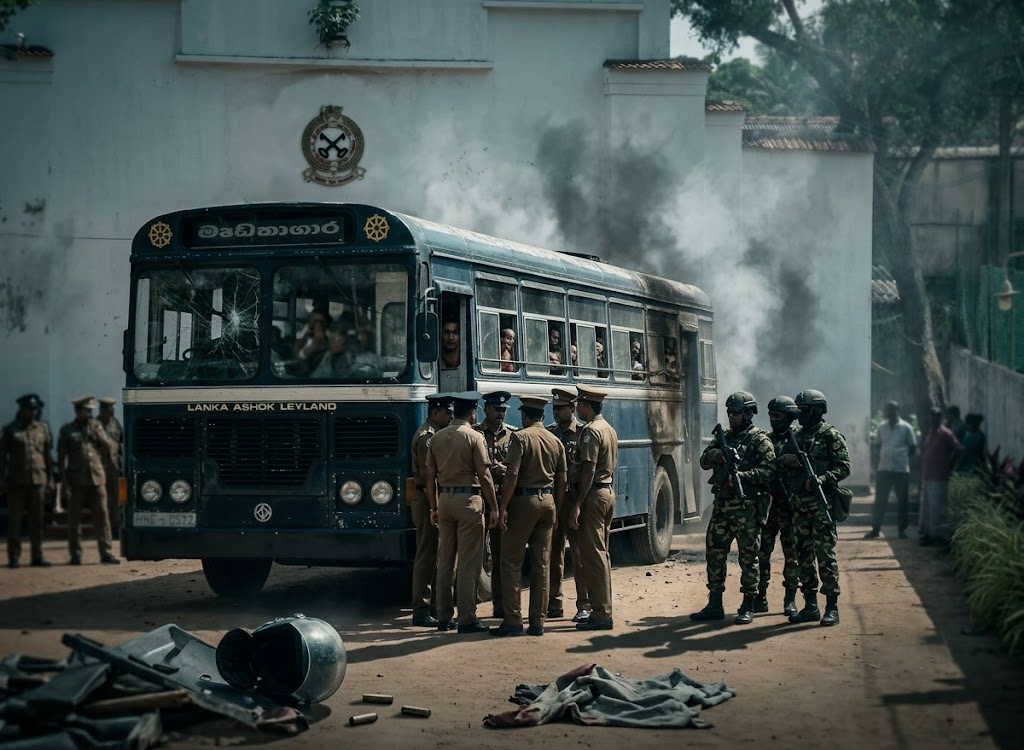
The bloodshed at Negombo Prison is more than a security failure. It is a national tragedy that has laid bare the consequences of years of neglect within Sri Lanka’s prison system and raised uncomfortable questions about accountability, governance and the state’s ability to manage one of its most fundamental responsibilities – the custody and protection of those behind bars.
With at least 25 people dead, including five prison officers and 20 inmates, and close to 100 others injured, the violence ranks among the deadliest prison disturbances in the country’s recent history. While authorities have succeeded in restoring order, the political and institutional consequences of the incident are only beginning to unfold.
Pressure build-up
The immediate trigger appears to have been an alleged prison break attempt that escalated into a deadly confrontation. Yet few observers believe the tragedy can be explained by that event alone. What happened inside Negombo Prison reflects pressures that have been building for years within a correctional system operating far beyond its limits.
The numbers alone illustrate the scale of the problem. Prisons built to accommodate around 11,000 inmates are currently holding nearly 40,000 prisoners. Human rights groups have long warned that some institutions are operating at more than 300 percent capacity, with prisoners sleeping in shifts or beside toilets due to a severe shortage of space.
Under such conditions, maintaining discipline, protecting lives and ensuring rehabilitation become increasingly difficult. Overcrowding is not simply a humanitarian concern; it is also a security risk. A prison that functions well beyond its intended capacity becomes vulnerable to violence, organised criminal activity and breakdowns in authority.
Delayed prison reforms
For successive governments, prison reform has remained an issue frequently acknowledged but rarely prioritised. Political attention has often focused on high-profile criminal cases or isolated incidents, while deeper structural issues, including ageing infrastructure, prolonged pre-trial detention, limited rehabilitation programmes and staffing shortages, have received comparatively little sustained action.
The Negombo tragedy has therefore become a moment of political reckoning.
Opposition Leader Sajith Premadasa was quick to place responsibility squarely on the government, arguing that the incident demonstrated failures in prison administration, governance and law enforcement. His demand for an independent investigation reflects broader public concerns about whether any inquiry conducted solely within government structures will command public confidence.
Accepting responsibility
In contrast, Justice Minister Harshana Nanayakkara adopted a markedly different tone.
Speaking after the violence, the Minister said he was deeply shocked and saddened by the loss of life and acknowledged that, as the minister responsible for the prison system, he must accept responsibility.
In Sri Lankan politics, such admissions are relatively uncommon. Ministers often respond to crises by emphasising institutional failures beneath them or by attributing blame elsewhere. Nanayakkara instead chose to publicly recognise ministerial responsibility while expressing condolences to the families of those who died.
However, accepting responsibility carries expectations that extend beyond expressions of regret.
The Minister has promised a thorough investigation and has said his priority is to establish the facts and ensure that such an incident never occurs again, rather than focusing on assigning blame.
Those commitments now create a benchmark against which both the government and the Ministry of Justice will be judged.
The challenges ahead
The first challenge is establishing precisely what occurred inside Negombo Prison. Questions remain about the sequence of events, the circumstances that led to the use of lethal force, the adequacy of prison intelligence, and whether earlier warning signs were missed following the previous day’s violence between remand and convicted prisoners.
The second challenge is institutional reform.
If investigations conclude only by identifying individual failings without addressing systemic weaknesses, the opportunity created by this tragedy may be lost.
Prison overcrowding is not a problem that can be solved through emergency inmate transfers alone. Moving prisoners from one overcrowded facility to another may temporarily ease tensions but does little to resolve the underlying imbalance between prison capacity and inmate numbers.
Meaningful reform requires a broader conversation about criminal justice policy.
Alternative sentencing for minor offences, faster court proceedings to reduce prolonged remand detention, expanded rehabilitation programmes, improved prison infrastructure and better support for correctional officers all deserve renewed attention.
The debate also extends beyond prison walls.
Sri Lanka’s criminal justice system functions as an interconnected chain. Delays in investigations, court proceedings and appeals contribute directly to overcrowding. Without reforms throughout the justice system, prison administrators will continue to struggle with populations that exceed available capacity.
The political response in the coming weeks will therefore be as significant as the investigation itself.
Moving beyond politics
If the tragedy becomes another partisan confrontation between government and opposition, public attention may shift away from the deeper structural reforms that experts have advocated for years.
Conversely, if the government follows through on promises of transparency and meaningful reform, the events at Negombo could become a catalyst for long-overdue changes to a prison system that has operated under sustained pressure for decades.
The deaths at Negombo Prison cannot be undone. The grief experienced by families of both prison officers and inmates cannot be erased.
What remains within the government’s control is how it responds.
Justice Minister Nanayakkara’s acknowledgment of ministerial responsibility is an important first step. Whether it becomes a defining moment of political accountability – or merely another statement made in the aftermath of a national tragedy – will depend entirely on what follows.
For Sri Lanka, the challenge is no longer simply explaining how the violence occurred. It is demonstrating that the lessons learned will produce reforms substantial enough to prevent the next prison tragedy before it begins.
Disclaimer: The views and opinions expressed in this article are those of the writer and do not necessarily reflect the official position of this publication.













Leave a comment