
By Kusum Wijetilleke
Through articles and interviews across various fora and media, including this column, I have argued that Sri Lanka’s International Monetary Fund (IMF) programme is technically sub-optimal and conceptually shaped by a narrow ideological lens.
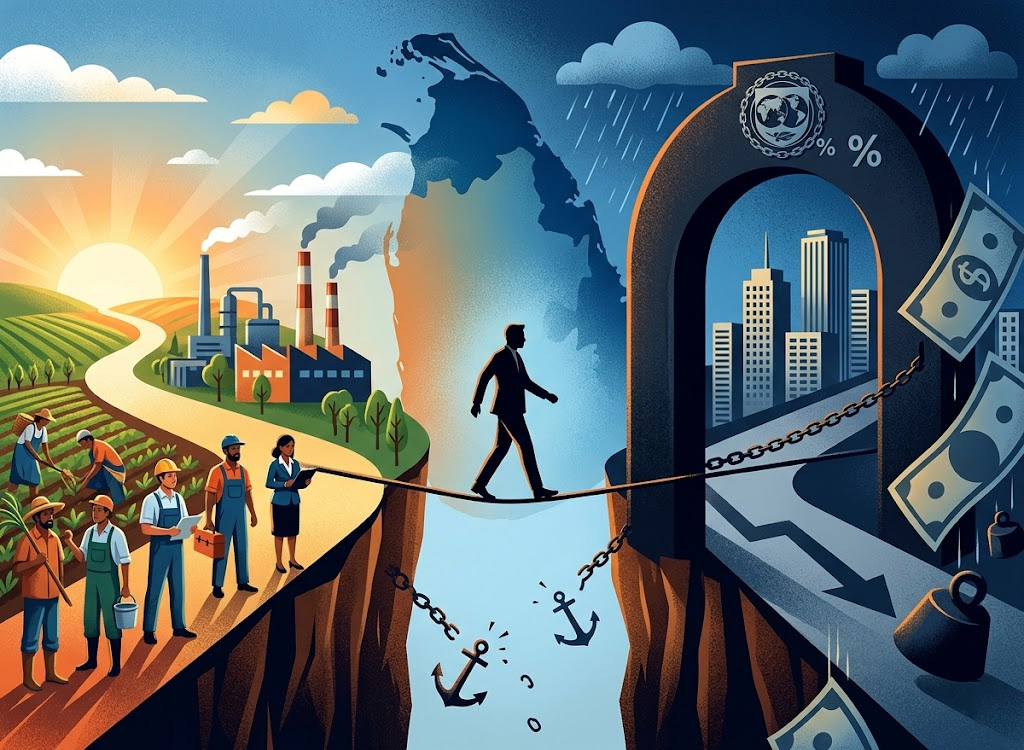
As structured by the 2022 Ranil Wickremesinghe-Sri Lanka Podujana Peramuna (SLPP) Government, the programme risks entrenching the very dynamics that led to Sri Lanka’s economic vulnerabilities. At its core, the programme is best understood as stabilisation-first and transformation-limited.
Choosing austerity
First, while the IMF programme is anchored to standard benchmarks – primary account surplus target (2.3% of Gross Domestic Product – GDP), foreign exchange debt service ratio (4.5% of GDP), public debt-to-GDP ratio of 95% – Sri Lanka’s crisis was fundamentally external in nature. A persistent trade deficit financed through external borrowing, often for consumption rather than productive investment. Meeting the IMF’s intended targets does not resolve that structural imbalance.
Even within the IMF’s own projections, Sri Lanka’s trade deficit persists, external debt levels remain elevated, and repayment obligations are effectively back-loaded, with stepped up payments in the years following the end of the programme period. In other words, the programme restores indicators of solvency without correcting the underlying drivers of vulnerability.
Second, the programme implicitly calls for the rebuilding of a significant International Sovereign Bond (ISB) portfolio, despite Sri Lanka’s default being a textbook case of rollover risk associated with excessive exposure to dollar-denominated commercial debt. At the point of default, ISBs accounted for roughly 40% of total external debt, with external debt at around 60% of GDP.
This level of exposure is highly atypical; no comparable peer economy has sustained ISB shares at such levels, most top out at 20% of their total external debt portfolios. Recreating even a portion of this structure reintroduces the same medium-term fragility the restructuring was meant to resolve.
Third, the fiscal framework reflects a constrained approach to State capacity. The revenue target of approximately 15% of GDP is low relative to Sri Lanka’s development requirements. Countries that have successfully transitioned towards higher growth trajectories typically operate within a 18–22% range, enabling sustained investment in infrastructure, industrial policy, and social protections. A lower target may be politically expedient and easier to achieve, but it effectively locks in a shallow state, limiting the Government’s ability to drive structural transformation.
This issue is further compounded by the composition of taxation: adjustment continues to rely heavily on indirect taxes, particularly Value-Added Tax, rather than a decisive shift towards progressive direct taxation. While administratively convenient, the current approach is economically distortionary in a demand-constrained economy, compressing household consumption while leaving higher-income and capital income relatively under-taxed. The result is a regressive fiscal structure that weakens both recovery and the broader social contract.
Fourth, and most critically, the programme leaves little room for a credible industrial or export strategy. Stabilisation is treated as a precursor to growth, with an implicit assumption that growth will follow once macroeconomic balances are restored. This ignores Sri Lanka’s central constraint: a narrow export base and weak tradable sector.
Without coordinated industrial policy, targeted sectoral development, and deliberate efforts to upgrade the external sector, the programme risks restoring macro stability without altering the underlying growth model, leaving the country exposed to recurring balance of payments pressures and crises.
Fifth, while the debt restructuring improves near-term liquidity through maturity extensions, coupon reductions, and instruments such as macro-linked bonds, it does not materially reduce the underlying debt stock vulnerability. Combined with continued reliance on external commercial borrowing, this amplifies rollover risk and financial pressure on reserves.
Finally, the political economy of the programme cannot be ignored. A lower, more achievable revenue target, paired with reliance on indirect taxation, reduces immediate political costs, minimises resistance from higher-income groups, and facilitates smoother compliance with IMF benchmarks. This, in turn, enhances the short-term credibility of the reform programme and its political sponsors. However, it does so by trading off fiscal depth and developmental capacity, prioritising programme success metrics and political manageability over optimal economic design.
In sum, the programme stabilises key indicators but does not fundamentally transform the economy. It addresses symptoms more effectively than causes, restoring a degree of macroeconomic order while leaving intact the structural weaknesses that produced the crisis in the first place.
Your grandmother’s IMF
The key point to understand is that the IMF today appears more flexible than in previous eras. As its Managing Director remarked during a recent visit to Sri Lanka: “This is not your grandmother’s IMF.”
One notable shift was the inclusion of an albeit minuscule social spending floor, requiring a minimum allocation of 1% of GDP towards social protection and related services. Sri Lanka reported spending of approximately 0.9% of GDP in 2023, falling short even of this modest benchmark; that shortfall is a domestic policy choice, a conscious trade-off.
Yes, the IMF programme nevertheless remains implicitly ‘neo-liberal’ in orientation, prioritising fiscal consolidation and economic compression to restore net cash flows and macroeconomic stability. Yet crucially, it does not inherently require that the burden of this adjustment fall disproportionately on working people and the middle class; once again, this has been a policy choice.
Four years on from the crisis, there is still no wealth tax, no mechanism to recover prior windfalls from previous tax cuts, and no increase in the top marginal income tax rate. It is these policy choices that have made the adjustment path explicitly austerity-driven.
The broader critique of neo-liberalism remains familiar: insufficient emphasis on domestic productive capacity, a tendency towards financialisation, pressure on welfare systems, and chronic underinvestment in health, education, and public services. Sri Lanka’s programme reflects these very tendencies.
It provides only a narrow safety net for the most vulnerable while simultaneously calling for greater investment in health, education, and social protection. The contradiction lies in the limited fiscal space available to deliver on those objectives, leaving the country with minimal social cover and insufficient resources for the productive and human capital investments required for long-term recovery.
Neo-liberalism is often reduced to a simplistic checklist: deregulation, privatisation, fiscal austerity, and free trade. This is analytically incomplete: neo-liberalism is not defined by the mere presence of these tools, but by how they are applied and the structural outcomes they produce. In practice, those outcomes have often enhanced the position of entrenched capital, weakened state capacity, and constrained developmental policy space.
How to spot a neo-liberal
More insidious still is the rhetorical shield often used to defend such policies. Critique is framed through a pseudo-radical vocabulary, draped in a thin Leftist veil, creating the illusion of political boldness while disarming more superficial observers.
Take deregulation. In theory, deregulation is meant to enhance competition, reduce barriers to entry, and enable small and medium enterprises to flourish. In practice, however, particularly in economies with weak regulatory institutions, deregulation can consolidate market power rather than diffuse it. When regulatory frameworks are selectively relaxed in environments already dominated by large firms, the result is not competition, but concentration. This is where neo-liberal policy, as applied rather than theorised, begins to take shape.
Throughout history and in Sri Lanka, deregulation has often moved in tandem with crony capitalism. The language of ‘State-Owned Enterprise reform’ and privatisation has, in many instances, created rentier spaces vulnerable to exploitation by politically connected entities with close links to the State. Liberalise segments of the energy market, for instance, and politically connected, even foreign State-linked entities, can quickly emerge as dominant players. These are not isolated occurrences; they reflect a broader pattern.
A similar distinction applies to privatisation. The sale of non-strategic commercial State assets, such as distilleries or other competitive enterprises, can be justified on efficiency or fiscal grounds without invoking ideology. However, the privatisation of natural monopolies – utilities, energy, and water – has long been associated with neo-liberal reform, particularly when undertaken without strong regulatory safeguards.
In such cases, ownership transfer does not necessarily improve efficiency or service delivery; instead, it can enable rent extraction at significant cost to consumers. The poster child for natural monopoly privatisation, Thatcherism, today faces broad public support for the renationalisation of such essential services.
As noted earlier, Sri Lanka’s longstanding imbalance between direct and indirect taxation has contributed to a regressive distributional outcome, and offers a parallel illustration, where the burden falls disproportionately on consumption and, therefore, once again, on lower-income households.
Free trade in itself is not neo-liberal; it is an essential component of economic development. It becomes problematic only without the domestic industrial capacity and organisational depth required to compete, when pursued under conditions of premature liberalisation, within a set of rules that entrench a system of dependency.
In such circumstances, economies risk being locked into low-value segments of global value chains, with limited scope for upgrading. The issue in Sri Lanka has not been trade per se, but the persistent absence of an industrial strategy to support it. What value is a Free Trade Agreement (FTA) if domestic firms have little of value to trade?
Unconscionable trade-offs
The current IMF programme is illustrative. A revenue path of around 15% of GDP may satisfy debt sustainability requirements, but it remains insufficient for a country at Sri Lanka’s stage of development to build the fiscal capacity required for sustained growth, public investment, and social protection. It reflects a negotiated floor rather than a developmental ceiling.
This pattern is not new. During the ‘Yahapalana’ period, the Inland Revenue Act was introduced to strengthen revenue mobilisation. Yet by the end of that administration, tax-to-GDP remained only just above 11%. Across successive administrations, there has been no sustained effort to move Sri Lanka towards the 18–20% range more commonly associated with developmental states. In the aftermath of the economic collapse, fiscal reform has prioritised compliance with external benchmarks over the expansion of State capacity, contributing directly to economic compression.
Policy has consistently leaned towards trade liberalisation and external integration, without the parallel effort to build domestic productive capacity. This reflects the assumption that growth will emerge from openness itself, rather than from deliberate structural transformation.
The consequences are also evident in Sri Lanka’s external debt structure. Heavy reliance on ISBs prior to the crisis exposed the country to acute rollover risk and market volatility. This was not an inevitable feature of development, but a policy choice that privileged access to international capital markets over more stable, but conditional, concessional financing, creating a vulnerability central to the severity of the crisis.
Any suggestion that Sri Lanka needs to shift to the economic ‘Right’ is a misdiagnosis and ignores the historical experience of every successful late-stage industrialiser. Countries such as Japan, South Korea, Taiwan, Singapore, and Vietnam did not develop through unqualified market liberalisation. They combined openness with strategic state intervention, disciplined industrial policy, and sustained public investment. Sri Lanka’s challenge is not that it has failed to embrace markets, but that it has embraced a narrow and incomplete version of them, one that prioritises stabilisation over transformation, external validation over internal capacity.
Winning the race to the bottom
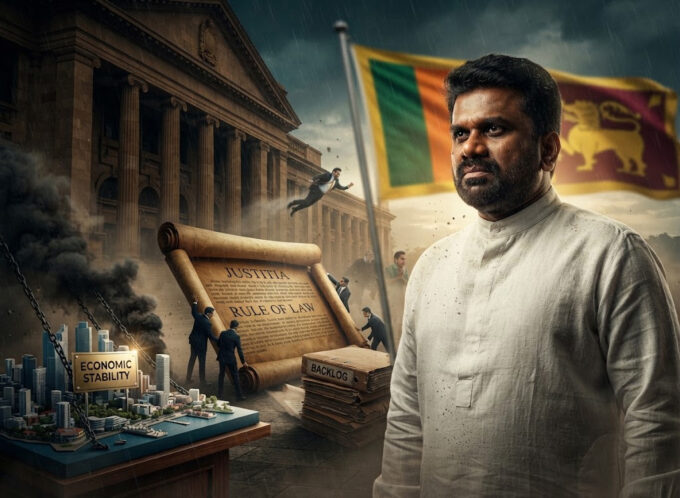
Anura Kumara Dissanayake and the National People’s Power (NPP) have accepted the previous Government’s economic baton, which, as clearly outlined here, is suboptimal and was always likely to leave Sri Lanka vulnerable to external shocks. This is why many independent analysts warned that Sri Lanka’s path to debt sustainability was too narrow, on a not-so-proverbial “knife edge”. Now, with two once-in-a-generation shocks – a cyclone and an oil shock amid an ongoing global energy crisis – Sri Lanka’s path to debt sustainability becomes more complicated.
The main Opposition Samagi Jana Balawegaya (SJB) and its Leader Sajith Premadasa have consistently argued that the IMF programme and its intended targets do not adequately differentiate between external and domestic debt. That growth itself can deepen the cycle of currency depreciation and external indebtedness due to import dependence; thus, not all growth is created equal.
GDP growth driven by investment and capital formation in sectors such as construction, infrastructure, and real estate, while important, can further feed the imbalance because of Sri Lanka’s net-importer structure. That is why Sri Lanka requires external sector-led growth. Only industrial policy and export-oriented manufacturing integrated into global supply chains are likely to generate long-term sustainable growth where significant value is both created and retained within the local economy.
This has been a consistent point in Premadasa’s economic platform, with repeated references to a production economy and export-oriented industrialisation across two election cycles. It is time policymakers, and voters, paid closer attention.
(The writer is a political commentator, media presenter, and foreign affairs analyst. He serves as Adviser on Political Economy to the Leader of the Opposition and is a member of the Working Committee of the Samagi Jana Balawegaya [SJB]. A former banker, he spent 11 years in the industry in Colombo and Dubai, including nine years in corporate finance, working with some of Sri Lanka’s largest corporates on project finance, trade facilities, and working capital. He holds a Master’s in International Relations from the University of Colombo and a Bachelor’s in Accounting and Finance from the University of Kent [UK]. He can be contacted via email: [email protected] and X: @kusumw)
Disclaimer: The views and opinions expressed in this article are those of the writer and do not necessarily reflect the official position of this publication.












Leave a comment