
By Vox Civis
Sri Lanka’s political history has always been shaped as much by perception as by performance. Governments rise on waves of public optimism, only to discover that hope is difficult to sustain when confronted with the harsh realities of governance. The National People’s Power (NPP) administration came to office on the back of an extraordinary public mandate, promising not merely a change of government but a transformation of the political culture itself. It pledged accountability instead of impunity, justice instead of political protection, transparency instead of secrecy, and economic renewal instead of endless crisis management.
Nearly two years into its tenure, however, many are the questions that are beginning to emerge. Primarily among them is the question of whether the country is witnessing genuine transformation, or increasingly being asked to believe in a carefully constructed narrative that is becoming detached from observable reality?
This has become particularly relevant following the release of the Centre for Policy Alternatives’ (CPA) latest Social Indicator survey. According to the poll, President Anura Kumara Dissanayake enjoys an extraordinary public satisfaction rating of 75.5 percent, while Opposition Leader Sajith Premadasa trails at a pitiful 29.4 percent. Supposedly conducted between May 23 and June 18 among 1,240 respondents across Sri Lanka’s 25 districts, the survey was immediately embraced by the government as definitive proof that the administration enjoys overwhelming public confidence.
Within minutes of its publication, pro-government social media platforms, sympathetic media outlets and numerous political commentators were presenting the figure as an unquestionable reflection of national opinion. The number itself became the story. Yet there is good reason to pause before accepting it as political gospel.
Real vs. Artificial
Only one year earlier, Sri Lanka conducted something far more reliable than any opinion survey – it held local government elections. Unlike surveys, elections are not based on statistical sampling. They involve millions of citizens casting real votes under legal supervision at polling stations across the country. They remain the ultimate measure of public support in any democracy. Those elections delivered a sobering message for the ruling party.
The NPP secured approximately 43 percent of the national vote, a dramatic fall from the 61 percent it received in the parliamentary election only six months earlier. More than 2.3 million voters who had supported the party previously, either voted elsewhere or chose not to vote at all. Voter turnout itself fell sharply from approximately 80 percent to just over 60 percent. That was not the opinion of 1,240 respondents. It was the verdict of millions.
How then does a government that received 43 percent support in an actual election suddenly command 75.5 percent satisfaction just 12 months later? Such a phenomenal increase would ordinarily require dramatic improvements in governance, living standards and economic opportunity. But that is clearly not the reality confronting the vast majority of Sri Lankans today.
Crime statistics published by the police indicate rising criminal activity. The cost of living continues to burden ordinary families despite the end of hyperinflation. Unemployment remains stubbornly high. Large-scale development projects capable of creating substantial employment opportunities are largely absent while household budgets remain under enormous pressure. Ironically, the very same CPA survey itself reflects much of this economic dissatisfaction.
According to it, more than half of respondents – 51.4 percent – have said that their household economic situation has deteriorated. A significant 44 percent have expressed dissatisfaction with the government’s handling of the cost of living. If, as the survey suggests, the majority believes their economic circumstances have worsened, how does nearly three-quarters simultaneously express satisfaction with the President? The contradiction deserves explanation.
Absence of methodology
Even more troubling is the absence of detailed methodological transparency. A sample of 1,240 respondents spread across 25 districts averages roughly 50 respondents per district in a nation of over 22 million people. The published survey barely provides any information regarding sampling procedures, weighting methods, question framing, margin of error or respondent selection – factors normally associated with a credible survey.
In the absence of such, the poll conductor must be in a position to explain if respondents were selected randomly? Were interviews conducted face-to-face, by telephone or online? Were certain demographic groups overrepresented or underrepresented? Were interview locations geographically balanced? Were the questions neutrally phrased?
Serious international polling organisations routinely publish comprehensive methodological notes primarily because credibility depends upon transparency. In the absence of such transparency, the public is being asked to accept conclusions without being allowed to examine how those conclusions were reached.
This matters because numbers carry enormous political power. Once repeated often enough, they become accepted truth irrespective of whether they withstand scrutiny. A favourable poll becomes tomorrow’s headline, next week’s parliamentary quotation and next month’s campaign message. Before long, perception begins replacing evidence, and more importantly, performance.
The danger extends beyond politics. The CPA, that carried out the survey, has spent decades building a reputation as one of Sri Lanka’s leading civil society organisations. Its research has frequently challenged governments of every political colour. That institutional credibility is in fact its institutional capital and what drives the perception of it being generally viewed as independent.
More questions than answers
However, when a survey producing such extraordinary findings is released without sufficient methodological transparency, it is bound to raise questions not merely about the numbers themselves but about the institution publishing them as well. In this day and age when individuals can carry out their own surveys using widely available Artificial Intelligence resources, whether fairly or unfairly, the given figures risk becoming political instruments rather than objective research.
The broader concern is whether Sri Lanka is gradually entering an era where managing public perception is becoming more important than delivering measurable, actual results. Governments throughout history have understood that controlling the narrative is often easier than solving difficult structural problems. But what most do not understand is that, that era is almost at an end – replaced by social media and Artificial Intelligence; and whatever the survey it may be, it must be able to withstand the unforgiving scrutiny of both.
While economic growth requires investment, job creation requires private sector confidence, judicial reform requires institutional independence, and combating corruption requires political courage, managing public perception requires only effective communication and favourable headlines. This distinction becomes even more significant when examining the government’s core election promise of justice.
No promise resonated more strongly with voters than the commitment to investigate corruption, prosecute wrongdoing and dismantle the culture of impunity that many believed had flourished for decades. That promise however, remains unfulfilled. Justice cannot exist merely through speeches or arrests staged for maximum publicity; it depends fundamentally upon credible investigations, protected witnesses and impartial institutions.
Mysterious deaths
This is why recent events have given rise to some very serious questions. Several individuals associated with sensitive investigations or politically significant allegations have died under circumstances that continue to attract public speculation. Among those frequently cited are Dan Priyasad, who reportedly lodged complaints regarding the controversial container incident; Nandana Gunathilake, who allegedly intended to reveal politically sensitive information; the principal complainant connected to the Treasury’s US$2.5 million External Resources Department “hacking” controversy; businessman Kapila Chandrasena and the Airbus controversy; and the most recent being former Inspector General of Police )IGP) C.D. Wickramaratne, who was expected to become an important witness in matters connected to the Easter Sunday investigations.
It is essential to emphasise that speculation cannot replace evidence. Every death deserves careful, professional investigation based solely upon facts because speculation is dangerous, and investigations must be transparent enough to eliminate reasonable public doubt. Instead, public confidence is weakened when official conclusions – often citing ‘suicide’ – appear to arrive even before the most basic independent forensic processes are completed.
Many seem to have noticed this recurring pattern in recent high-profile cases where even before post-mortem examinations conclude, before magisterial inquiries commence and before comprehensive investigations unfold, official narratives frequently appear remarkably certain regarding the cause of death. Such pronouncements are bound to invite scepticism – and there is no shortage of it across social media platforms.
In a functioning democracy, no credible criminal justice system should appear to reach conclusions before completing the investigative process. Ironically, while remarkable speed is demonstrated in determining causes of death – including the former IGP, investigations into some of Sri Lanka’s gravest national tragedies continue to progress painfully slowly.
The Easter Sunday attacks remain the clearest example. Years later, despite multiple commissions, reports and investigations, many citizens continue asking whether the complete truth has emerged. It is a valid question given that social media is simmering with speculation whether the sudden death of the Former IGP could in some way be related to that investigation. After all, justice delayed is damaging enough, but justice appearing selective is even more corrosive.
Striking contrast
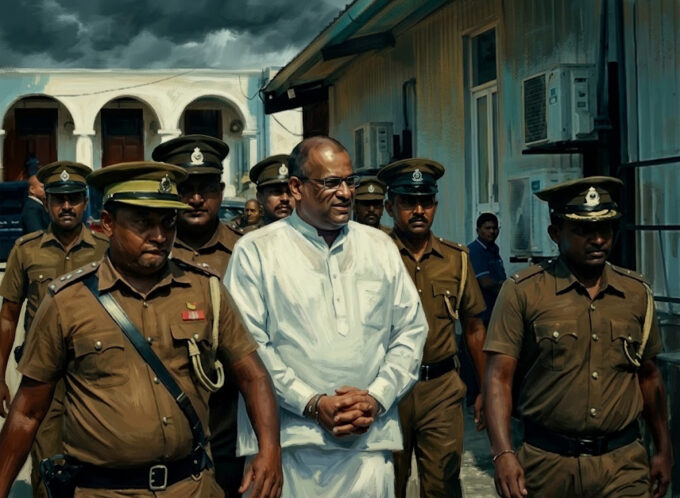
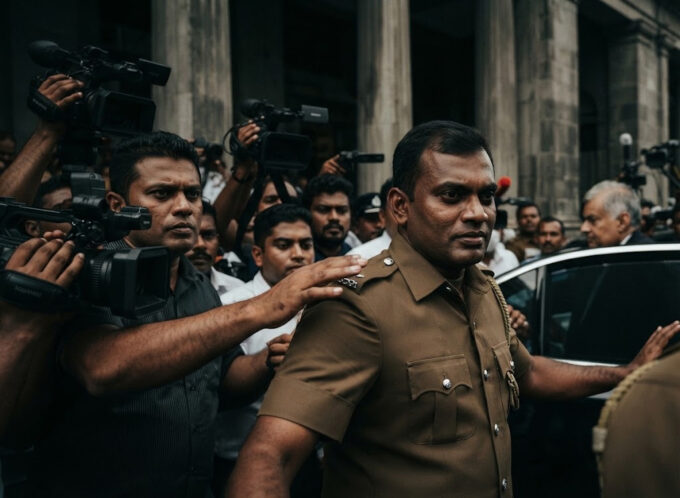
Recent developments reinforce those concerns. The Fort Magistrate’s Court last week ordered the arrest of ruling party members, Deputy Minister Eranga Gunasekara, MP Jagath Manuwarna and four others after their failure to appear before court. Months earlier, similar orders reportedly involved three other prominent Ministers. Yet no comparable urgency appears evident in executing those warrants. Simultaneously, opposition politicians continue to feature prominently in highly publicised arrests.
This inevitably creates the perception – whether accurate or not – that one standard applies to government allies and another to political opponents. Perception, once again, becomes central.
Few individuals have articulated this distinction more clearly than Samagi Jana Balawegaya Parliamentarian, Dr. Harsha de Silva. In a recent interview, he acknowledged that justice must never become selective. Investigations into corruption must apply equally irrespective of political affiliation. If opposition politicians are investigated while credible allegations involving government figures receive less visible attention, public confidence will inevitably suffer.
Equally concerning are proposals affecting the judiciary, including extending retirement ages for superior court judges. Whether or not such proposals are well intentioned, perception again becomes critical. Judicial independence depends not only upon actual impartiality but upon public confidence that impartiality exists. Once citizens begin believing institutions are politically influenced, rebuilding trust is almost always extraordinarily difficult.
A government cannot claim to administrate justice while credible allegations involving its own political circles appear to receive less urgency than allegations against its opponents. In a democracy, institutions are judged not only by what they do, but by whether citizens believe they are acting fairly. Perception, matters.
This is the central problem confronting the NPP today. The party rose to power because it promised to destroy the politics of perception, privilege and impunity. Now, nearly two years in office, it risks becoming trapped in the very same political culture it promised to replace.
The solution is not about attacking critics or manufacturing more favourable surveys; neither is it about accusing every sceptic of being a supporter of the old regime. The solution lies in one thing and one thing only, performance.
Towards this end it must protect witnesses and investigate every death independently. It must execute court orders regardless of political affiliation and investigate allegations against government supporters with the same determination applied to opponents.
People’s will
The people of Sri Lanka have already demonstrated that they are capable of extraordinary political change. They rejected governments that appeared invincible and removed leaders who believed their popularity was permanent. Today, they are aware of what they voted for.
They endured economic hardship and still demanded accountability. What is clear is that they cannot be permanently managed through slogans, social media campaigns or favourable opinion polls. A government may control the narrative for a time, it may dominate the news cycle, it may produce statistics that are repeated until they become familiar, but what it must keep in mind is that the real-life experience of citizens is more powerful than any propaganda.
The family struggling to pay its bills knows whether the economy is improving. The unemployed young person knows whether opportunities are expanding. The victim waiting for justice knows whether the system is working. The witness living in fear knows whether the state is protecting him or her. The citizen watching one politician being arrested while another appears to ignore a court order understands the difference between justice and political theatre. And when the time comes, the voter remembers.
The central challenge facing the NPP is therefore not how to convince Sri Lanka that everything is going well, it is how to make things genuinely better. The government does not need a 75.5 percent approval rating to survive. All it needs to do is to honour its promises and create institutions that people trust.
It needs to create an economy that produces opportunity. It needs to ensure justice that is demonstrably blind to political affiliation. It needs to create a police service that investigates before it pronounces judgement. It needs to ensure that the judiciary’s independence is beyond doubt. It needs to create a political culture in which government supporters are held accountable with the same determination as opponents.
The final verdict
That is the transformation that Sri Lanka was promised. And that is the standard by which the government will ultimately be judged. Not by the loudest social media campaign or by the most favourable survey. Not even by the number of opposition politicians arrested or by the fact that the economy has been stabilised.
The final verdict will be delivered by ordinary citizens who know the price of food, the difficulty of finding employment, the experience of dealing with the state and the reality of whether justice is truly equal. The NPP must now decide whether it wants to govern the country in the manner it promised the people or just govern the narrative about the country.
A government can manufacture perception for a while. It can manipulate the headlines. It can amplify favourable numbers. It can dismiss criticism. But it cannot indefinitely postpone the creation of prosperity, justice and public trust. Eventually, the narrative will meet reality. And when that happens, no survey can save it.
Disclaimer: The views and opinions expressed in this article are those of the writer and do not necessarily reflect the official position of this publication.











Leave a comment