
By Vox Civis
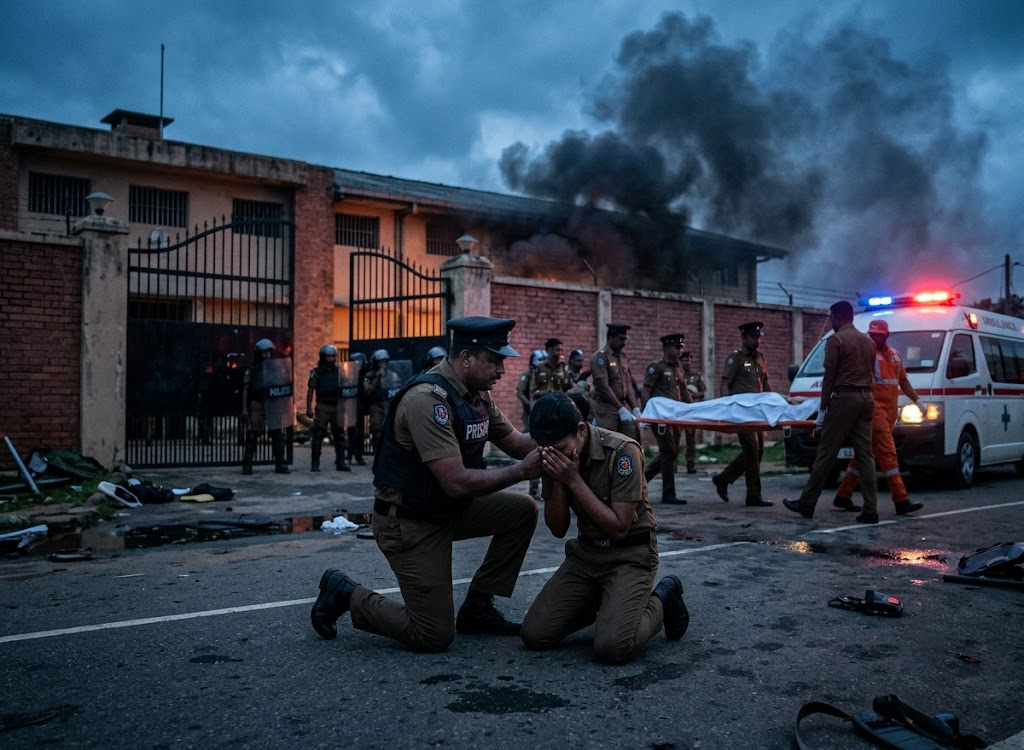
Who was actually in command while the Negombo Prison descended into chaos last Monday (6)?
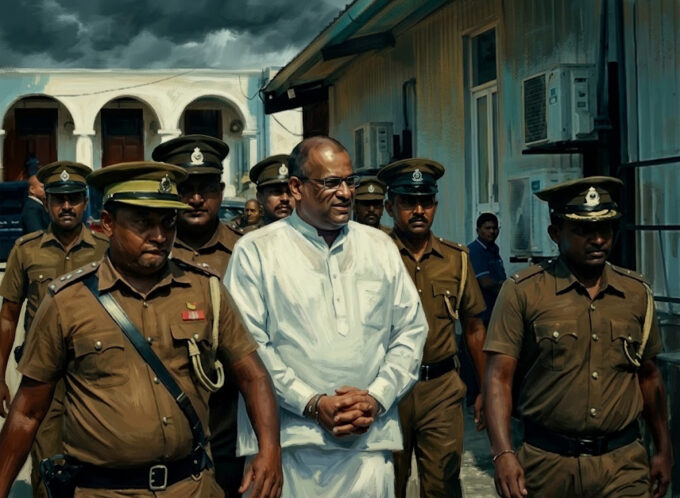
This primary question has become even more pronounced following Justice Minister, Harshana Nanayakkara’s own televised interview days after the incident. Asked who possessed the authority to issue firing orders inside a prison during a crisis, the Minister replied that he had “absolutely no power” to issue such orders and acknowledged that he did not fully understand the command arrangements governing their authorisation. Indeed, he remarked that he would have to “go home and read up on it.” He also revealed that while numerous calls were coming into his phone that day, he experienced difficulty contacting the prison itself.
Those remarks may ultimately prove consistent with the legal framework governing prisons. It may well be that the Minister has no statutory authority to authorise the use of lethal force. But that is not the issue. The issue is that, during one of the gravest prison emergencies in modern Sri Lankan history, the country’s political head responsible for the prison system appeared publicly uncertain about the operational chain of command and was also incommunicado during a crucial period, according to Prison officials themselves.
Critical questions
Crises rarely wait for constitutional interpretations for the simple reason that they demand leadership, coordination and decisiveness. If authority rested with prison officials, were they empowered to act? If they sought guidance, who provided it? If communication broke down, where exactly did it break down? If emergency protocols existed, were they followed? These questions are even more pressing when prison officers themselves publicly maintain that earlier intervention would have prevented the escalation that ultimately claimed so many lives.
The issue is not whether the Minister should have pulled the trigger, the issue is whether someone was firmly holding the wheel, because leadership is rarely judged by the decisions made after the shooting stops. It is judged by the decisions taken while events are still unfolding. Therefore, the issue is not who had the authority to order the first shot. The issue is who was providing leadership while the first warnings were being ignored.
Before assuming office, Anura Kumara Dissanayake frequently criticised custodial deaths and promised a higher standard of governance. Governing, however, is different from campaigning. The Negombo tragedy presents his administration with an opportunity to prove that those promises meant something. That means accepting responsibility where appropriate, implementing genuine prison reform, expanding prison capacity, reconsidering sentencing policies for non-violent offenders, strengthening prison intelligence, and addressing the enormous backlog in the courts. Otherwise, Negombo will simply join the long list of preventable disasters that Sri Lanka remembers briefly before moving on.
Cost of delayed leadership
The greatest tragedy of Negombo is not merely that 27 lives were lost, it is the growing suspicion that many of those lives may have been saved had decisions been taken when there was still time. That is the question no committee, no press conference and no political slogan can avoid. Until it is answered honestly, and until the failures that allowed this catastrophe are corrected, Negombo will remain not just a prison riot, but a monument to the cost of delayed leadership. Therefore, the question facing the powers that be is not who eventually took control of Negombo Prison; it is who was in control while control was being lost. The nation deserves answers.
What is obvious was that the regime moved in to damage control mode no sooner the extent of the carnage became apparent. Justice Minister Nanayakkara’s visit to the homes of the prison officers who lost their lives in the Negombo Prison violence was expected to be one of sympathy and solace. It was a moment for a grieving government to stand beside grieving families. Instead, it became something altogether different. What should have been a carefully choreographed expression of compassion turned into a painful confrontation with the consequences of a national tragedy.
The Minister did not encounter political opponents eager to score points. He faced prison officers mourning colleagues with whom they had served shoulder to shoulder. Their grief was raw, their emotions unfiltered and their message devastatingly simple. They believed that had timely instructions been issued and had officers been empowered to act decisively when the first signs of unrest emerged on Sunday night, the violence could have been contained before it spiraled into one of the deadliest prison riots in Sri Lanka’s history.
The significance of those allegations cannot be dismissed. They did not come from anonymous social media accounts or partisan political platforms; they came from the very men and women entrusted with maintaining order inside one of the country’s most volatile institutions. Their testimony raises the fundamental question of whether there was a window of opportunity during which decisive action might have prevented the bloodshed that followed?
Political accountability
If the answer is even partially yes, then the Negombo Prison tragedy represents more than a security failure, and instead, becomes a failure of governance. In every functioning democracy, ministerial responsibility is one of the cornerstones of public administration. Ministers are not expected to personally direct every operational response, nor can they reasonably be blamed for every decision made by officials under their charge. They are, however, expected to answer for the performance of the institutions they lead. That is the essence of political accountability.
This is why, when systems collapse, when lives are lost and when questions arise about whether earlier intervention could have changed the outcome, responsibility cannot simply disappear into the bureaucracy.
The tragedy in Negombo is no ordinary institutional failure: it is one of the gravest prison security breakdowns the country has witnessed in decades. It is also believed to be the first occasion in Sri Lanka’s history that so many prison officers have lost their lives in a single incident. Such an unprecedented disaster cannot simply be explained away as an unavoidable consequence of dealing with violent offenders. Institutions are tested not when everything proceeds according to plan, but when crises erupt without warning. Leadership is measured by decisions taken under pressure, not statements issued after the event.
This is why the emotional testimony of the prison officers deserves the country’s full attention. Their central grievance was not merely that violence occurred, it was that they believe escalation could have been prevented. Experienced prison officers have pointed out that in previous disturbances involving rival inmate groups, authorities often moved swiftly to separate or transfer inmates before tensions escalated beyond control. If similar options existed in Negombo but were not pursued in time, then the country deserves to know why.
The purpose of asking such questions is not to prejudge individuals or assign guilt before investigations conclude. It is to establish whether the State fulfilled its duty to protect both those in custody and those employed to guard them. Accountability in a democracy is not confined to criminal liability. Political accountability exists because public office carries public responsibility. This is where the debate must rise above partisan politics.
Leveraging the law in public interest
Governments have a habit of responding to national disasters in familiar ways; committees are appointed, investigations are announced, statements promising “appropriate action” are issued, and public attention gradually shifts elsewhere. Yet genuine accountability requires more than procedural exercises. It requires public confidence that the investigation itself is independent, transparent and capable of examining every level of decision-making, including the political leadership where necessary. That confidence must be earned through action.
Fortunately, Sri Lanka already possesses one of the strongest legal mechanisms for public scrutiny in the region. The Right to Information Act, introduced during the Yahapalanaya administration, remains one of the country’s most significant democratic reforms, designed for instances such as this, when citizens seek not speculation or political rhetoric, but documentary evidence.
Civil society including the fourth estate, should actively leverage the Act to establish a factual timeline of events surrounding the Negombo violence such as, when was the first report of unrest received by the Ministry? Who communicated with whom? What recommendations were made by prison authorities? What operational decisions followed? Were requests for additional authority made? Were inmate transfers considered? If they were rejected, on what basis? What intelligence assessments were available before the violence escalated?
Where the law permits, official records relating to communications, operational directives, emergency meetings and institutional decision-making during those critical hours should be disclosed. Transparency should never be viewed as a threat to government. On the contrary, it is often the only means by which governments can restore public confidence after catastrophic failures. Democracies do not become stronger by asking citizens to trust official narratives blindly. They become stronger when governments are willing to demonstrate that their decisions can withstand public scrutiny.
The prison officers who buried their colleagues have already delivered the country’s most painful testimony. They believe this tragedy did not have to unfold as it did. Whether that belief is ultimately confirmed or challenged by evidence, it deserves a full, transparent and independent examination. The nation owes it to the families of the dead, to the officers who continue to risk their lives inside overcrowded prisons, and to a public entitled to know whether those entrusted with protecting lives acted when it mattered most.
For if there is one lesson emerging from Negombo, it is this: tragedies rarely occur because of a single mistake. More often, they are the consequence of warnings overlooked, decisions delayed and responsibilities deferred until there is no time left to act.
Negombo was not the problem; it was the symptom
If the bloodshed at Negombo Prison taught one lesson, it is that prisons do not suddenly become dangerous overnight. They become dangerous because governments ignore problems for years until those problems eventually explode into public view.
The tragedy at Negombo has understandably centered on the immediate questions of who knew what, when they knew it and whether quicker intervention could have prevented the loss of life. Those questions deserve answers and those responsible, wherever responsibility lies, must be held accountable. But limiting the debate to those events alone would be a mistake. Negombo did not create Sri Lanka’s prison crisis, it merely exposed it.
For decades, successive governments have treated the prison system as an institution that exists beyond public consciousness. Politicians visit prisons when riots occur, when a high-profile inmate is remanded or when election promises require dramatic statements about crime. Once public attention fades, so too does political interest. Meanwhile, prison officers continue working in impossible conditions while inmates remain packed into facilities that have long exceeded their intended capacity.
Sri Lanka’s prison system was designed to accommodate roughly 18,000 inmates. Today it reportedly houses well over 43,000. That statistic alone should alarm every citizen. A prison operating at well over twice its intended capacity is not only overcrowded but inherently unstable. No security system, however sophisticated, can function effectively when institutions are pushed beyond their physical limits. And when rival gangs are forced into close proximity, tensions become permanent rather than occasional. Given these circumstances, the question is not why prison riots occur, but why they do not occur more often.
The consequences extend well beyond prisoners themselves. Prison officers work under relentless pressure, supervising inmate populations that far exceed internationally accepted standards. Every shift becomes an exercise in risk management and every confrontation carries the possibility of escalation, while every shortage of staff reduces the State’s ability to respond quickly when violence erupts.
The Negombo tragedy demonstrated the human cost of expecting prison officers to manage extraordinary circumstances with ordinary resources. Yet overcrowding itself is only one symptom of a larger policy failure.
Arrests without capacity building
The National People’s Power (NPP) Government’s “Ratama Ekata” campaign has resulted in thousands of additional arrests – a significant proportion reportedly involves drug-related offences. Existing narcotics legislation means that many suspects cannot easily obtain bail, resulting in prolonged periods in remand while their cases crawl through the judicial system. Whether one supports or opposes the campaign is beside the point. Every policy produces consequences.
If the State intends to intensify arrests, it must also expand the capacity of the institutions expected to receive those arrested. Otherwise, the inevitable result is exactly what Sri Lanka now faces, a prison system absorbing thousands of additional inmates without the infrastructure, staffing or resources required to manage them safely.
On the flip side, the prison crisis cannot be separated from the crisis in the justice system. Justice delayed does not only deny justice to victims and accused persons alike, it fills prisons with remand prisoners waiting months or years for cases to conclude. Many occupy scarce prison space not because they have been convicted but because the judicial process moves painfully slowly. Meanwhile the taxpayer finances their accommodation, meals, security and repeated transportation to courts across the country, incurring massive expenditure.
Many countries have increasingly turned towards community service, supervised rehabilitation, electronic monitoring and structured correctional programmes for non-violent offenders. Such alternatives reduce overcrowding while allowing prison resources to be concentrated on dangerous criminals who genuinely require secure detention. Sri Lanka should not hesitate to begin that conversation.
Imprisonment must punish crime, but it should also serve the interests of society. Housing thousands of non-violent offenders at enormous public expense while prisons overflow serves neither objective well.
Intelligence failure or disregard?
The Negombo tragedy also raises questions about prison intelligence and institutional preparedness. Every correctional system depends upon information. Officers must identify emerging gang rivalries, monitor organised criminal networks operating within prisons and detect escalating tensions before violence erupts. Intelligence exists because prevention is always preferable to suppression. Where, then, was the intelligence? Were warning signs missed?
These questions deserve answers no less than the questions surrounding operational decision-making during the riot itself. Leadership matters equally.
Sri Lanka has experienced repeated debates regarding appointments, transfers and administrative continuity within the Department of Prisons including the suspension of its head. Whatever political considerations may exist, one principle should remain beyond dispute: institutions responsible for public safety require experienced leadership, operational continuity and long-term strategic planning. They cannot function effectively through uncertainty or temporary arrangements indefinitely.
Most importantly, the government must finally acknowledge that prison reform requires investment rather than rhetoric. Modern correctional facilities capable of reducing overcrowding, improving rehabilitation and enhancing officer safety are no longer optional infrastructure projects. They are national necessities.
The prison crisis belongs not to one administration alone but to decades of collective political neglect. Governments past and now the NPP administration have each inherited an overcrowded correctional system and left it substantially unchanged. Negombo should finally persuade Sri Lanka that postponing reform carries consequences measured not merely in statistics but in human lives.
The prison officers who died were not responsible for creating overcrowded prisons. They did not write narcotics legislation. They did not delay court proceedings. They did not determine prison budgets or approve infrastructure projects. Yet they paid the ultimate price for political failures. Their sacrifice has shown the nation that the real tragedy of Negombo was not simply that violence erupted inside a prison: it was that the political leadership had failed to mitigate the conditions in which such violence became almost inevitable.
Disclaimer: The views and opinions expressed in this article are those of the writer and do not necessarily reflect the official position of this publication.











Leave a comment