
By Vox Civis
Notwithstanding the booming May Day rhetoric of the ruling party’s leadership, led by President Anura Kumara Dissanayake, the reality unfolding on the ground appears to be markedly different. Political theatre has always been a staple of May Day platforms in Sri Lanka, but what transpired this year cannot be dismissed as mere rhetorical excess. It carries implications that strike at the very foundations of the country’s democratic order.
The most disturbing aspect is not a policy failure, nor even the widening gap between promise and delivery, but something far more fundamental. At two separate May Day commemoration venues, the President and the Janatha Vimukthi Peramuna’s (JVP) General Secretary, Tilvin Silva – arguably the most influential duo within the ruling establishment – made strikingly similar assertions: that this government would be the last to be elected. Even allowing for political exaggeration, such a statement cannot be treated lightly. In a country that has endured decades of political upheaval, insurrection, and civil war, democracy is not merely a system of governance, it is a hard-won national asset.
What exactly was meant by “the last government” statement of the duo remains unclear, yet ambiguity, in this instance, is not reassuring given the history of the party in office. It casts a long and unsettling shadow over Sri Lanka’s democratic credentials at a time when the country is attempting to rebuild investor confidence and restore credibility among international creditors. Such statements, even if it is to please the gallery, introduces a new layer of unnecessary uncertainty.
Words matter
Investors do not merely assess economic indicators; they evaluate what the leaders of the nation state on public platforms, they gauge institutional stability, the rule of law, and the predictability of governance. Any suggestion – implicit or explicit – that democratic continuity is in question is bound to raise red flags. It appears that the comrades are determined to learn the hard way that the rhetoric that served them well in opposition, may not do the same while in government, where words and actions, have consequences.
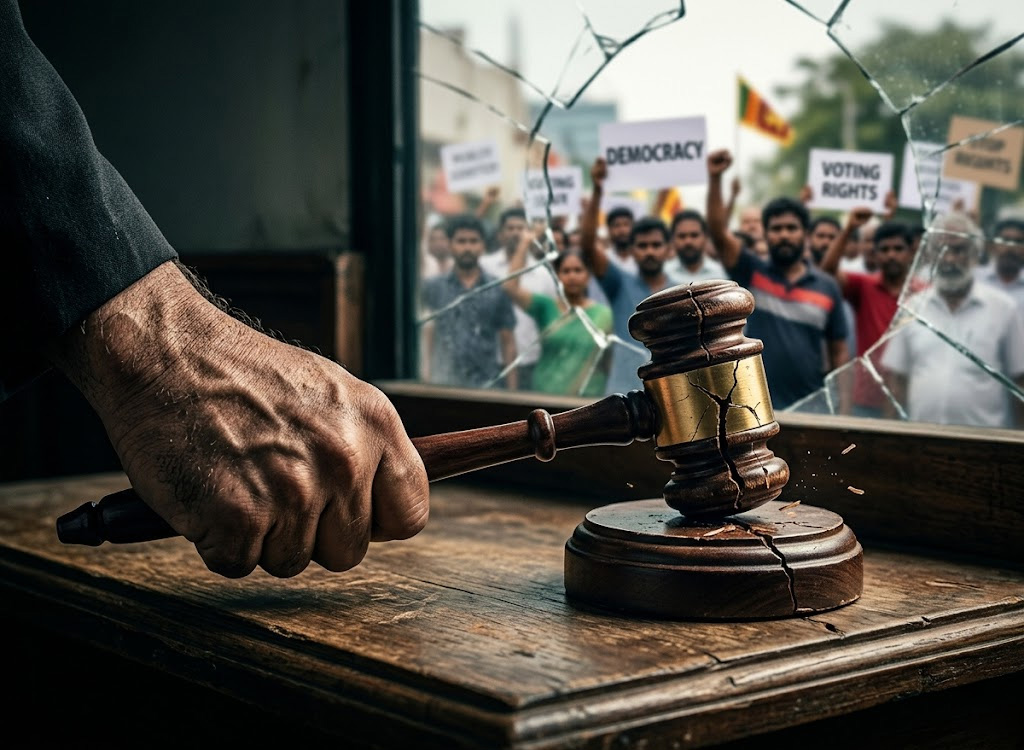
If the ‘last government’ statement were the only concern, it would already be significant. But what followed was arguably even more alarming. The President in his speech ventured into territory that even seasoned politicians typically avoid: commenting on the likely outcomes of ongoing judicial proceedings. By publicly stating that former Presidents in the opposition and their associates would “end up in prison,” he crossed a sacred line that separates political authority from judicial independence.
For all intents and purposes, this by no means is a trivial matter of semantics for it strikes at the very heart of the doctrine of separation of powers. The judiciary, by design, must operate free from executive influence – real or perceived. When the Head of the Executive branch appears to predict judicial outcomes, it raises unavoidable questions. How can any individual, regardless of office, claim foreknowledge of verdicts in cases that are still being heard and even go to the extent of providing specific dates on which these verdicts will be given? And more importantly, what does such a claim imply about the independence of the courts? Does it not amount to contempt of court and the much-respected judiciary as a whole?
The principle of sub judice exists precisely to prevent such scenarios. Public commentary that prejudges the outcome of a case risks influencing not only public perception but also the judicial process itself. Judges, witnesses, and litigants operate within a social context where statements from powerful figures can exert subtle yet significant pressure. Even the appearance of such influence is enough to erode public trust.
Serious offence
Sri Lanka’s Constitution is unequivocal on this point. Under Article 111C, interference with judicial power is a serious offence. While the President enjoys immunity under Article 35 during his tenure, this does not render the issue moot. Fundamental rights petitions, complaints to the Judicial Service Commission, and even contempt proceedings remain avenues through which such conduct can be challenged by any citizen. The law recognises that the integrity of the judicial process must be safeguarded at all costs.
Beyond legal technicalities lies the deeper concern of perception that justice must not only be done; it must also be seen to be done. When a President declares that certain individuals “will definitely go to jail,” and then goes on to even give dates, it risks creating the impression that outcomes are predetermined. That is a dangerous narrative in any democracy, but particularly so in a country where trust in institutions has already been severely tested. It is even more ironic that such actions are coming from a regime that was elected to office to restore public confidence in what they described as a broken ‘system.’
Intriguingly, these statements were made in the context of a broader narrative about restoring institutions, cracking down on corruption, the underworld, and narcotics networks. Few would dispute that such efforts are necessary. Indeed, the electorate granted the current administration a mandate, in part, to address precisely these issues. But the pursuit of justice must itself be just. Ends do not justify means when those means undermine the very institutions tasked with delivering justice.
Meanwhile, the government’s actions on the ground tell a story that is quite different from its rhetoric. The decision by the ruling National People’s Power (NPP) to forgo a traditional large-scale May Day rally in Colombo, ostensibly to conserve fuel, was presented as a responsible response to ongoing economic constraints. Instead, the party opted to hold smaller rallies across 21 districts in order to supposedly minimise bus transportation and fuel consumption.
Costly mismatch
On paper, the decision appeared prudent and seemed to set the right example. What has come to signify the NPP in the period it has been in office is that its words rarely match what it actually does in practice. Video footage from Nuwara Eliya and other locations shows large numbers of buses transporting supporters – hardly consistent with the narrative of cost-saving. When one considers the logistical expenses involved 21 fold, it becomes reasonable to ask whether the purported savings were real, merely symbolic or a calculated attempt at deception. On the contrary, a single central rally in Colombo may well have been more economical than the multiple decentralised events requiring transportation across the nation.
In a milieu where accountability seems to be taken for granted more often than not, it might not be a bad idea for a public-spirited citizen to utilise the Right to Information framework, and seek clarity on how public resources have been utilised in this instance. In an era where fiscal discipline is being emphasised, often at the expense of ordinary citizens, transparency in government spending complemented by public spirited action, is the way to go.
Meanwhile the President also used the occasion to warn of alleged attempts by opposition forces to destabilise the government. He pointed to intensified raids on drug networks and ongoing investigations by the Criminal Investigation Department (CID) and the Commission to Investigate Allegations of Bribery or Corruption (CIABOC) as the reason for these attempts. According to him, a wave of prosecutions would see numerous individuals including high-profile figures facing justice within the year.
Yet conspicuously absent from this narrative was any acknowledgement of mounting allegations within the government’s own ranks. While allegations ranging from dubious educational certificates to notorious coal and fuel tender benders to misappropriation of Treasury payments to unaccounted accumulation of personal wealth among ministers, etc. continues to grow by the day, not a word was spoken about them by any of the government speakers at any of the 21 rallies.
The most recent such controversy is the now-infamous Treasury incident involving the disappearance of USD 2.5 million in debt repayment transactions. According to the Chair of the Committee on Public Finance (CoPF), MP Harsha de Silva, 10 separate transactions intended for an Australian entity failed to reach their destination between November and January.
Serious implications
The implications of this incident extend far beyond the immediate financial loss. They point to systemic weaknesses in financial oversight, internal controls, and institutional accountability. That red flags emerged in January but were only formally acknowledged in March raises serious questions about transparency and responsiveness within the Finance Ministry. The involvement of multiple agencies including the Central Bank of Sri Lanka (CBSL), the CID, and Sri Lanka CERT, underscores the complexity of the issue, but it does not excuse the delay.
Considering both the amount in question and the multiple instances the fraud has taken place, in no way can the scam be termed a minor accounting discrepancy. It points to systemic weaknesses in financial oversight at a time when Sri Lanka can ill afford such lapses. The delay in identifying and disclosing the issue only compounds the problem. In the interim, the country’s reputation suffered, with international headlines amplifying concerns about governance, cybersecurity and continuing corruption.
Equally troubling was the initial reluctance of Treasury Secretary, Harshana Suriyapperuma to appear before the CoPF. In Sri Lanka’s constitutional framework, Parliament exercises absolute control over public finance. The CoPF is not a ceremonial body; it is a critical mechanism of oversight. Attendance when summoned is not discretionary; it is a constitutional obligation. Failure to comply can attract serious legal consequences including jail time.
The Secretary’s hesitation to engage until the eleventh hour raised some fundamental questions like, why resist scrutiny if there is nothing to hide? As the custodian of public funds, accountability is not merely a professional duty; it is a constitutional imperative. The eventual decision to appear before the committee, albeit at the last minute, does little to dispel the initial impression of evasion. There is also a growing trend of thought questioning as to why the decision to attend the meeting was taken just minutes after reports emerged of the sudden demise of the whistleblower.
Broader concerns
This episode underscores the broader concern of the slow but steady erosion of institutional checks and balances. The concentration of the finance portfolio within the presidency has already tilted the balance of power. Thus, when key officials appear reluctant to submit to parliamentary oversight, the system’s safeguards are further weakened. The precedent this sets is deeply problematic. If parliamentary summons can be ignored or delayed, what remains of legislative oversight? What comfort does it provide to the creditor community including the International Monetary Fund (IMF) that continues to insist on watertight accountability?
The controversy does not end there. Subsequently, there have been further revelations of similar missing payments to French and US entities involving substantial amounts of precious foreign exchange. The government’s refusal to allocate parliamentary time for a debate on these Treasury incidents has further fuelled suspicion. Transparency is not served by avoidance. In a democracy, contentious issues must be confronted in the open, not sidestepped. More so in a nation that is striving to rebuild its economy.
Parallel to this is the ongoing debate surrounding the “Rebuilding Sri Lanka” Fund. While the government maintains that the fund is secure and compliant with existing laws, questions persist regarding its legal foundation. Critics argue that, under the country’s commitments to the IMF, only statutory funds established through an Act of Parliament should exist. If the fund lacks such a basis – as it is at the moment – its legitimacy becomes questionable.
This matters not only for domestic governance but also for international credibility. Sri Lanka’s recovery is closely tied to its engagement with the IMF and other external partners. Governance reforms, transparency, and anti-corruption measures are central to these engagements. Any perception that these commitments are being diluted risks jeopardizing future support.
Fifteen months into NPP governance, the gap between promise and performance is becoming increasingly evident. The ambitious reform agenda outlined during the election campaign – ranging from the abolition of the executive presidency to sweeping anti-corruption measures – remains largely unfulfilled. Instead, the government appears to be caught in a cycle of reactive policymaking, often attributing current challenges to the failures of previous administrations.
Justifying inaction
While historical context is important, it cannot serve as a perpetual justification for inaction. Governance is ultimately about delivery, and on that front, progress has been uneven at best. The absence of a clear, actionable roadmap has contributed to a sense of drift, with key reforms either delayed or diluted. Ambitious pledges ranging from sweeping anti-corruption measures to constitutional reforms have yet to translate into tangible outcomes. What was presented as a decisive break from the past is beginning to look, in many respects, as a continuation of familiar patterns made worse by inexperience and the absence of political will to prosecute its own even in the face of overwhelming evidence.
Public frustration is further compounded by unresolved issues such as the quest for accountability in the Easter Sunday attacks. For many Sri Lankans, this remains an open wound. The lack of visible progress reinforces a broader sense of disillusionment. Adding to the unease are allegations of irregularities in areas such as coal procurement, with circulating evidence suggesting systemic issues. Whether these claims withstand scrutiny remains to be seen, but their mere existence contributes to a growing perception of governance failure. Such perceptions this early in the tenure of a new government is hardly likely to do it any good.
In a different political context, such developments might have triggered widespread public mobilisation. It is worth recalling the period when the JVP, now the backbone of the ruling coalition, operated as an opposition force. Protests were frequent, often strategically timed to maximise disruption and public visibility. Streets in Colombo were routinely brought to a standstill during peak hours.
Today, the landscape is markedly different. The opposition, while vocal within Parliament, has yet to translate criticism into sustained public engagement. This relative inertia has provided the government with breathing space. It has allowed missteps to accumulate without triggering the kind of political pressure that might otherwise force corrective action.
Sobering implications
This dynamic raises the uncomfortable question whether the government’s survival is being facilitated as much by opposition weakness as by its own strengths? If so, the implications are sobering. Democratic accountability relies not only on those in power but also on those who challenge it.
Besides, the absence of visible dissent should not be mistaken for public satisfaction. If anything, it may reflect a deeper sense of disillusionment; a belief that the political system, regardless of who occupies office, is unable to deliver the change that was promised. This is perhaps the most dangerous outcome of all, as it erodes not just confidence in a particular political party, but in the democratic process itself.
It is about time that the current regime understood the fact that Sri Lanka, yet, stands at a critical juncture where economic recovery, institutional reform, and democratic resilience are intertwined. None can be pursued in isolation. Statements that cast doubt on democratic continuity, actions that appear to undermine judicial independence, and reluctance to embrace transparency will collectively erode the foundation upon which recovery must be built.
The government was elected on a promise of ‘system change’ which resonated with a public weary of corruption, inefficiency, and political cynicism. Delivering on it, as the NPP is learning the hard way, requires more than just booming rhetoric. It demands a consistent commitment to the principles that underpin democratic governance: accountability, transparency, and respect for institutional boundaries.
The events surrounding this year’s May Day serve as a stark reminder of what is at stake. Words matter, particularly when spoken by those in positions of power. They shape perceptions, influence behaviour, and ultimately determine the trajectory of governance. In a country striving to rebuild both its economy and its image, there is little room for ambiguity, inconsistency, or overreach. The government would do well to recognise that its mandate is not a blank cheque, but a responsibility that must be exercised with restraint, accountability, and respect for the institutions that underpin Sri Lanka’s democracy.
Anything less risks turning a historic mandate into a historic missed opportunity.
Disclaimer: The views and opinions expressed in this article are those of the writer and do not necessarily reflect the official position of this publication.











Leave a comment