
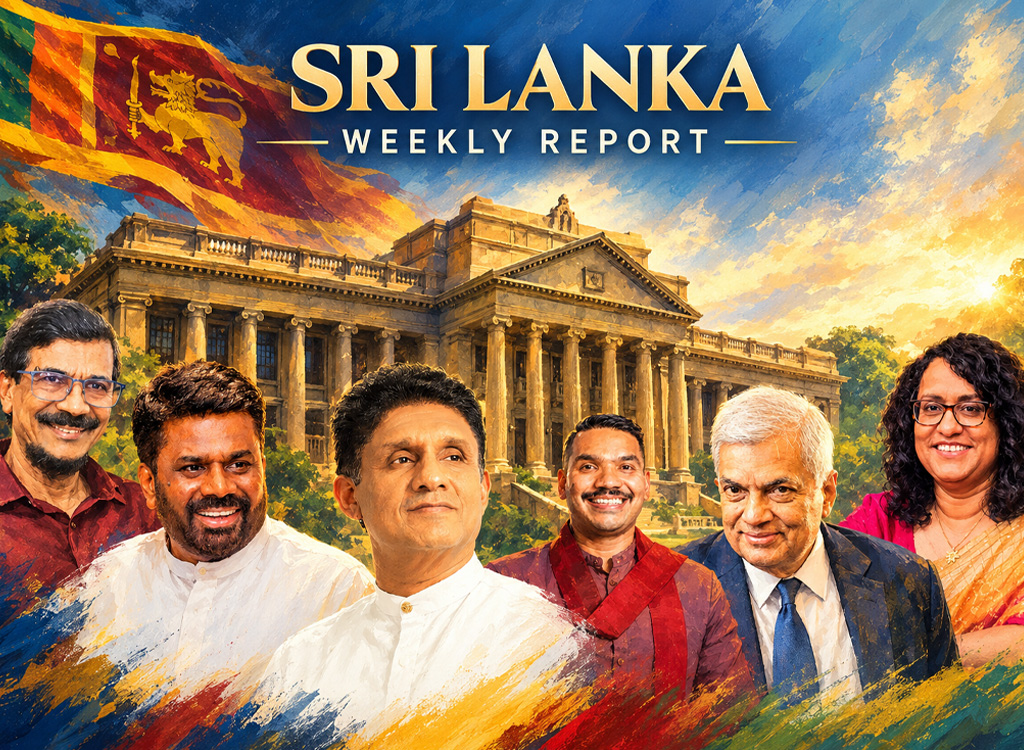
What happened, what mattered and what comes next
The week in a minute
Sri Lanka’s second week of October was dominated by a landmark development in the country’s accountability debate: the arrest and remanding of former First Lady Shiranthi Rajapaksa over alleged financial misconduct, alongside investigations involving other prominent political figures. Meanwhile, the Supreme Court’s reported decision to invalidate the presidential pardon granted to Buddhist monk Galagoda Aththe Gnanasara Thero, and his subsequent imprisonment, intensified tensions surrounding the judiciary, religious sentiment and political influence.
Economically, the International Monetary Fund (IMF) reached a staff-level agreement on its Seventh Review, potentially unlocking US$345 million, while the World Bank confirmed that Sri Lanka’s economy had returned to pre-crisis levels. Yet rising fuel-import expenditure, renewed fuel queues, incomplete poverty recovery and substantial reconstruction underspending exposed the fragility beneath the headline improvements.
The Government’s 2027 Budget entered Parliament against this backdrop, with recurrent expenditure rising and capital spending declining. Meanwhile, proposed counterterrorism legislation, a new NGO regulatory Bill and other security-related measures drew criticism over civil liberties and accountability. The amendments to the Anti-Corruption Act were also passed in parliament.
Foreign policy also demanded careful navigation as American naval activity coincided with Iranian vessels remaining near Sri Lankan waters.
The week therefore presented a familiar contradiction: measurable economic stabilisation and renewed institutional activity alongside unresolved questions about governance, public welfare, the rule of law and the sustainability of the recovery.
WHAT HAPPENED
Economy: IMF Progress, but recovery uneven
The most notable economic development was the IMF’s staff-level agreement with Sri Lanka on the Seventh Review of the four-year Extended Fund Facility. Announced on 5 October, the agreement could release approximately SDR 254 million, equivalent to US$345 million, following Executive Board approval. The Board’s decision depends on the Government presenting a 2027 Budget consistent with programme parameters and satisfying financing-assurance requirements confirming creditor support and progress in debt restructuring.
The IMF also concluded its 2026 Article IV Consultation. However, the Government is already discussing a successor programme beyond the current facility’s scheduled conclusion in March 2027, with Deputy Finance Minister Anil Jayantha confirming that discussions are under way. The Seventh Review is therefore an important milestone, but not the end of Sri Lanka’s dependence on external financial support and continued fiscal discipline.
The World Bank’s October Sri Lanka Development Update, titled From Recovery to Transformation, delivered a similarly mixed assessment. Economic output has returned to pre-crisis levels with GDP projected to expand by 4.4% in 2026 and 4.2% in 2027. Nevertheless, household incomes, employment and poverty remain under pressure. The Bank’s revised estimates indicate that poverty rose from 11.5% in 2019 to 20.7% in 2023, rather than the previously estimated 27.6%, meaning approximately two million people were pushed below the poverty line. Its estimate of poverty in 2025 stood at 16.9%.
The Bank also highlighted a major implementation failure: by mid-year, only around 8% of the Rs.500 billion allocated for reconstruction following Cyclone Ditwah had been disbursed. The gap between budgetary allocations and actual delivery remains significant.
External-sector indicators offered further reasons for caution. Fuel imports cost US$4.07 billion during the first eight months of 2026, a 61.6% increase and an additional US$1.55 billion outflow compared with the corresponding period last year. Official reserves declined 1.1% in September to US$6.851 billion from US$6.929 billion at the end of August, including funds under the Chinese swap arrangement. Nevertheless, the Central Bank purchased a net US$64.2 million in foreign exchange during September.
Private fuel operators Lanka IOC, Sinopec and RM Parks reportedly restricted domestic supplies because regulated prices were causing losses, contributing to renewed queues in Colombo.
The Government approved a Rs.16 billion fertiliser-assistance programme for the 2026/27 Maha season, providing Rs.30,000 per hectare for paddy and other field crops cultivated on paddy lands, subject to a maximum of two hectares per farmer.
Meanwhile, the 2027 Appropriation Bill was tabled in Parliament. Recurrent expenditure increased by approximately one-fifth, while capital expenditure fell 5.4% compared with the previous year. The Bill estimated expenditure at Rs.4,992.77 billion, while total spending including Consolidated Fund items approached Rs.9.92 trillion.
Other economic developments included Customs exceeding its September revenue target by 32.1%, with collections during the first nine months rising approximately 22% year-on-year. The Central Bank reported improved confidence in financial-system stability over the short and medium terms despite geopolitical risks. Condominium sales fell 6.7% year-on-year in the second quarter, while Fitch Ratings anticipated medium-term growth in Islamic finance.
Accountability, Corruption and Political Fallout
The arrest of former First Lady Shiranthi Rajapaksa was among the week’s most politically significant developments. The Bribery Commission took her into custody following a statement concerning an investigation into the alleged acquisition and misuse of Rs.10 million from a state bank. She was remanded until 13 October and subsequently transferred to the general female inmates’ ward at Welikada Prison after a medical examination.
Former Minister Rohitha Bogollagama was arrested by the Bribery Commission on an open warrant issued by the Colombo High Court in connection with an ongoing case.
Investigators also identified approximately 34,000 individuals who had failed to submit mandatory asset declarations, with the Commission to Investigate Allegations of Bribery or Corruption (CIABOC) preparing to enforce statutory fines. Separately, CIABOC questioned the manager of the Speaker’s official residence over the disappearance of its linen inventory.
Authorities moved to suspend the use of a Browns Hill property in Matara allegedly belonging to former Minister Basil Rajapaksa under the Prevention of Money Laundering Act.
In another financial investigation, a 25-year-old man from Wellampitiya was arrested by the Financial Crimes Investigation Division (FCID) over alleged overseas transfers totaling Rs.7.5 billion, or approximately US$25 million, through six Sri Lankan companies between January 2024 and July 2025 without corresponding imports.
Former Central Bank Governor Ajith Nivard Cabraal withdrew his Supreme Court petition challenging the legal basis of proceedings concerning investments in Greek sovereign bonds during his tenure.
Former State Intelligence Service (SIS) Director Suresh Salley was discharged from Colombo National Hospital on 6 October after 119 days of treatment, following a 10-member medical committee’s determination that he was fit for discharge.
The Government’s accountability agenda also faced scrutiny over the proposed Protection of the State from Terrorism Bill. Authorities acknowledged that the version tabled in Parliament differed from the draft prepared by technical experts. Former Bar Association President Saliya Peiris warned that changes concerning bail and detention extensions could facilitate prolonged detention and renewed abuses.
Human Rights Watch similarly warned that the proposed replacement for the Prevention of Terrorism Act (PTA) retained sweeping powers associated with the existing law. Four UN Special Rapporteurs separately raised concerns about the proposed NGO Registration and Supervision Bill 2026, warning of potential restrictions on freedom of association and departures from international standards on counter-terrorist financing.
The Government also gazetted a Prevention of Organised Crimes Bill intended to implement the UN Convention Against Transnational Organised Crime. It proposes five to 20 years’ imprisonment and fines of up to Rs.1 million for membership of an organised criminal group for the purpose of committing a serious crime.
Meanwhile, President Anura Kumara Dissanayake designated the Central Crime Investigation Bureau in Colombo as a place of detention under the PTA through Extraordinary Gazette No.2509/11, published on 6 October.
Judiciary, political institutions and the law
Former President Gotabaya Rajapaksa filed an appeal in the Supreme Court challenging the Court of Appeal’s dismissal of his application seeking protection from arrest under the PTA in connection with investigations into the 2019 Easter Sunday attacks.
Fifteen individuals convicted over the Easter attacks also appealed to the Supreme Court against prison sentences ranging from 200 to 260 years, alleging that their trial was unfair and that their defence statements and evidentiary objections were not properly considered.
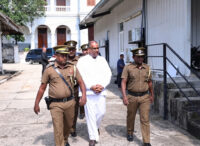
The Court of Appeal ordered enforcement of the remaining prison term imposed on Ven. Galagoda Aththe Gnanasara Thero for contempt of court. Buddhist monks continued their protest march from Kandy demanding his release and objecting to the removal of his monastic robes while in prison.
President Dissanayake announced a committee to review laws governing the treatment and transportation of Buddhist monks in prison, following objections to Gnanasara Thero appearing in court in civilian clothing. The committee, comprising the Attorney General, relevant ministries and prison officials, was instructed to submit recommendations within two weeks.
The Opposition, led by Sajith Premadasa, signed a no-confidence motion against Speaker Jagath Wickramaratne containing 49 allegations concerning his conduct and parliamentary administration.
The Anti-Corruption (Amendment) Bill was passed with amendments. The Supreme Court determined that two amendments to the Poisons, Opium and Dangerous Drugs Ordinance could be passed by a simple parliamentary majority, subject to specified committee-stage changes.
High Court Judges Navaratne Marasinghe and H.M.R.M. Thilakaratne were sworn in as Court of Appeal judges.
The Judicial Services Commission acquitted interdicted Colombo Fort Magistrate Kosala Senadheera of all charges and reinstated him with back wages. In contrast, former Moratuwa Chief Magistrate and District Judge Thilina Gamage was removed after being found guilty of all charges against him.
Investigations into whether Wimal Weerawansa’s remarks at an SLPP rally in Anuradhapura amounted to contempt of court concluded, with the summary of evidence forwarded to the Court Registrar.
Former State Minister Shasheendra Rajapaksa’s objections over the case CIABOC case against him were rejected by the Colombo High Court, thereby paving the way for the case to proceed.
Indictments were filed against former IGP Deshabandu Tennakoon and seven others in the Matara High Court over the shooting at the W15 Hotel in Matara. Separately, six individuals, including activist Piyath Nikeshala, were discharged from the case concerning the 2022 arson attack on Ranil Wickremesinghe’s private residence following instructions from the Attorney General. The overseas travel ban imposed on all 29 original suspects was lifted.
A Colombo High Court trial-at-bar sentenced Abu Hanifa Mohamed Musif and Amir Hamza Mohamed Hamza to 10 years’ rigorous imprisonment each for possessing explosives illegally at the Lastos Estate in Wanathavilluwa in 2018.
The Government also approved plans to introduce electronic communication facilities across 350 courts, including 1,050 official email accounts, as part of a broader e-Court programme involving electronic case management, voice-to-text technology and video conferencing.
Parliament, Public Administration and Education
The Government approved a revised national curriculum and student assessment framework for Grades 1–11, alongside policy-level approval for a Rs.96 billion school digitalisation project. A unified higher education admissions system is planned for 2028.
A special parliamentary committee is reviewing Sri Lanka’s election laws, excluding Provincial Council elections. An interim report is to be prepared using submissions from the public, political parties and other organisations.
The Government’s 2027 Budget process also exposed continuing challenges in public-sector management. Lanka Sathosa had accumulated losses of Rs.22 billion by December 2025, including Rs.14 billion owed to suppliers, against stocks valued at Rs.5.8 billion. Of its 452 outlets at that time, 250 were loss-making. Following restructuring, 212 of its remaining 423 outlets continued to operate at a loss.
Opposition Leader Premadasa questioned the accuracy of economic statistics produced by the Central Bank and Department of Census and Statistics, arguing that unreliable figures could lead to policies disconnected from people’s experiences. He also called for targeted microfinance debt relief, saying more than two million people had been affected by exploitative lending, particularly women.
The Government announced promotions for 2,086 Army non-commissioned officers to coincide with the Army’s 77th anniversary. Retired Air Chief Marshal Kolitha A. Gunatilake was appointed Chancellor of the General Sir John Kotelawala Defence University.
Foreign Affairs, Trade and International Relations
Sri Lanka’s handling of Iranian vessels remaining in international waters near the island became a sensitive diplomatic issue. Cabinet Spokesman Nalinda Jayatissa said decisions on assistance or facilities would be based on national security and the safety and welfare of Sri Lankans, amid concerns about possible American sanctions.
The USS Tulsa, a US Navy littoral combat ship, arrived at Colombo Port on 7 October for its second Sri Lankan visit in two years. It departed on 9 October while approximately 19–20 Iranian vessels remained offshore, according to reports.
A four-member Sri Lankan legal delegation led by Additional Solicitor General Azard Navavi travelled to Saudi Arabia to pursue the release or reduction of the death sentence imposed on Sri Lankan national Anojan Sivarasa. The delegation also included Faizer Musthapha PC, Upul Kumarapperuma PC and Hafeel Farisz.
Sri Lanka and Thailand agreed to pursue a mutual visa-exemption arrangement for ordinary passport holders.
Foreign Minister Vijitha Herath met Chinese Ambassador Wei Huaxiang on 10 October to discuss bilateral cooperation and preparations to commemorate the 70th anniversary of diplomatic relations and the 75th anniversary of the Rubber-Rice Pact in 2027.
Sri Lanka’s engagement with international human rights institutions remained contentious, particularly over proposed counterterrorism and NGO legislation.
Business, Agriculture, Transport and Sport
Poultry producers warned that prolonged maize shortages were forcing increased substitution with rice in animal feed, reducing production efficiency and threatening higher chicken and egg prices during the festive season.
One of Sri Lanka’s largest apparel exporters, MAS Holdings, committed US$90–100 million to an expansion in Tamil Nadu, reportedly linked to approximately 7,000 jobs. The investment highlights continuing regional competition for export-oriented manufacturing.
Sri Lanka’s Vehicle Emission Testing Programme is establishing a photographic unit to identify excessively smoky vehicles, with officers monitoring public roads at strategic locations.
SriLankan Airlines suspended all flights to Riyadh until 18 October amid safety and operational assessments.
In sport, javelin thrower Rumesh Tharanga Pathirage was nominated for the 2026 Men’s World Athlete of the Year award by World Athletics. Test captain Dhananjaya de Silva resigned, with Kusal Mendis appointed as his successor ahead of the two-match Test series against Pakistan.
WHAT MATTERED – THE DEEPER STORY
Three underlying issues defined the week.
First, accountability is becoming a test of institutional credibility. Investigations involving prominent political figures could strengthen public confidence if evidence is pursued impartially and cases are concluded through due process. Arrests alone, however, do not establish guilt. The treatment of suspects, transparency of investigations and consistency in applying the law will determine whether accountability becomes institutional reform or another cycle of political spectacle.
Second, economic recovery has not yet become economic security. The IMF agreement and World Bank assessment offer evidence of progress, but rising fuel costs, renewed supply constraints, poverty and reconstruction delays expose the distance between macroeconomic indicators and household welfare. The 2027 Budget should ideally reconcile fiscal discipline with investment, job creation and targeted protection for vulnerable groups.
Third, the Government faces a growing credibility challenge over civil liberties and governance. The gap between expert recommendations and the final counterterrorism Bill, together with concerns over NGO regulation, raises questions about whether promised reform will dismantle excessive state powers or reproduce them under new legislation.
WEEK IN NUMBERS
US$345 million: Potential IMF disbursement following Executive Board approval of the Seventh Review.
4.4%: World Bank’s projected Sri Lankan GDP growth for 2026.
US$4.07 billion: Fuel-import expenditure during January–August 2026.
US$6.851 billion: Official reserves at end-September.
Rs.4.99 trillion: Estimated expenditure in the 2027 Appropriation Bill, excluding additional Consolidated Fund items.
Rs.500 billion: Reconstruction allocation following Cyclone Ditwah, of which approximately 8% had been disbursed by mid-year.
34,000: Individuals identified as having failed to submit mandatory asset declarations.
Rs.22 billion: Lanka Sathosa’s accumulated losses by December 2025.
Rs.16 billion: Approved fertiliser assistance for the 2026/27 Maha season.
Rs.96 billion: Proposed school digitalisation project.
THE WEEK AHEAD: 11–17 OCTOBER
The immediate focus will be on the IMF’s Executive Board process and whether the Government’s fiscal plans satisfy the conditions required to unlock the next disbursement. The 2027 Budget will come under closer scrutiny over recurrent expenditure, capital investment and the Government’s ability to convert allocations into actual delivery.
The remand of Shiranthi Rajapaksa, scheduled to continue until 13 October, will keep attention on the Bribery Commission’s investigations and the wider question of accountability. Also, the anticipatory bail application filed by her against her possible arrest by the FCID will be taken up at the Maligakanda court on 12 October.
The two cases against Namal Rajapaksa on the controversial Airbus deal will be taken up. The Bribery case is due on 13 October while the money laundering case is due on 14 October.
Further legal developments concerning Gnanasara Thero, the Easter Sunday investigations and proposed counterterrorism legislation will test the independence and credibility of the country’s institutions.
Fuel availability, the cost of imports and the implementation of reconstruction and fertiliser assistance will remain immediate economic concerns.
The Government must also manage diplomatic sensitivities surrounding Iranian vessels and American interests while protecting Sri Lanka’s national interests.





Leave a comment