
By The Pulseline News Desk
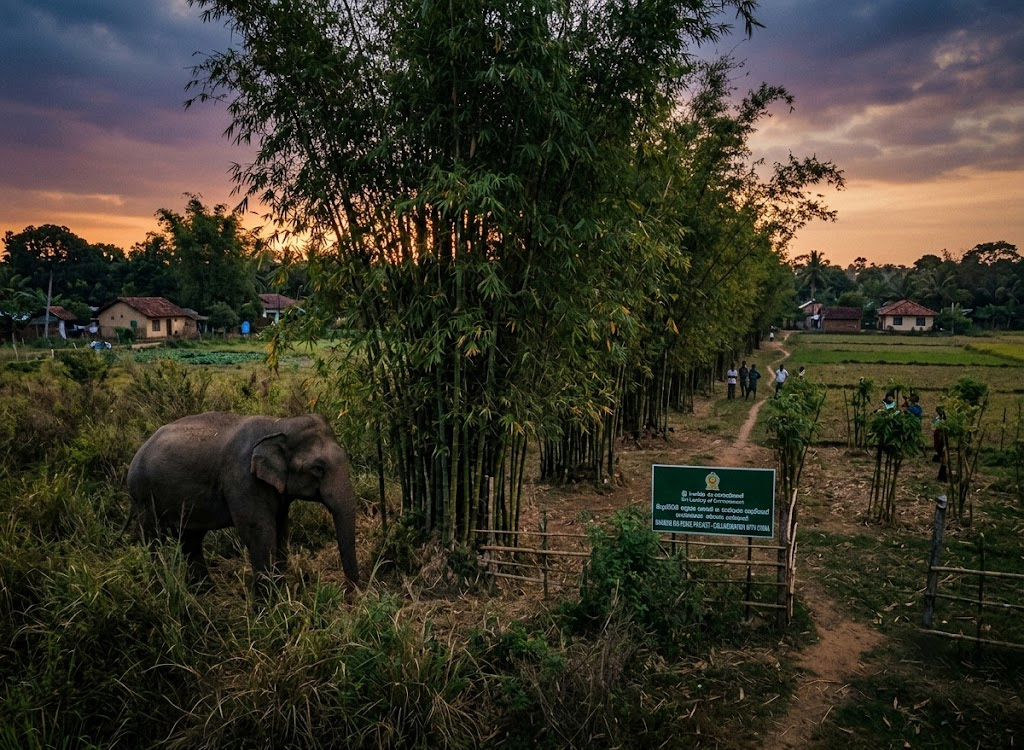
After decades of electric fences, trenches and costly mitigation programmes that have failed to end Sri Lanka’s deadly human-elephant conflict, the government is now looking to an unlikely ally — bamboo.
Sri Lanka has secured China’s support to explore the use of bamboo “bio-fences” as an environmentally friendly barrier to reduce encounters between wild elephants and farming communities, marking a fresh attempt to tackle one of the country’s most persistent conservation crises.
The proposal was discussed during an official visit to the International Center for Bamboo and Rattan (ICBR) in Beijing, where a Sri Lankan delegation led by Deputy Environment Minister Anton Jayakody had sought technical cooperation on bamboo cultivation and industrial applications.
The Chinese institution had agreed to assist Sri Lanka through research, technology transfer and the sharing of international best practices to develop bamboo-based protective barriers.
Searching for a new approach
Human-elephant conflict remains one of Sri Lanka’s most difficult wildlife management challenges, claiming the lives of hundreds of elephants and dozens of people every year while causing extensive damage to crops and property.
Successive governments have invested heavily in electric fences and other deterrent systems, yet many have struggled with poor maintenance, encroachment and limited long-term effectiveness.
The government now hopes bamboo could provide a more sustainable alternative.
Unlike conventional fencing, bamboo bio-fences could serve multiple purposes — acting as a natural barrier while also supporting environmental restoration and generating economic value.
More than conservation
Officials say the proposal extends beyond wildlife protection.
During discussions in Beijing, Sri Lankan representatives had also explored modern bamboo cultivation techniques, processing technologies and the potential to develop bamboo-based industries.
The Environment Ministry believes the initiative could create new livelihood opportunities for rural communities by encouraging bamboo cultivation and supporting value-added manufacturing.
If successful, the project could combine conservation with economic development, allowing communities living near elephant habitats to benefit from bamboo production while reducing conflict with wildlife.
China expands green cooperation
China has become an increasingly important partner in Sri Lanka’s environmental and agricultural sectors, providing technical expertise in areas ranging from forestry to climate resilience.
Its commitment to support bamboo research adds another dimension to bilateral cooperation, particularly as Sri Lanka seeks nature-based solutions to environmental challenges.
The proposed collaboration will focus on research and development, modern cultivation techniques and adapting successful international practices to local conditions.
Can it work?
Whether bamboo bio-fences will prove effective in Sri Lanka remains to be seen.
Wildlife experts have long argued that no single solution can resolve the human-elephant conflict, which is driven by habitat fragmentation, expanding agriculture and human settlements encroaching into elephant ranges.
However, proponents argue that combining ecological restoration with community-based economic incentives could make bamboo fences more sustainable than conventional infrastructure that often falls into disrepair.
For the government, the initiative represents an attempt to move beyond reactive measures and experiment with a greener, more integrated approach.
If the research delivers positive results, bamboo could become more than just a plant — it could emerge as an unexpected tool in one of Sri Lanka’s longest-running battles between people and wildlife.













Leave a comment