
By The Pulseline News Desk
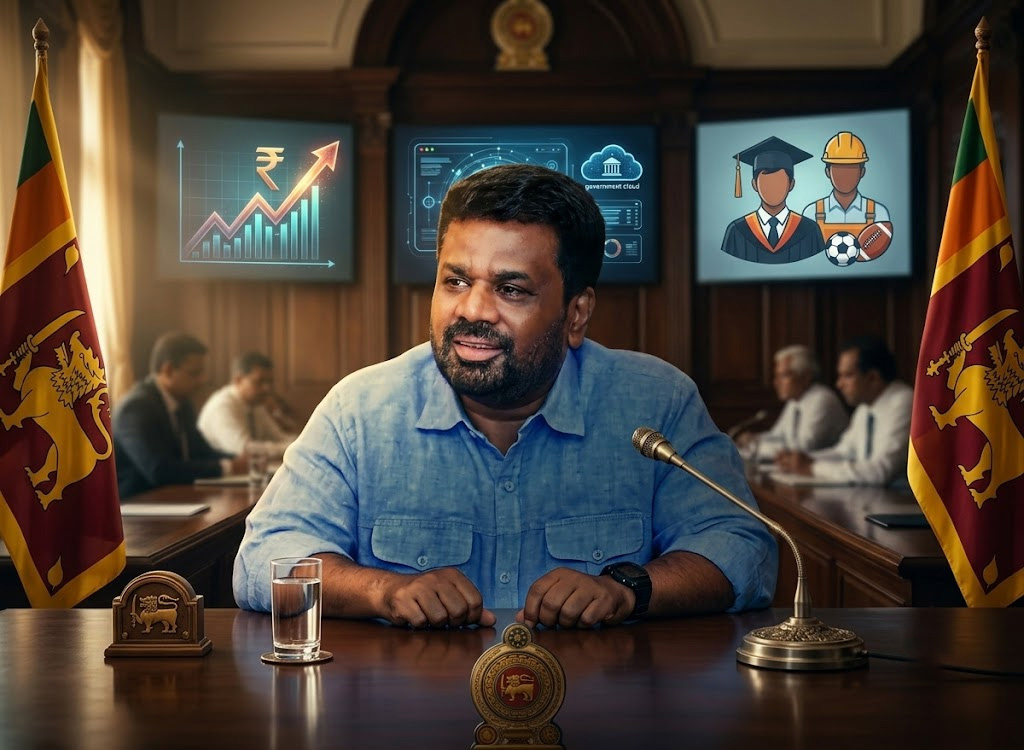
President Anura Kumara Dissanayake has unveiled the broad contours of the government’s economic strategy for 2027, promising a decisive shift from fiscal stabilisation towards development spending, digital transformation and job creation.
Addressing the Galle District Special Coordination Committee Meeting, the President said the government was preparing to substantially increase public investment while keeping a tight grip on recurrent expenditure — a move that signals the next phase of the administration’s economic agenda following efforts to restore macroeconomic stability.
At the heart of the plan is a dramatic increase in capital expenditure, with the government intending to allocate around Rs. 2 trillion for development projects in 2027, an increase of approximately 40% compared to previous allocations.
The announcement suggests the administration believes it has created sufficient fiscal space to transition from crisis management to long-term investment, although financing such an ambitious programme will remain closely watched amid Sri Lanka’s continuing commitments under the IMF-backed reform programme.
From austerity to investment
President Dissanayake said the government intends to reduce recurrent expenditure, currently standing at around 9%, while increasing capital expenditure from roughly 4%.
The strategy reflects the administration’s argument that public finances should increasingly support productive investment rather than administrative costs.
Government officials have repeatedly argued that sustained economic recovery will depend not merely on stabilising public finances but on generating growth through infrastructure, industry and investment.
The President’s latest remarks reinforce that message.
Digital government takes centre stage
Another major priority identified for the 2027 Budget is the digitalisation of public services.
The government plans to expand online public services, allowing citizens to access government institutions remotely while reducing bureaucracy and improving efficiency.
Digital governance has become one of the NPP administration’s flagship reform initiatives, with ministers arguing that technology can reduce corruption, minimise delays and improve transparency across the public sector.
If successfully implemented, it would represent one of the most significant overhauls of Sri Lanka’s state administration in decades.
Retirement debate widens
The President also revealed that the government is considering extending the retirement age in selected sectors to retain experienced professionals.
The announcement comes as the government is already facing fierce resistance over its proposal to increase the retirement age of judges through constitutional amendments.
Unlike the judicial proposal, however, the President framed his latest remarks in broader terms, suggesting that extensions would apply selectively where specialised expertise is needed within the public service.
The comments are likely to fuel further debate over how the government intends to balance retaining experienced officials with creating opportunities for younger entrants into the public sector.
Betting on youth
While emphasising experience in key sectors, the President simultaneously pledged to create more employment opportunities by building what he described as an outward-oriented economy.
Youth development also featured prominently in the government’s priorities.
President Dissanayake said greater investment would be directed towards sports, arguing that stronger sporting infrastructure and participation could help address wider social problems, including drug abuse among young people.
Anti-drug campaign continues
The President also used the meeting to highlight the government’s ongoing anti-narcotics campaign.
According to official figures, authorities have conducted 12,608 raids in the Galle District under the “Ratama Ekata” operation since October 2025, resulting in the seizure of 119.6 kilograms of illicit drugs.
The government has increasingly linked its anti-drug drive with broader social and economic policies, arguing that community development, employment and youth engagement are essential components of crime prevention.
A broader development push
Beyond national policy, the President reviewed progress on a range of district-level projects, including housing programmes, rural roads, water supply schemes, waste management initiatives and plans to position Galle as a major tourism and economic hub.
Taken together, the announcements indicate that the government is preparing to enter a new phase of its economic programme – one focused less on stabilisation and more on investment-led growth.
Whether the ambitious spending plans can be delivered while maintaining fiscal discipline will become one of the defining tests of the government’s 2027 Budget and its broader promise of economic transformation.









Leave a comment