
By The Pulseline News Desk
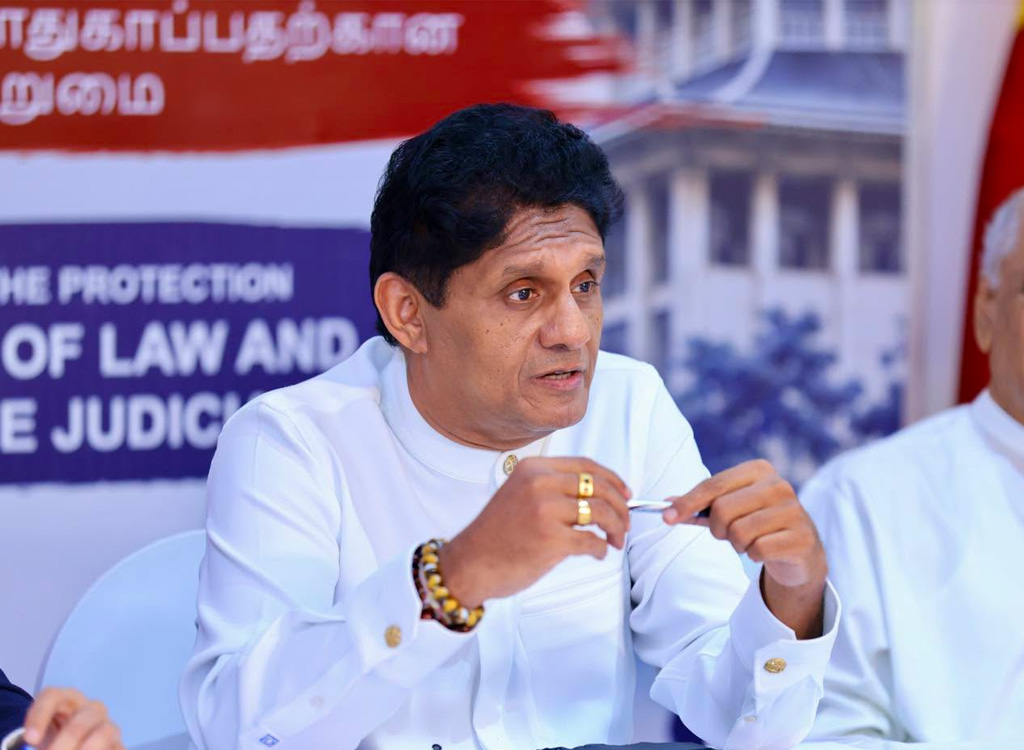
Opposition Leader Sajith Premadasa has launched a scathing attack on the government over its proposed constitutional amendment to extend the retirement age of judges, alleging that the move is an attempt to bring the Judiciary under executive influence and poses a serious threat to Sri Lanka’s democratic framework.
In a special statement on Thursday (30 July), Premadasa claimed that the National People’s Power (NPP) government had been elected with a mandate to abolish or reform the Executive Presidency and strengthen democratic institutions, not to alter the structure of the Judiciary.
“The government was given a mandate to abolish the Executive Presidency, not to turn the Judiciary into an instrument of the Executive,” he said.
The Opposition Leader argued that changing the retirement age of judges through constitutional amendments would enable the Executive to interfere with the independence of the courts, undermining one of the three pillars of democratic governance.
According to Premadasa, Sri Lanka’s constitutional order is founded on the separation of powers between the Legislature, the Executive and the Judiciary, with each institution serving as a check on the others. He accused the government of attempting to weaken this balance by introducing reforms that would compromise judicial independence.
He also criticised the administration for pursuing what he described as an increasingly authoritarian approach to governance, warning that efforts to exert influence over the Judiciary could erode public confidence in the courts and damage the credibility of judges.
Referring to the political philosophy of Montesquieu, Premadasa urged President Anura Kumara Dissanayake and Justice Minister Harshana Nanayakkara to revisit the principles outlined in The Spirit of Laws, arguing that the doctrine of separation of powers remains fundamental to any functioning democracy.
The remarks come amid growing debate over the government’s proposal to amend the Constitution to increase the retirement age of superior court judges. The proposal has already drawn criticism from several legal bodies, including the Judicial Service Association of Sri Lanka (JSASL) and the Bar Association of Sri Lanka (BASL), both of which have warned that extending judicial tenure could have implications for judicial independence, institutional integrity and public confidence.
Premadasa also drew parallels with developments in neighbouring India, arguing that political interference in public institutions often faces resistance from citizens. He cited recent youth-led protests in India as an example of public pressure leading to political accountability, claiming that Sri Lankan youth would similarly oppose any attempt to weaken democratic institutions.
He warned that civil society, young people and the wider public would not remain silent if the government proceeded with constitutional changes that, in his view, undermine the independence and reputation of the Judiciary.
Calling on the government to abandon what he described as an “authoritarian agenda”, Premadasa urged the administration to instead focus on strengthening democratic institutions, protecting media freedom, safeguarding civil society and upholding the rule of law.
He said the Samagi Jana Balawegaya (SJB), as the main opposition, was prepared to oppose any constitutional amendment that threatens the independence of the Judiciary and would continue to defend the country’s democratic institutions.











Leave a comment