
By The Pulseline News Desk
President Anura Kumara Dissanayake’s decision not to occupy any of Sri Lanka’s official presidential residences has been one of the most visible symbols of his administration’s promise to reduce the privileges of political office. Yet the latest National Audit Office (NAO) report suggests that symbolism alone does little to reduce the cost of maintaining the institution of the presidency.
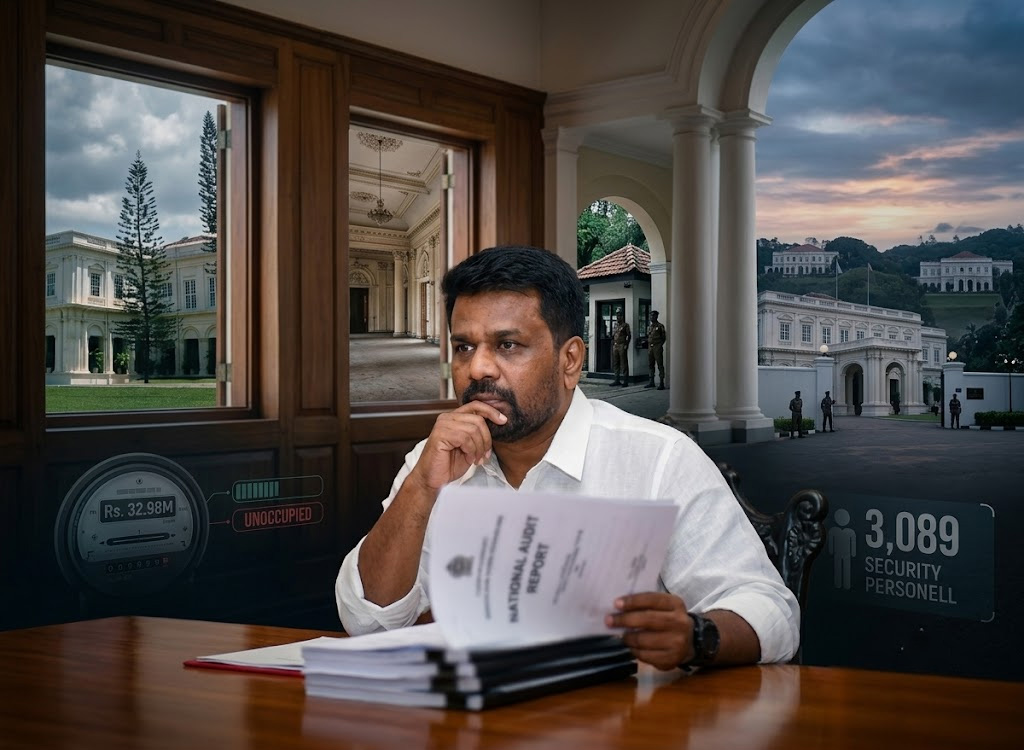
According to the audit, President Dissanayake did not stay at any of the seven official presidential residences during 2025. Nevertheless, the State had spent nearly Rs. 33 million on electricity, telephone services, maintenance and other recurring expenses to keep the properties operational.
The findings underscore a broader reality confronting the Government’s austerity agenda: reducing expenditure often requires structural reforms rather than individual decisions.
The audit had revealed that Rs. 32.98 million was spent maintaining the seven official residences located in Colombo Fort, Kandy, Anuradhapura, Kataragama, Mahiyanganaya, Nuwara Eliya and Bentota during the year.
Three of those properties – in Kataragama, Mahiyanganaya and Bentota – had not been used at all. No official meetings had been held and no overnight stays were recorded at any of the three locations throughout 2025. Even so, they had accumulated Rs. 2.45 million in utility and related expenses.
While the President himself had stayed away from the residences, the audit had recorded that 3,089 individuals were accommodated at several of the premises during the year. Only three official meetings, however, had taken place across the entire network of residences, prompting questions over the primary purpose for which the facilities continue to be maintained.
The findings initially sparked political criticism and speculation that the residences had been occupied by outsiders despite the President’s decision not to use them. However, the President’s Media Division (PMD) quickly rejected that interpretation.
According to the PMD, the audit figures have been misunderstood. It said the 3,089 individuals referred to in the report were security personnel, officers attached to the PMD and other state officials who were provided temporary accommodation in separate buildings located within the compounds of the presidential residences to meet operational requirements. It stressed that no one had been accommodated inside the presidential residences themselves.
The clarification addresses one aspect of the controversy but leaves the broader financial question unresolved.
Whether the occupants had stayed inside the residences or elsewhere within the compounds, the audit had once again highlighted the recurring public cost of maintaining an extensive presidential estate inherited from previous administrations.
The issue is particularly significant given the political message President Dissanayake has sought to project since taking office. His refusal to move into the official residences has been presented as part of a wider effort to reduce unnecessary state expenditure and distance his administration from the excesses traditionally associated with executive office.
However, the audit illustrates the limits of symbolic reforms. State assets continue to generate maintenance costs regardless of whether they are actively used. Utilities, security, staffing and routine upkeep remain necessary unless the Government makes policy decisions on the long-term future of the properties.
The report is therefore likely to revive an old but increasingly relevant debate: does Sri Lanka still require seven official presidential residences spread across the country?
Those residences were established over decades to facilitate official travel, ceremonial functions and state engagements. Yet changing patterns of governance, improvements in transport infrastructure and growing fiscal pressures have led many to question whether such an extensive network remains justified.
As the Government presses ahead with public sector reforms and fiscal consolidation following Sri Lanka’s economic crisis, the audit may strengthen calls for a comprehensive review of the presidential estate portfolio. Options such as consolidating the number of official residences, repurposing underutilised properties for other government functions or transferring them to institutions capable of making productive use of them are likely to gain renewed attention.
For an administration that has consistently campaigned on accountability and prudent use of public resources, the audit presents both a challenge and an opportunity. While the President may have chosen not to enjoy the privileges of the official residences, the report suggests the real test of reform lies not in declining to occupy them, but in deciding whether the State still needs to maintain them at all.








Leave a comment