
By the Pulseline News Desk
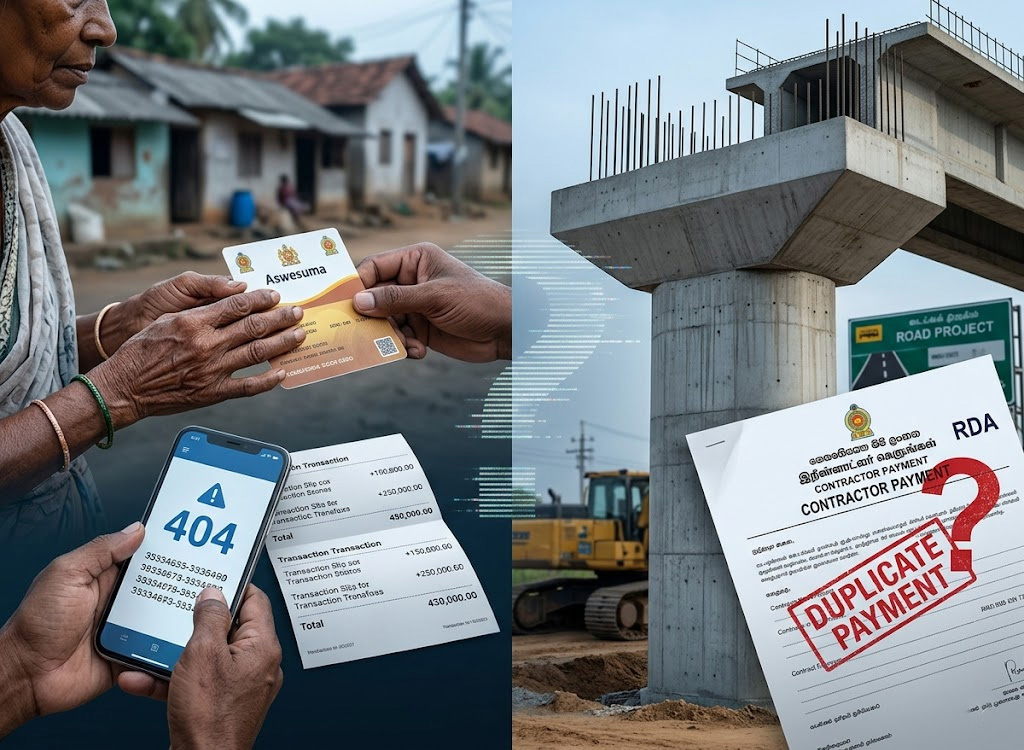
What began as a festive welfare allowance for struggling families has evolved into a wider debate over accountability in Sri Lanka’s public finance system, especially after recent revelations that duplicate payments were also made to Road Development Authority (RDA) contractors.
The Finance Ministry recently admitted that thousands of Aswesuma recipients had received double payments for April after what officials described as an “accidental” duplicate upload of payment files during the processing of additional Sinhala and Tamil New Year allowances.
In a statement, the Welfare Benefits Board said a payment “slip file” had been uploaded twice, leading to duplicate transfers into beneficiary accounts. Though authorities insisted the mistake was technical in nature, the incident has triggered public criticism over oversight failures within state financial systems.
But the controversy has unfolded against a broader backdrop of government spending decisions that are increasingly drawing scrutiny from economists, opposition politicians, and citizens alike.
Even as officials investigate the duplicate Aswesuma payments, the government is looking at correcting the erroneous payments made to RDA contractors.
Pressure on public finances
The Aswesuma programme was introduced as a replacement for the long-running Samurdhi scheme, with the government promising a more targeted and digitally efficient welfare model.
Authorities had promoted the system as a reform aimed at reducing corruption, improving beneficiary identification, and ensuring that financial assistance reached the country’s most vulnerable households.
However, the duplicate payment incident has exposed weaknesses in operational controls and raised concerns about whether Sri Lanka’s rapidly digitised public payment infrastructure has adequate safeguards.
Analysts say the issue extends beyond a simple technical mistake.
“This is fundamentally about governance and financial discipline,” said one Colombo-based public finance researcher. “When a state is under IMF-linked fiscal pressure, every rupee disbursed through public systems comes under scrutiny — whether it is welfare payments or infrastructure spending.”
The government has not yet disclosed the total financial value of the duplicate Aswesuma transfers or how many accounts were affected. Officials also remain unclear about whether recipients will be asked to repay the excess amounts.
Public confidence at stake
For many Aswesuma recipients, the duplicate deposits initially appeared to be part of the government’s New Year relief package. Some families reportedly used the money immediately for food, clothing, school expenses, and holiday preparations.
Now uncertainty surrounds whether those funds may eventually be recovered.
Social policy advocates warn that any aggressive repayment effort could place additional pressure on already vulnerable households.
At the same time, governance activists say the incident highlights a deeper challenge confronting Sri Lanka’s public sector: ensuring transparency and accountability across increasingly digitised financial systems.
The government now faces the difficult task of reassuring both welfare recipients and taxpayers that public money – whether directed toward social protection or infrastructure contractors – is being managed responsibly.
In a country still recovering from economic trauma, even a single administrative error can quickly evolve into a broader symbol of public distrust.










Leave a comment