
By The Pulseline News Desk
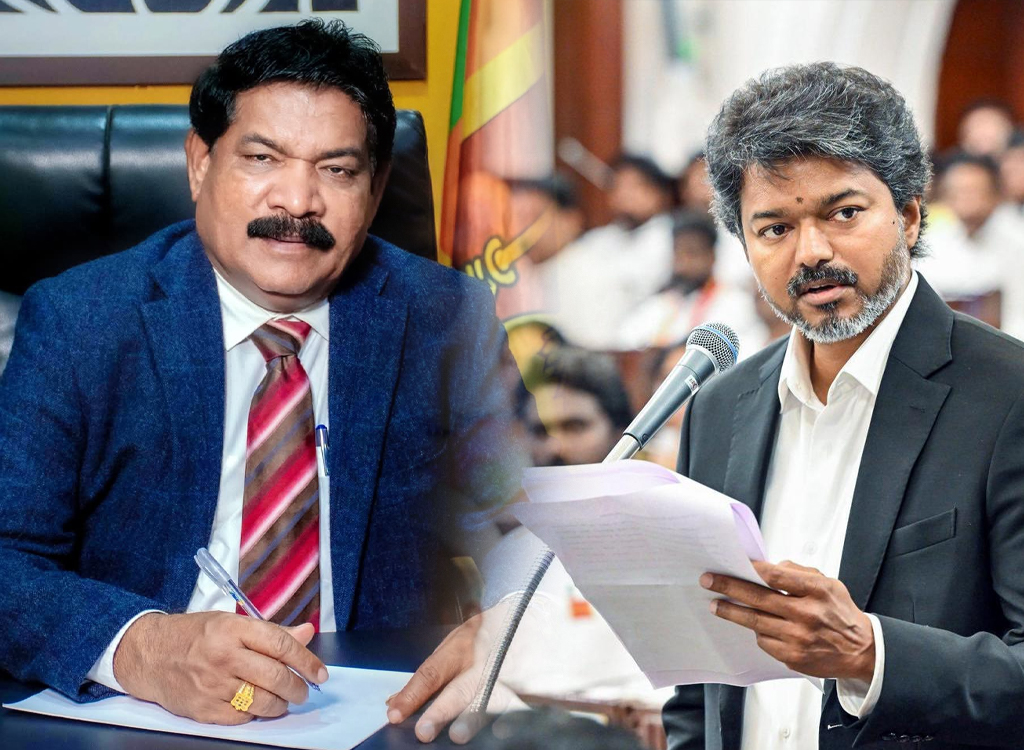
The waters of the Palk Strait have long carried more than fishing boats. They bear the weight of history, livelihoods, politics, and an increasingly urgent environmental crisis shared by Sri Lanka and India. It is in such a backdrop that Sri Lanka’s Fisheries Minister Ramalingam Chandrasekar has renewed calls for an end to bottom trawling by Indian fishermen, describing the practice as destructive and unsustainable, while also extending an olive branch to Tamil Nadu’s newly elected Chief Minister C. Joseph Vijay.
Addressing journalists in Kilinochchi, Chandrasekar has said he hoped to travel to Tamil Nadu for direct talks with Vijay, signalling a possible diplomatic thaw in one of the region’s most contentious maritime disputes.
At the centre of the issue lies bottom trawling – a fishing method in which weighted nets are dragged across the seabed, scooping up fish along with coral, juvenile marine life, and fragile ecosystems. Sri Lanka outlawed the practice in 2017, citing severe environmental damage and declining fish stocks. However, many mechanised trawlers from Tamil Nadu continue to cross into Sri Lankan waters, particularly in the narrow Palk Strait, where rich fishing grounds sustain thousands of coastal families on both sides.
For northern Sri Lankan fishermen, especially in districts such as Jaffna, Mannar, and Kilinochchi, the issue is existential. Local fishing communities say Indian trawlers enter their waters at night in large numbers, damaging nets, depleting marine resources, and threatening the recovery of livelihoods devastated during Sri Lanka’s nearly three-decade civil war.
Livelihood woes
“The sea is our only source of income,” said a fisherman from the northern coast who attended the press briefing. “After the war ended, we hoped to rebuild our lives. But the trawlers are taking everything.”
The dispute has repeatedly strained relations between Colombo and New Delhi. Sri Lankan authorities frequently arrest Indian fishermen accused of crossing the International Maritime Boundary Line, while Tamil Nadu politicians often demand their immediate release, arguing that traditional fishing rights in the Palk Strait predate modern maritime borders.
Chandrasekar’s remarks suggest Sri Lanka may now be seeking a more political and cooperative route to resolving the conflict. By directly appealing to Chief Minister Vijay, the minister appeared to recognise Tamil Nadu’s central role in influencing fishing policy and fishermen’s behaviour along India’s southern coast.
Observers say the timing is significant. Vijay, a popular actor-turned-politician, assumed office amid high public expectations and strong support from coastal communities. His administration is likely to face pressure from both mechanised trawler owners and artisanal fishermen, whose interests often diverge sharply.
Welcome move
Environmental groups have welcomed Sri Lanka’s renewed push against bottom trawling, warning that the ecological damage could become irreversible if the practice continues unchecked. Marine scientists have repeatedly cautioned that the shallow seabed of the Palk Strait is particularly vulnerable to intensive trawling methods.
Yet solutions remain politically difficult. Tamil Nadu’s fishing industry depends heavily on mechanised trawlers built over decades with government subsidies and economic incentives. Transitioning to sustainable deep-sea fishing would require substantial financial support, training, and bilateral coordination.
Despite the tensions, both countries have continued periodic diplomatic engagements on fisheries management. Joint working groups and fishermen-level talks have been held intermittently, though with limited success.
Chandrasekar’s statement in Kilinochchi carried a tone of cautious optimism. “We are prepared to resolve this through discussion and diplomacy,” he said, emphasising dialogue over confrontation.
For fishing communities on both shores, the hope is that politics can finally succeed where years of arrests, protests, and negotiations have struggled – preserving both livelihoods and the fragile waters that sustain them.










Leave a comment