
By Milinda Moragoda
Sri Lanka is once again at a moment of crisis – shaped by economic uncertainty, energy insecurity, and the aftershocks of its recent financial collapse. Recent attacks on Iran have further disrupted energy markets, exposing the fragility of supply chains. Yet, as so often in its post-independence history, the central question is not the nature of the crisis, but whether the country has the vision to convert it into opportunity.
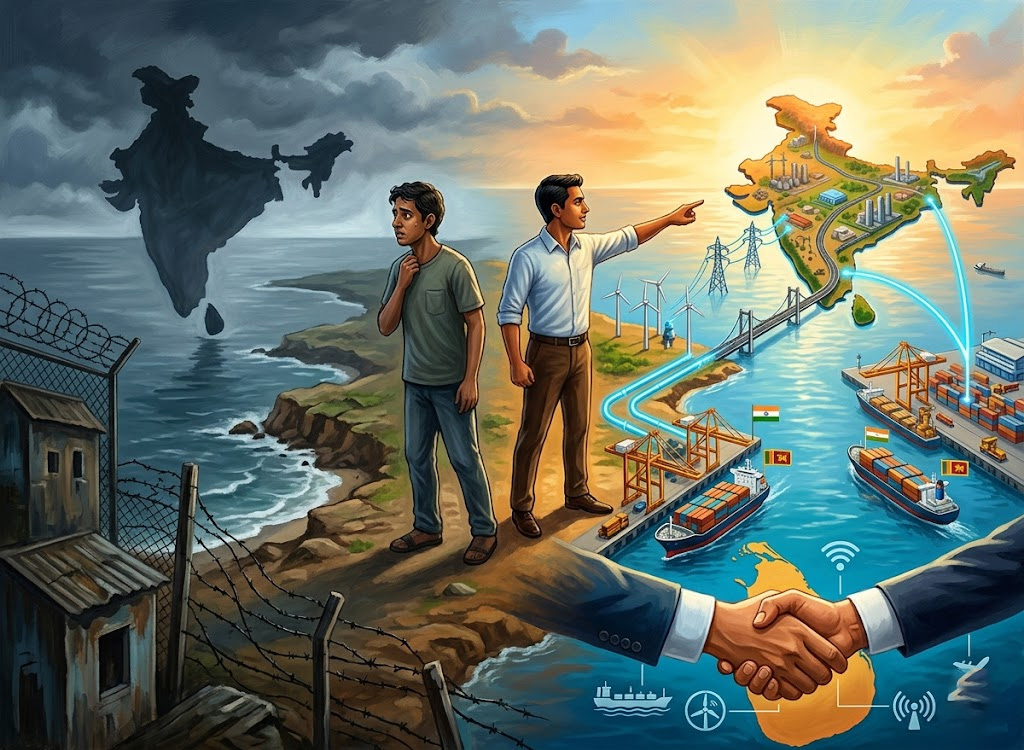
At a time when India is emerging as a principal driver of regional growth and connectivity, Sri Lanka faces a stark choice: align with this transformation or remain constrained by the anxieties of the past.
History offers instructive parallels. The Netherlands positioned itself as Europe’s logistics hub after the Second World War, while Singapore became Southeast Asia’s gateway. Both translated geographic advantage into sustained execution.
Sri Lanka, too, was poised – by geography and history – to play a comparable role for South Asia. Yet its trajectory has been marked by false starts and unrealised expectations. External shocks played a part, but the deeper constraint has been internal: populist politics and an inward-looking mindset, accompanied by unease about external engagement, particularly with India.
The contrast is striking. Sri Lankans have excelled globally in open, competitive environments. Yet, at home, the country has struggled to align policy with opportunity.
Recent proposals on energy connectivity between India and Sri Lanka-including an oil pipeline, the development of the Trincomalee tank farm, and the transformation of the Port of Trincomalee into a regional energy hub-reflect a long-overdue recognition of strategic reality. Interest from the United Arab Emirates strengthens the case. Sri Lanka’s annual oil and petroleum requirement is roughly equivalent to about one week’s requirement for India, making practical arrangements on energy security relatively straightforward.
These discussions have gained urgency. The strategic imperative, however, is fundamentally Sri Lanka’s: to finally operationalise an asset that has remained unrealised for decades.
Sri Lanka’s wind energy potential in the northwest – estimated at over 15,000 MW, around three times current capacity – offers another opportunity. Exporting renewable energy to India is both commercially viable and strategically transformative.
Yet, Sri Lanka’s experience suggests that opportunity alone is not enough. The trajectory of Indo-Sri Lankan economic relations reflects this pattern of missed opportunities. India’s first-ever Free Trade Agreement with any country, signed with Sri Lanka in 1998, held considerable promise, but progress has been uneven. Delays in the Trincomalee tank farm project, signed in 2003, and the cancellation of the Sampur power project illustrate this pattern, as does the more recent cancellation of a major wind project in Mannar and Pooneryn.
The ports sector tells a similar story. Sri Lanka’s deep-water advantage at the Port of Colombo has made it a vital transhipment hub, with nearly 50% of its volume linked to India. However, as India expands its own port infrastructure, this advantage cannot be taken for granted. The withdrawal from the East Container Terminal arrangement reflected recurring hesitation, while progress on the West Container Terminal must be followed by further development, including Colombo’s North Port.
Connectivity must extend beyond ports. Bandaranaike International Airport requires expansion and investment, potentially through partnerships with India and Japan. Measures such as pre-clearance arrangements for Indian travellers in Colombo, akin to US-style pre-clearance in Abu Dhabi, could further deepen linkages.
Looking ahead, more ambitious infrastructure links – through road and rail connections between India and Sri Lanka – should be explored, despite political sensitivities. Sri Lanka’s mineral resources-graphite, phosphate, and ilmenite-also offer opportunities for integration into regional supply chains, particularly in meeting India’s growing industrial demand. In this regard, the recent proposal by Japan for an India-Sri Lanka export-oriented economic corridor merits serious consideration.
Across decades, successive governments have often squandered strong mandates through short-term populism. Each crisis has raised hopes of course correction; too often, those hopes have faded.
There are, however, clear examples of progress. Tourism is one such area. India is now Sri Lanka’s largest source of visitors, and this flow has been both economically beneficial and socially well-received. Sri Lanka has the potential to position itself as a preferred leisure destination for Indian travellers – perhaps even as a “new Goa” for segments of the market, with Colombo only about an hour further from Delhi.
Digital cooperation is another promising frontier. Collaboration on digital public infrastructure, including initiatives around a unique digital identity, could enhance service delivery, expand financial inclusion, and integrate Sri Lanka more deeply into regional ecosystems.
The central challenge, therefore, is not one of geography or resources, but of mindset. Sri Lanka must recognise that while asymmetries in size and power are real, India is an opportunity that should be seized with clarity and confidence, as an equal partner.
For such a partnership to succeed, the Indian side must move decisively to translate agreements into tangible outcomes, with faster and more responsive execution. India, as the larger partner, should also be more sensitive to the imbalance inherent in the relationship, and accordingly more accommodating.
If that shift occurs, Sri Lanka can still realise its long-delayed destiny as South Asia’s logistics and economic hub-its own version of the Netherlands or Singapore, albeit belatedly.
The present crisis is not just a test of resilience-it is a test of imagination. Sri Lanka has long stood at the threshold of opportunity without crossing it. If it can now overcome its hesitations and engage more confidently with India and the region, it may yet convert vulnerability into lasting transformation.
(Milinda Moragoda is a former Cabinet Minister and diplomat from Sri Lanka and founder of the Pathfinder Foundation, a strategic affairs think tank, can be contact at [email protected])
Disclaimer: The views and opinions expressed in this article are those of the writer and do not necessarily reflect the official position of this publication.












Leave a comment