
By Lionel Bopage
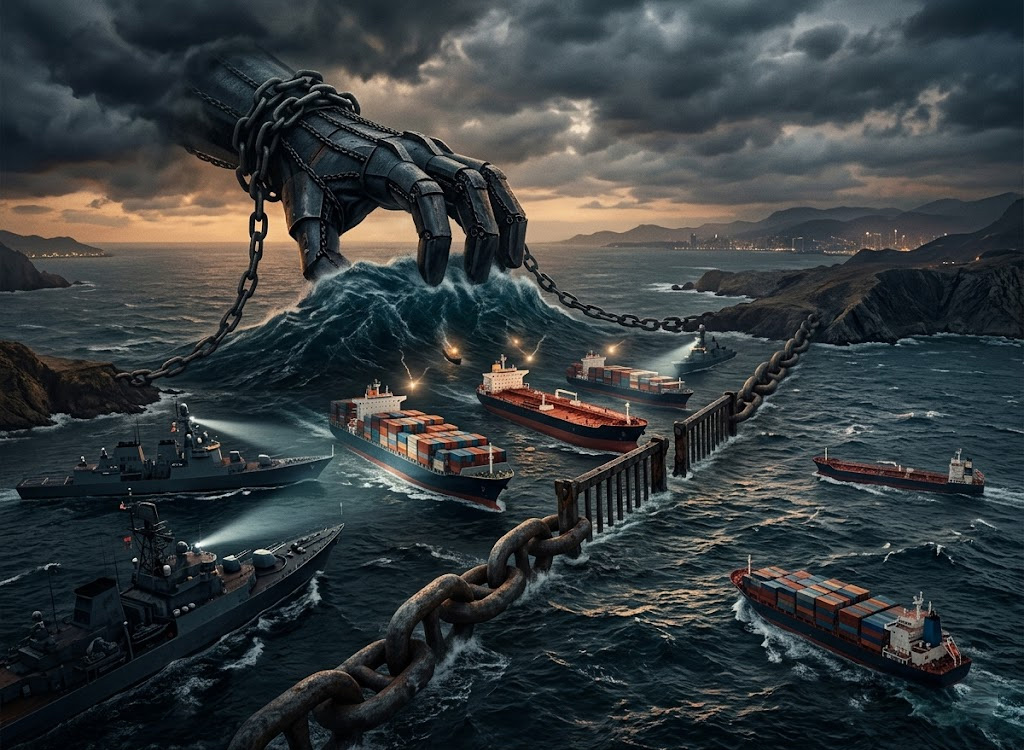
Secretary of State Marco Rubio demands that the international community force Iran to reopen the Strait of Hormuz, calling on the United Nations to pressure Tehran to “stop blowing up ships, remove the mines and allow humanitarian relief”. The world would do well to pause and ask a pointed question: what standing does the United States have to invoke the principle of free passage when it has spent decades doing precisely the opposite, strangling nations, blocking trade, and making life unliveable for millions of ordinary people?
Rubio has urged the UN Security Council to back a resolution that could lead to sanctions against Iran and potentially authorise force if Tehran fails to halt attacks on commercial shipping. The closure of the strait, through which one-fifth of the world’s oil and natural gas passes during peacetime, has caused oil prices to rocket and prompted fears of a global economic crisis. These are legitimate concerns. Freedom of navigation matters. But the United States cannot position itself as the guardian of open waterways while simultaneously running the most extensive unilateral economic blockade system in the world.
This hypocrisy is not subtle. This is decades old and is written in the suffering of ordinary people across multiple continents.
Cuba: Six decades of strangulation
For over 60 years, the United States has maintained an extensive regime of economic, trade and financial restrictions against Cuba. This is the longest-running unilateral sanctions policy in US foreign relations. A UN Special Rapporteur visiting the island concluded that the US “must lift” these sanctions, which have severely affected every aspect of Cuban life for generations.
The situation has intensified dramatically in 2026. This January, Executive Order 14380 entered into force, authorising the imposition of additional tariffs on imports from any country that directly or indirectly supplies oil to Cuba. The result has been catastrophic. In this February, Cuba suspended refuelling for airliners at its airports, including José Martí International Airport, stating it had exhausted the country’s fuel supply due to the US blockade (https://www.ohchr.org/en/press-releases/2025/11/enforcement-and-recent-strengthening-us-sanctions-deepen-hardships-cuban).
This is collective punishment of an entire population. Shortages of essential machinery, spare parts, electricity, water, fuel, food and medicine, alongside the growing emigration of skilled workers, including medical staff, engineers and teachers, have severe consequences for the enjoyment of human rights, including the rights to life, food, health and development, the UN rapporteur found. Cuba estimated that between March 2024 and February 2025 alone, it suffered material losses amounting to $7.5 billion, roughly $20 million per day.
What happens to countries that dare to trade with Cuba? They too face punishment. Trump threatened potential military action and tariffs against any country supplying oil to Cuba. This forced Mexico to temporarily halt its shipments. Washington has essentially told the world, trade with this island nation, and ‘we will come after you’ too.
In October 2025, the UN General Assembly voted 165 to 7 to call for an end to the US embargo. The United States stood almost alone. Yet the blockade continues. Rubio, who was quick to warn Iran about closing a strait, has said not a word about his own government closing off an island nation’s fuel supply.
Iraq: Children who paid the price
The Cuba situation is not unique. Before the US invasion of Iraq in 2003, the comprehensive UN sanctions regime, driven largely by American pressure, devastated the Iraqi civilian population throughout the 1990s. A UNICEF demographic survey confirmed that the under-five mortality rate more than doubled in central and southern Iraq. The rate had risen from fifty-six deaths per 1,000 births in the mid-1980s to 131 per 1,000 births by the late 1990s.
The sanctions greatly restricted Iraq’s ability to import supplies of food and medicines, leading to a marked increase in malnutrition, particularly among the most vulnerable young children. Saddam Hussein’s regime bore its own enormous responsibility for the suffering of the Iraqi people – but the sanctions regime ensured that ordinary families, not the regime, bore the heaviest burden.
Iran, Venezuela, and the “maximum pressure” blueprint
The same logic continues today. As described, Washington’s “maximum pressure” campaigns are designed not merely to change behaviour but to make a government’s survival economically impossible. The United States has drafted a UN resolution with Gulf allies. If passed, it could lead to further sanctions against Iran and potentially authorise force. This resolution is from an administration that has spent years undermining the very UN system it now wants to use as a weapon.
This selective multilateralism is breathtaking in its audacity. Since Donald Trump began his second term, Washington has undermined the UN and the existing international rules-based order. Trump himself questioned the purpose of the United Nations in a 2025 speech to the General Assembly. Yet now, when it suits Washington’s interests, Rubio calls the UN’s credibility into question if it doesn’t back America’s resolution. The UN, it seems, is useful when it agrees with Washington and irrelevant when it doesn’t.
Where the blockade comes with bombs
No account of economic warfare against civilian populations would be complete without Gaza. Since October 2023, the people of the occupied Palestinian territories have endured not merely a sanctions regime but a comprehensive siege. It is siege in which the withholding of food, medicine, and fuel has been paired with the systematic destruction of the very institutions meant to sustain life.
Before the war, malnutrition in Gaza was almost non-existent. For two and a half years, the systematic blockade of humanitarian aid and commercial goods has severely restricted access to food and clean water, forcing healthcare facilities out of service and profoundly deteriorating living conditions. Médecins Sans Frontières has been unequivocal: the malnutrition crisis is entirely manufactured.
More than half of the women cared for at two hospitals suffered from malnutrition during pregnancy. Ninety percent of babies born under those conditions were premature, and eighty-four percent had a low birth weight. All these a consequence of deliberate policy, not the fog of war. Since March 2025, Israeli authorities have been blocking UNRWA from directly bringing humanitarian personnel and aid into the Gaza Strip. The agency already had enough food parcels, flour, and shelter supplies pre-positioned outside Gaza for hundreds of thousands of people (https://www.msf.org/deliberate-restriction-food-and-aid-led-alarming-malnutrition-gaza).
The assault on Gaza’s future has been equally systematic. Nearly 88 percent of all school buildings in Gaza have been damaged or destroyed, leaving 625,000 students without education. More than 5,479 students and 261 teachers have been killed. WHO verified 668 attacks on healthcare facilities in Gaza, resulting in 886 fatalities and 1,355 injuries. 22 of the 36 hospitals have been rendered non-functional. Between October 7, 2023, and April 29, 2026, a total of 72,599 Palestinians have been killed in the Gaza Strip and another 172,411 injured.
These are not the incidental casualties of armed conflict. They represent the obliteration of an entire society’s capacity to feed itself, heal itself, and educate its children. This is carried out with weapons supplied and diplomatically shielded by the United States. Washington’s unflinching support for this campaign makes its posturing about the Strait of Hormuz and free passage of goods all the more unconscionable. The world’s self-appointed guardian of open waterways is the same power that has looked away – and actively enabled, as an entire population has been sealed in, starved, and bombed into ruin (https://www.savethechildren.net/blog/education-under-attack-gaza-nearly-90-school-buildings-damaged-or-destroyed).
The double standard the world must name
None of this means the Iranian and other governments are beyond criticism. The people of Iran, like the people of Cuba, Venezuela, and all sanctioned nations, deserve political freedom, economic justice, gender equality, and environmental protection. The answer to repressive governance is not to be found in Washington installing a compliant successor, or flying in a deposed prince, or engineering economic collapse. The answer lies with the people themselves, free from both their own authoritarian rulers and from foreign economic warfare.
The global community has a legitimate demand to make of the United States. Submit your sanctions and embargoes to UN oversight. If Washington’s blockades are genuinely about human rights and international security as claimed, then let them be judged by the same international rules-based system that Rubio is now suddenly invoking over the Strait of Hormuz. Unilateral economic warfare imposed without UN authorisation should have no more legitimacy than unilateral military action.
A world in which one country can strangle another’s economy, punish third parties for trading with the target, and block fuel shipments to an island of eleven million people, all without any international mandate, is not a rules-based world. It is a world ruled by the most powerful. The United States cannot simultaneously be the architect of that system and its moral enforcer. The glass house is visible from every corner of the globe.
Disclaimer: The views and opinions expressed in this article are those of the writer and do not necessarily reflect the official position of this publication.









Leave a comment