
By Chanakya
At some of the most difficult periods in Sri Lanka’s modern history, members of the Maha Sangha, the Buddhist monastic community, has stepped out of temples and into public spaces to lead peace marches calling for reconciliation, non-violence, and national unity.
These initiatives became especially significant during the decades of civil conflict, when the country was divided by violence and mistrust between communities.
One of the most notable figures in this movement was Ven. Venawatte Dhammaratana Thero, a Sri Lankan Buddhist monk who led the “Sama Yathra” or peace march. During the late 1980s and early 1990s, when Sri Lanka was experiencing armed conflict in the North and widespread violence in the South, he undertook long foot marches to promote peace.
Beginning in Colombo, his journey aimed to reach Jaffna, passing through key locations such as Anuradhapura. Travelling entirely on foot, the Thero maintained religious observances throughout and deliberately avoided aligning himself with any political party or armed group.
His purpose was to appeal for an immediate end to violence and encourage a negotiated political settlement. Along the route, his message of compassion resonated across ethnic and religious communities, with people from both Sinhalese and Tamil backgrounds offering support and blessings. At times, religious leaders from other faiths also joined parts of the journey.
Despite facing significant challenges including security restrictions, restricted access to certain areas, and threats from groups opposed to peace he continued the march without abandoning his mission. His journey became a powerful statement that non-violence requires courage and commitment, not weakness.
Another influential figure was Ven. Maduluwawe Sobhitha Thero, who became widely recognised for his advocacy of social justice and inter-ethnic harmony. He led public demonstrations and visits to conflict-affected areas in the North, aiming to highlight civilian suffering and encourage understanding between communities in different parts of the country.
In addition to individual efforts, traditional religious pilgrimages also played an important role in promoting coexistence. The Kataragama pilgrimage, a long annual foot journey connecting northern and southern regions, often brought together Buddhist monks and Hindu priests walking side by side. This served as a strong symbol of religious harmony and shared cultural tradition.
Similarly, various peace marches and “friendship journeys” organised by religious and civil society groups linked Colombo with the Northern Province, expressing solidarity with communities affected by the conflict.
These initiatives carried broader social significance. By walking long distances under difficult conditions, participants demonstrated sacrifice and commitment, reinforcing the message that peace requires sustained effort.
More importantly, they conveyed a consistent message that dialogue, compassion, and unity are the only sustainable paths to resolving conflict.
Historically, the Maha Sangha has played a mediating role in Sri Lankan society, guided by the principle of Sangha Samagriya, or unity of the monastic community. Their involvement in peace marches has been widely viewed not only as a civic contribution, but also as a deeply spiritual and humanitarian effort aimed at national reconciliation.
Walk for Peace
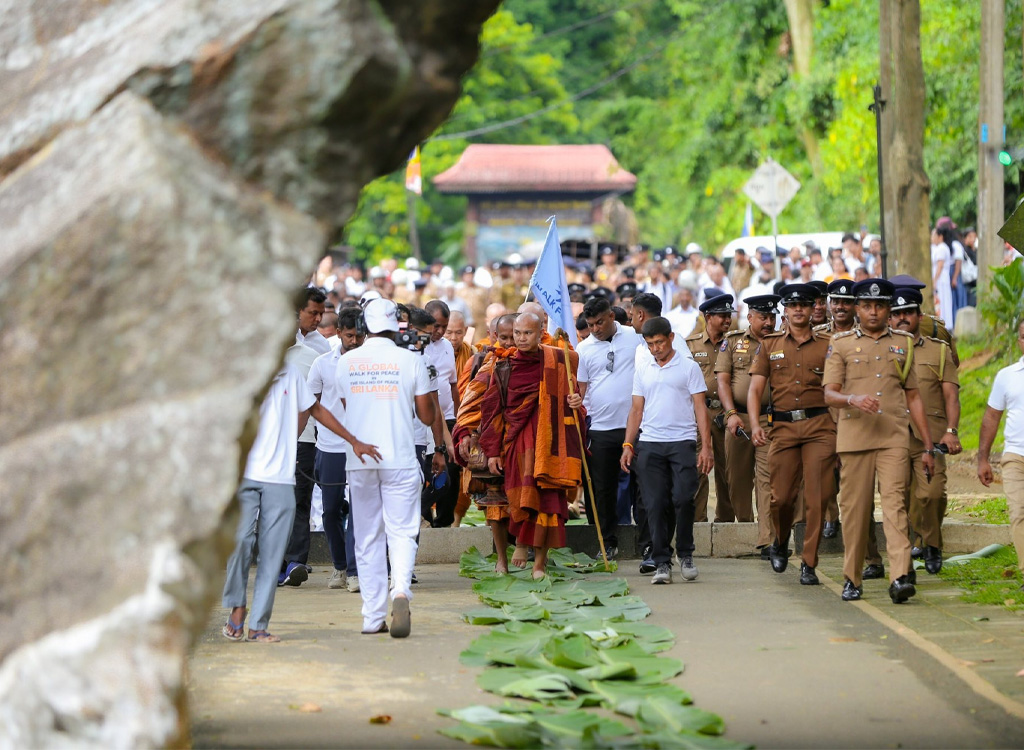
Meanwhile, a large-scale monastic peace march currently underway in Sri Lanka is set to conclude today (28), as part of the internationally coordinated “Walk for Peace” initiative, which has drawn participation from Buddhist monks, volunteers, and supporters from multiple countries.
The ongoing procession that widely known as the “Walk for Peace” is being led by senior Buddhist clergy and is moving across key cultural and religious locations in the island, from the ancient city of Anuradhapura to Colombo. The event is scheduled to conclude with a formal ceremony in the capital at Independence Square, where state representatives and religious leaders are expected to participate.
According to organisers, the march began on April 21 and spans seven days, with participants travelling on foot through several major towns including Dambulla, Matale, Kandy, and Gampaha before reaching Colombo. The programme is aimed at promoting non-violence, mindfulness, and interfaith harmony, while also encouraging reflection on peace and reconciliation in Sri Lankan society.
The initiative has received state support and coordination from religious institutions, with Buddhist monks carrying symbolic objects such as a sapling of the sacred Jaya Sri Maha Bodhi and sacred relics during parts of the journey. Organisers say these symbols represent continuity, compassion, and spiritual unity.
The “Walk for Peace” has also attracted international attention, as it is linked to earlier peace pilgrimages conducted abroad by participating monastic groups. The Sri Lankan segment of the journey follows similar large-scale peace walks conducted in the United States earlier in the year.
Throughout the march, monks have been joined by local communities along the route, with residents offering food, water, and traditional religious offerings. In several locations, interfaith participation has also been observed, reflecting the broader message of coexistence promoted by the initiative.
Security and logistical support have been provided by state authorities to ensure the smooth conduct of the event, particularly as the procession moves through densely populated areas.
Organisers say the concluding ceremony will include religious observances, public addresses, and cultural presentations, marking the formal end of the Sri Lanka phase of the global peace initiative.
The march is part of a broader tradition of Buddhist-led peace movements in Sri Lanka, which have historically been used to advocate for reconciliation during periods of national tension.
Disclaimer: The views and opinions expressed in this article are those of the writer and do not necessarily reflect the official position of this publication.







Leave a comment