
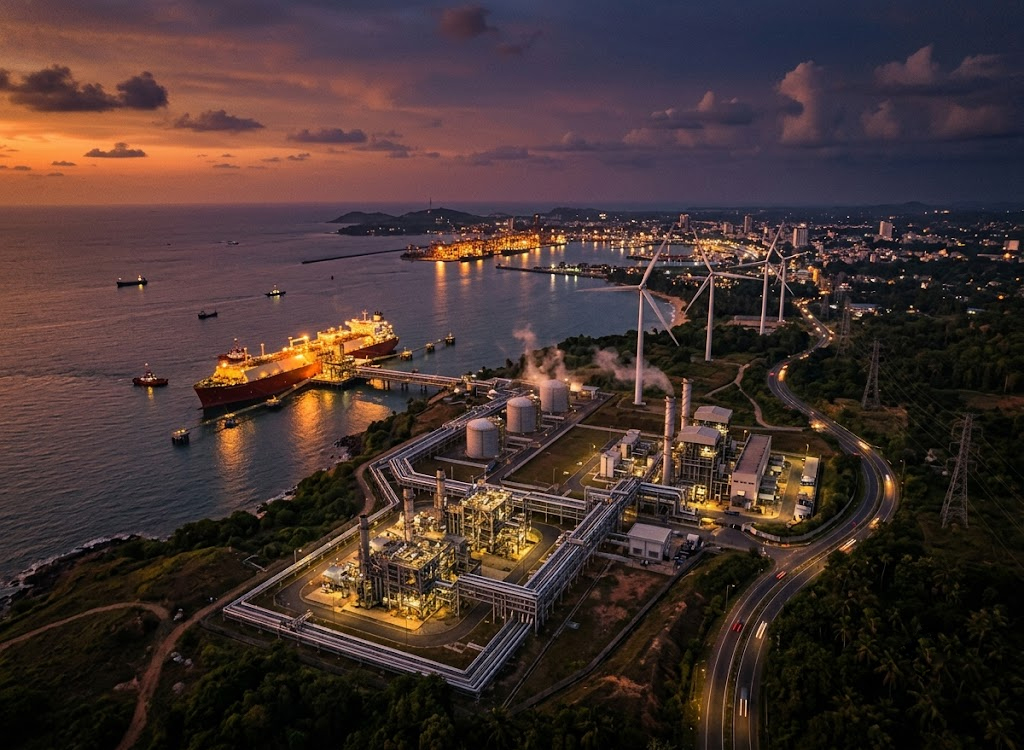
Moving beyond government-funded infrastructure
By Prof. Udayanga Hemapala
Sri Lanka’s energy transition is usually discussed in terms of renewable energy, battery storage, transmission expansion, and the modernisation of the electricity grid. These are all essential components of a cleaner and more resilient power system. Yet there is another important element of the conversation that often receives far less attention and, when it does, tends to divide opinion: Liquefied Natural Gas (LNG).
The country already has a government-commissioned report that quantifies the benefits of switching to LNG, a selected bidder, and a procurement process that has been underway since 2021. Yet despite years of discussion, a fundamental question remains unresolved. Are we developing LNG infrastructure in a way that genuinely serves consumers and protects public finances, or are we simply following a conventional procurement model because that is how such projects have traditionally been implemented?
As someone who has spent many years working in and studying the power sector, I believe this question deserves far greater attention than it currently receives. The debate should not be framed as LNG versus renewable energy. In reality, the two are not competitors. They are complementary components of an evolving electricity system.
As Sri Lanka moves toward a future with greater penetration of solar and wind power, flexible generation sources will continue to be necessary to maintain reliability and system stability. Until large-scale energy storage becomes economically viable at the required scale, LNG can play an important transitional role by replacing expensive liquid petroleum fuels, reducing emissions, and providing the operational flexibility needed to integrate larger quantities of renewable energy into the grid.
Recent assessments confirm that switching thermal generation from diesel and fuel oil to LNG can deliver significant economic and environmental benefits. The question, therefore, is no longer whether LNG has a role in Sri Lanka’s future energy mix. The more important question is how the required infrastructure should be developed and financed.
A Savings Estimate That Has Already Moved
An independent committee appointed by the Ministry of Energy estimated in November 2024 that switching the country’s gas-capable thermal fleet from liquid petroleum fuel to LNG would save approximately USD 711 million over a ten-year period, reducing total fuel costs from USD 3,665 million to USD 2,954 million while cutting carbon dioxide emissions by 25 to 30 percent.
Those figures are encouraging and demonstrate the potential value of LNG as a transition fuel. However, anyone who has worked in energy planning knows how quickly market assumptions can change.
The committee’s analysis assumed an LNG price of USD 11.2 per MMBtu. Since then, Asian spot LNG prices have traded above USD 17-18 per MMBtu through much of 2026, driven in part by disruptions to shipping routes through the Strait of Hormuz. During the same period, Brent crude prices have remained close to USD 105 per barrel.
In other words, both sides of the original comparison have moved, and not necessarily in LNG’s favour.
Paradoxically, this volatility strengthens the central argument of this article. Energy markets are inherently uncertain. Fuel prices fluctuate, geopolitical events disrupt supply chains, and market conditions evolve continuously. Under such circumstances, Sri Lanka should be cautious about locking itself into infrastructure arrangements based on assumptions made years earlier.
If anything, the uncertainty surrounding future fuel prices strengthens the case for a procurement model that allows competition, rather than fixed historical assumptions, to determine the actual delivered cost of energy.
The scale of the issue becomes clearer when one examines the committee’s own financial analysis. Its tables indicate that the combined annual cost of the FSRU and pipeline infrastructure ranges from approximately USD 94.5 million to USD 135 million per year across the ten-year period, resulting in more than USD 1,169 million in infrastructure charges alone.
That figure sits alongside the projected fuel savings rather than within them. Consumers may never see it as a separate line item on their electricity bill, but they ultimately pay for it all the same.
A competitive delivered-energy-cost framework would bring these costs into the open and subject them to market discipline rather than relying solely on negotiated infrastructure charges.
Private Financing Is Not the Same as Competition
Traditional approaches to LNG development assume that governments, utilities, or system operators should invest directly in LNG infrastructure.
This model has been adopted in many countries. However, it also places substantial financial and operational risks on the public sector.
Sri Lanka is still recovering from a period of severe economic difficulty. Every major infrastructure decision should therefore be evaluated not only in terms of technical feasibility but also in terms of the financial risks transferred to taxpayers and electricity consumers.
At first glance, private financing appears to solve this problem. Yet private financing alone is not the same thing as competition. The government remains exposed to land acquisition costs, resettlement obligations, legal disputes, and other liabilities that sit outside the tariff structure. The issue is therefore not the absence of private capital but the LNG procurement policy.
What the Government’s Own Risk Register Already Tells Us
One of the most compelling arguments for changing the current model comes not from outside critics, but from the government’s own review process.
The risk register prepared by the 2024 ministerial review committee highlights several important concerns. It notes that the pipeline right-of-way had not yet been legally acquired by the government. It identifies land acquisition, resettlement, and litigation costs along the pipeline route as obligations that would ultimately fall on the government rather than the project developer. It also raises concerns regarding the need to reaffirm the financial standing of the selected bidder before proceeding.
The register goes even further.
It highlights the physical complexity of the proposed Kelanitissa pipeline route, which passes through densely populated and heavily built-up areas, crosses multiple canals, traverses a major river, and must navigate buried utility infrastructure while operating within limited construction space.
These are not minor implementation details.
They are precisely the types of open-ended risks that should be allocated to parties capable of pricing and managing them effectively.
Having reviewed similar infrastructure arrangements over the years, I find it noteworthy that the committee’s own documentation makes a stronger case for risk reallocation than many external critiques.
A Model Built Around Delivered Cost, Not Infrastructure Cost
Instead of asking the Government, the Ceylon Petroleum Corporation (CPC), or the National System Operator (NSO) to finance LNG infrastructure, Sri Lanka should consider a fundamentally different approach.
Private investors should be invited to finance, build, own, and operate the infrastructure while competing on the basis of delivered energy cost rather than infrastructure cost.
Under this framework, investors would develop and finance the required infrastructure, recover their capital through a predefined energy charge, and compete against one another by offering the lowest delivered energy cost to the power system.
Government exposure to capital investment would be significantly reduced while investors assume the financing and infrastructure risks.
One weakness of conventional procurement is that policymakers often become focused on negotiating the cost of capital. Discussions revolve around pipelines, terminals, storage facilities, and construction costs.
Consumers, however, do not purchase pipelines.
They purchase electricity.
The procurement objective should therefore be straightforward: What is the lowest cost at which qualified investors can reliably deliver regasified LNG energy to Sri Lanka’s power system?
Investors should be free to optimise financing arrangements, technology selection, operational strategies, and risk allocation provided they satisfy all technical, environmental, and safety requirements.
Competition should focus on the delivered energy charge and nothing else.
A Two-Phase Mechanism for Sharing Long-Term Benefits
A practical implementation mechanism could operate in two phases.
During the first phase, investors would recover capital through a competitively bid energy charge covering capital recovery, financing costs, operations, and maintenance withing pre defined time frame and delivered energy.
Once the approved investment has been recovered, the project would automatically transition to a second phase in which the energy charge declines according to a pre-agreed formula.
This ensures that long-term benefits are passed directly to electricity consumers rather than remaining permanently embedded within infrastructure payments.
At the same time, investors retain a transparent and predictable mechanism for recovering their investment.
Guarding Against the Cheapest-Bidder Problem
A legitimate concern with any competitive procurement model is the possibility that undercapitalised bidders may submit unrealistically low offers and later struggle to perform.
This is not a theoretical concern.
The 2024 committee itself raised questions regarding the creditworthiness of the incumbent bidder.
Any serious proposal must therefore address this issue directly.
The two-phase capital recovery structure helps mitigate this risk. By linking capital recovery to a transparent and predefined formula rather than a fixed negotiated infrastructure charge, financiers can continuously assess project economics throughout the contract period.
Developers that are inadequately financed or unable to perform are exposed much earlier rather than remaining protected within long-term fixed payment arrangements.
Beyond LNG: Building for the Next Forty Years
The discussion should not stop at procurement reform.
Sri Lanka should seriously consider establishing an Energy Infrastructure Company (EIC), or adopting a similar framework, that views LNG infrastructure as part of a broader future energy platform rather than as a single-fuel investment.
If designed correctly, the same infrastructure could eventually support hydrogen blending, synthetic methane, green ammonia, carbon management solutions, and future regional energy trade.
This is not merely a theoretical possibility.
The infrastructure being discussed today will still be operating when those plants enter service.
Decisions made now regarding pipeline specifications, terminal configurations, and contractual structures will either enable or constrain future hydrogen integration.
Building solely for LNG would therefore be short-sighted. The objective should be to create infrastructure that remains valuable for decades rather than infrastructure designed only for the immediate needs of the next ten years.
This perspective is also what makes Sri Lanka attractive to international infrastructure funds increasingly focused on energy-transition assets rather than conventional fossil-fuel projects.
LNG, in this context, should not be viewed as competing with renewable energy.
It is the bridge that enables a renewable future.
A Decision Point, Not Just a Procurement Exercise
Sri Lanka’s electricity sector is entering a period of transformation characterised by greater competition, independent generation, energy trading, and increased private sector participation.
An LNG infrastructure model based on competitively determined delivered energy costs aligns naturally with that future. The question Sri Lanka faces is no longer whether LNG belongs in the energy mix. It is whether the next phase of that infrastructure will be financed the old way, or the way that actually rewards efficient delivery. I know which side of that argument I am on.
(Prof. Udayanga Hemapala is a Professor in the Department of Electrical Engineering, University of Moratuwa, and a former Secretary to the Ministry of Energy, Sri Lanka)
Disclaimer: The views and opinions expressed in this article are those of the writer and do not necessarily reflect the official position of this publication.











Leave a comment