
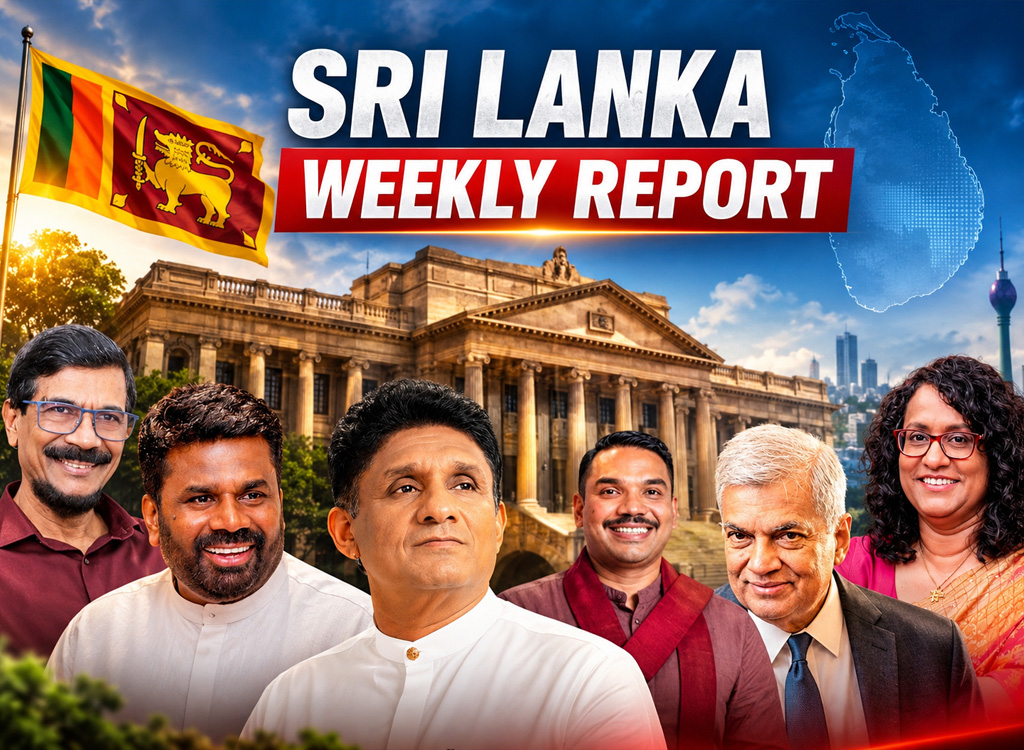
What happened, what mattered and what comes next
Week in a Minute
The week was dominated by the 2027 Budget and its attempt to combine fiscal consolidation with a more investment-driven growth strategy. Improving fiscal indicators and rising reserves provide some support for that ambition, but the real test will be implementation, private-sector confidence, institutional accountability and the Government’s ability to translate economic targets into tangible improvements in living standards.
In Depth
1. Budget 2027: Growth Ambitions, Tax Relief and Public Investment
President Anura Kumara Dissanayake presented the 2027 National Budget in Parliament, outlining an economic programme centred on fiscal discipline, targeted tax relief, increased public investment and structural reforms. The President identified sustained annual economic growth of 7% as the Government’s principal objective.
The Budget projects total revenue and grants of Rs.6.18 trillion against expenditure of Rs.7.673 trillion, resulting in a budget deficit of Rs.1.493 trillion. Revenue is estimated at approximately 15.8% of GDP, while the primary surplus target remains 2.9% of GDP. The core budget deficit is projected at 3.8% of GDP, increasing to 4.5% when the additional Rs.260 billion supplementary allocation for Cyclone Ditwah reconstruction is included.
Capital and public infrastructure investment has been prioritised, with approximately Rs.1.75 trillion allocated for public investment, supporting infrastructure, post-disaster reconstruction, highways and digital development. The Government is also seeking to accelerate public investment by revising procurement procedures to facilitate the utilisation of next year’s Rs.2 trillion capital expenditure allocation.
Personal income tax relief will take effect from April 1, 2027. The annual personal relief threshold will increase from Rs.1.8 million to Rs.1.95 million, raising the monthly tax-free threshold from Rs.150,000 to Rs.162,500. Revised tax slabs, including a new 12% bracket and wider income bands, are intended to reduce liabilities for middle-income earners.
Business and investment incentives include a 200% enhanced capital allowance for qualifying BOI-approved enterprises investing at least US$3 million in export-oriented manufacturing or tourism development.
The definition of capital assets for Capital Gains Tax purposes will be expanded to include digital and virtual assets, including cryptocurrencies, commercially valuable licences such as telecommunications and broadcasting rights, and high-value movable assets such as gems, jewellery and precious metals.
Other tax measures include VAT exemptions for exercise books, printed books, dictionaries and children’s colouring books, alongside the removal of exemptions for selected items.
The Tourism Development Levy will be abolished, while CESS import taxes will be reduced by 25% across approximately 800 product categories from April 2027. The Ports and Airports Development Levy will be removed on imported newsprint and solar energy storage batteries from January 2027. Special Commodity Levies on selected food imports, including sprats, Maldive fish and dried chillies, will also be reduced.
The Ceylon Chamber of Commerce welcomed the broad direction of the Budget, describing it as supportive of economic transformation, policy continuity, macroeconomic stability and fiscal discipline.
2. Investment, Trade and Foreign Economic Relations
The Government announced a series of measures intended to improve the investment climate and attract foreign capital.
A new, 100% Treasury-owned investment promotion agency will be established, operated by private-sector and international professionals under market-aligned remuneration arrangements. The President also announced plans to enact two key investment laws and overhaul capital allowances and capital gains taxation.
An Investor Protection Bill is expected to be presented to Parliament, while amendments to the Colombo Port City Economic Commission Act are planned to improve its attractiveness to foreign investors.
The Government has also gazetted a proposed Public-Private Partnerships Bill. It envisages establishing a dedicated national agency and a comprehensive legal framework to facilitate private-sector participation in infrastructure and development projects.
On international trade, the Cabinet has approved a new FTA policy framework. Sri Lanka intends to renegotiate four existing agreements and expand its Free Trade Agreement with India. A committee of officials has already been appointed to pursue the India agreement’s expansion.
The Government is also exploring a new FTA with China, has applied to join the Regional Comprehensive Economic Partnership (RCEP), and expects to pursue Comprehensive Economic Partnership Agreements with the UAE and Oman.
The India-Sri Lanka Innovation Forum was launched in Colombo on November 12 to promote cooperation in technology, innovation and start-ups through private-sector partnerships.
Separately, the Government announced plans to introduce a Global Sri Lankan Heritage Citizen programme targeting second- and third-generation diaspora members. Proposed concessions include free dual citizenship for spouses and children of applicants, extending to third-generation children of Sri Lankan origin living overseas.
3. Economy, Public Finance and Financial Markets
Sri Lanka’s fiscal position showed improvement during the first nine months of 2026. The Ministry of Finance’s Fiscal Review Report recorded an overall budget surplus of Rs.22.3 billion, compared with a deficit of Rs.441.4 billion during the corresponding period in 2025.
Gross official reserves increased to US$7.086 billion at the end of October, supported by Central Bank foreign exchange purchases and continued remittance inflows. The figure includes proceeds from the People’s Bank of China swap arrangement and should therefore not be interpreted as entirely usable reserves.
Sri Lanka Customs exceeded its October revenue target by 4.9%, with collections during the first 10 months of 2026 increasing approximately 15.9% year-on-year.
The Colombo Stock Exchange’s All Share Price Index crossed 22,000 points for the first time since July 6, reflecting continued activity in the equity market.
However, foreign investors continued selling rupee-denominated government bonds for a third consecutive week in the week ending November 5, indicating that confidence in local-currency debt instruments remains an area requiring attention.
The Ceylon Petroleum Corporation recorded a net profit of Rs.29.2 billion during the first six months of 2026, up 71.8% from Rs.17 billion during the corresponding period last year. The performance was supported partly by a Rs.41 billion Government subsidy to cushion the impact of higher international petroleum prices.
The Parliamentary Committee on Public Finance called for an independent regulatory mechanism to ensure transparency in fuel pricing and fair competition among suppliers, citing concerns about an uneven playing field.
The Government also announced plans to expand benefits available to private-sector employees through the Employees’ Provident Fund, including a contributory pension scheme, medical insurance and housing projects.
4. International Financial Assistance and Development
The Asian Development Bank approved two projects worth US$300 million to strengthen water supply and sanitation services.
The programme includes improving reliable access to safe water for more than 1.3 million people in the Western and Southern Provinces and upgrading sewerage and sanitation services for approximately 250,000 people in Jaffna.
The ADB also approved a US$98 million loan to support an inclusive, secure and resilient digital economy, improve public service delivery and strengthen the foundations for private-sector-led growth.
Cabinet approved negotiations for a further US$200 million ADB loan to support micro, small and medium-sized enterprises.
These commitments add to the development financing available for infrastructure, digitalisation and private-sector expansion.
Deputy Finance Minister Anil Jayantha Fernando indicated that the Government may consider another agreement with the IMF following an ongoing assessment of economic policies. This comes as the current Extended Fund Facility (EFF) is scheduled to conclude in March 2027.
5. Governance, Law and Political Developments
Several significant legislative developments emerged during the week.
The Attorney General informed the Supreme Court that the Government intends to amend several provisions of the proposed Prevention of Organised Crime Bill.
The proposed changes include removing offences under the Excise Act and copyright offences under the Intellectual Property Act from its scope, removing provisions that would treat tattoos and other physical marks as indicators of membership in criminal gangs, and reducing the maximum period of detention without judicial intervention from 72 to 48 hours.
The detention-order provisions are also to be amended. These concessions follow constitutional challenges and concerns raised before the Supreme Court about the breadth of the proposed legislation.
The Supreme Court also determined that the Protection of the State from Terrorism Bill could be passed with a simple parliamentary majority if specified amendments were made.
Regarding the Immigration Bill, the Court ruled that certain provisions were inconsistent with the Constitution but that the legislation could proceed with a simple majority if the required amendments were incorporated. Otherwise, a special majority would be necessary.
The Sri Lanka Cricket Bill was similarly determined to require a special majority unless amended to secure passage by a simple majority.
The Speaker communicated these determinations to Parliament.
Separately, a Prevention of Foreign Terrorist Fighters Bill received approval from the Parliamentary Sectoral Oversight Committee on Economic Development and International Relations. The proposed legislation seeks to prevent individuals from travelling overseas to join terrorist organisations or participate in terrorist activities.
The Government also announced that a new law would be introduced to regulate such activities.
The Government’s handling of legislation affecting civil liberties, judicial safeguards and law enforcement powers will remain under scrutiny as the respective Bills proceed.
6. Corruption Investigations and Judicial Proceedings
Investigations involving former political officeholders and public officials continued.
Former President Gotabaya Rajapaksa was summoned by the Central Crime Investigation Bureau in connection with investigations into his former private secretary, Sugeeshwara Bandara, who remains in remand custody over allegations of misusing funds from the President’s Office. Bandara was further remanded until November 18.
The Bribery Commission informed court that investigations into former Minister C.B. Ratnayake under the Money Laundering Act had been completed and indictments were being prepared.
Former National Water Supply and Drainage Board Chairman Nishantha Ranatunga was arrested by the Bribery Commission and subsequently released on bail.
MP Chamara Sampath was further remanded until November 20 over corruption allegations.
Former State Minister Sivanesathurai Chandrakanthan, alias Pillayan, was further remanded until November 23 in connection with the murder of five people in the Eastern Province.
Proceedings against former President Ranil Wickremesinghe over the alleged misuse of public funds were postponed by the Colombo Fort Magistrate’s Court until December 9.
Former Cooperative Commissioner Sunil Seneviratne died at the Welikada Prison Hospital while in remand custody over an alleged financial fraud investigation.
Separately, the Election Commission clarified that the Sri Lanka Freedom Party continues to be a recognised political party, rejecting media reports that its recognition had been withdrawn.
7. Public Administration, Elections and Institutional Accountability
A Parliamentary Select Committee appointed to examine and recommend an electoral system for Provincial Council elections commenced gathering proposals from political parties.
The long-delayed elections remain unresolved, with an Opposition legislator criticising the 2027 Budget for failing to provide for their conduct and alleging that the Government is weakening devolved powers.
The Parliamentary Committee on Public Enterprises disclosed that the amount recoverable from university lecturers who breached their service agreements by remaining overseas could approach Rs.30 billion across the university system.
The Government Services Engineers’ Association launched a nationwide token strike on November 13, protesting the failure to restore the Field Attendance and Transport Allowance in the 2027 Budget.
The Government also announced that financial literacy and entrepreneurship would become compulsory components of the Grade 6 curriculum in all state schools from 2027.
The move is intended to introduce practical financial awareness and entrepreneurial skills at an early stage of education.
8. Infrastructure, Energy and Public Utilities
Cabinet approved construction of a new railway bridge across the Mahaweli River between Sarasavi Uyana and Peradeniya, with assistance through an Indian credit scheme.
The Public Utilities Commission announced that electricity tariffs would not be revised again during 2026.
However, LAUGFS Gas announced substantial increases in domestic LPG prices. The 12.5kg cylinder increased by Rs.1,775, from Rs.4,965 to Rs.6,740, while the 5kg cylinder increased by Rs.732, from Rs.1,988 to Rs.2,720.
The Colombo Municipal Council warned that legal action would be taken against unauthorised constructions obstructing drainage systems and contributing to flooding.
Meanwhile, the National Water Supply and Drainage Board temporarily withheld 37 tonnes of hydrated lime used in drinking water treatment after internal laboratory tests detected chromium levels 58% above the recommended limit.
9. Health, Disaster Management and Public Safety
The Government announced that Sri Lanka would receive an Indian grant of Rs.1.725 billion to procure 100 new ambulances for the 1990 Suwa Seriya emergency ambulance service. Cabinet approved the signing of the relevant memorandum of understanding.
Health Minister Nalinda Jayatissa chaired the first BIMSTEC Health Ministers Meeting held in Colombo on November 11. BIMSTEC comprises seven countries in the Bay of Bengal region.
Heavy rainfall resulted in flood warnings across several areas, with flooding in urban centres and road damage, particularly in Kadugannawa, disrupting traffic.
The Colombo Municipal Council’s warning on drainage obstructions followed these weather-related disruptions.
The districts of Ratnapura, Galle, Kegalle, Kurunegala and Matara were identified as areas vulnerable to the spread of leptospirosis, commonly known as rat fever.
A separate maritime operation resulted in the seizure of more than 101kg of ICE and heroin aboard a fishing vessel intercepted off the southern coast. The haul was estimated to be worth approximately Rs.1.5 billion.
Meanwhile, five people were killed and more than 40 injured when two SLTB buses and a private bus collided at Rambewa in Mihintale.
10. Foreign Employment, Migration and Diaspora Affairs
Records indicate that approximately 1.4 million Sri Lankans left for overseas employment between 2020 and 2025, highlighting the continuing importance of labour migration to household incomes and the national economy.
A group of 261 Sri Lankan workers is scheduled to leave for employment in Israel on November 18 following an orientation programme conducted by the Sri Lanka Bureau of Foreign Employment.
Forty migrant workers who experienced difficulties while employed in Saudi Arabia received approximately Rs.56.9 million in recovered unpaid wages and allowances. The payments were handed over on November 13.
A Private Member’s Bill submitted by MP Faiszer Musthapha seeks to strengthen legal protection and emergency assistance for Sri Lankan migrant workers facing difficulties overseas. It proposes making State-funded legal representation and repatriation statutory rights.
In another development, Anojan Sivarasa, who had been sentenced to death in Saudi Arabia before receiving clemency, was acquitted of all charges by a Saudi court. Foreign Minister Vijitha Herath said arrangements were being made for his return to Sri Lanka within two weeks.
11. Foreign Relations and International Developments
Sri Lanka supported a United Nations resolution, alongside 150 other countries, affirming the permanent sovereignty of the Palestinian people over their natural resources in the occupied Palestinian territories, including East Jerusalem.
In a separate development, India’s National Investigation Agency arrested a wanted suspect in a Sri Lankan human trafficking investigation following his repatriation to India under an INTERPOL Red Notice.
The India-Sri Lanka Innovation Forum’s launch also reflected continuing efforts to expand bilateral engagement beyond conventional trade and diplomatic relations.
12. Environment, Wildlife and Other Developments
The investigation into the shooting and killing of Kavantissa, a tusker whose death generated considerable public concern, was transferred to the Criminal Investigation Department following an order by the Mahawa Magistrate’s Court.
Sri Lanka is also exploring an artificial intelligence-based early warning system developed in China to detect wild elephants approaching villages and alert residents before they enter populated areas.
Meanwhile, a public information platform, oversight.lk, was launched by the Opposition to enable citizens to monitor Government financial performance and assess progress against budget commitments.
At the Ruwanweliseya sacred area in Anuradhapura, Ven. Balangoda Kassapa Thero and several other monks were arrested following a clash and disturbance. They were remanded until November 26. The monks had previously been summoned by the Anuradhapura Chief Magistrate to appear on November 20 in connection with a protest campaign at the Anuradhapura sacred city.
Sri Lanka also recorded a sporting achievement when Lahiru Achintha won silver in the boys’ 1,500-metre event at the Dakar 2026 Summer Youth Olympic Games, clocking 3 minutes and 59.08 seconds.
WHAT MATTERED – The deeper story
The 2027 Budget dominated the week’s developments, presenting an ambitious combination of tax relief, infrastructure investment and private-sector-led growth. The Government’s 7% growth ambition, however, will depend on whether investment proposals translate into productive capacity, exports, employment and sustained improvements in household incomes.
The proposed tax concessions and investment incentives are significant, but their implementation must be reconciled with the IMF programme’s fiscal commitments. The possibility of a successor IMF arrangement after March 2027 suggests that the Government recognises the importance of maintaining external financial credibility even as it seeks greater room for growth-oriented expenditure.
The improvement in public finances, rising reserves and stronger Customs collections provide encouraging indicators. Nevertheless, the continued departure of foreign investors from rupee bonds and the inclusion of the Chinese swap in gross reserves underline the importance of distinguishing headline improvements from underlying financial resilience.
On governance, the Government’s willingness to amend provisions of the Prevention of Organised Crime Bill following Supreme Court proceedings is noteworthy. The changes demonstrate the importance of judicial scrutiny in protecting constitutional safeguards. The forthcoming legislative process surrounding the terrorism legislation will similarly test the balance between national security and individual freedoms.
The continued corruption investigations involving former political officeholders and senior officials remain significant. However, their credibility will ultimately depend on transparent investigations, timely prosecutions and due process rather than arrests and remand orders alone.
The Budget’s emphasis on private investment, trade liberalisation and public-private partnerships represents a broader attempt to reposition the economy. Yet the proposed import restrictions on tyres, which have prompted concerns about market favouritism and possible duopolistic exploitation, illustrate the need for consistent and transparent competition policies.
The Government’s approach to Provincial Council elections also remains unresolved. The absence of a clear electoral timetable continues to raise questions about the restoration of devolved democratic representation.
Finally, the increase in domestic LPG prices, water-treatment chemical quality concerns and weather-related disruptions demonstrate that immediate public welfare issues remain alongside the Government’s longer-term economic ambitions.
WEEK IN NUMBERS
| Indicator | Figure |
| 2027 Budget revenue and grants | Rs.6.18 trillion |
| 2027 Budget expenditure | Rs.7.673 trillion |
| Budget deficit | Rs.1.493 trillion |
| Core budget deficit target | 3.8% of GDP |
| Primary surplus target | 2.9% of GDP |
| Public investment allocation | Rs.1.75 trillion |
| Gross official reserves (end October) | US$7.086 billion |
| Fiscal surplus (January–September) | Rs.22.3 billion |
| Previous-year comparable fiscal position | Rs.441.4 billion deficit |
| ADB water and sanitation projects | US$300 million |
| ADB digital economy financing | US$98 million |
| Proposed ADB MSME financing | US$200 million |
| CPC first-half net profit | Rs.29.2 billion |
| CPC first-half Government subsidy | Rs.41 billion |
| University lecturer bond recoveries potentially due | Rs.30 billion |
| Indian grant for Suwa Seriya ambulances | Rs.1.725 billion |
| New ambulances | 100 |
| LPG 12.5kg cylinder price (Laugfs) | Rs.6,740 |
| LPG 5kg cylinder price (Laugfs) | Rs.2,720 |
| Drugs seized off southern coast | Over 101kg |
| Estimated value of seized drugs | Rs.1.5 billion |
| Migrant workers leaving for Israel | 261 |
| Recovered wages for Saudi-based workers | Rs.56.9 million |
| Sri Lankans departing for foreign employment (2020–2025) | Approximately 1.4 million |
| Proposed CESS reduction | 25% across approximately 800 product categories |
| New personal income tax-free annual threshold | Rs.1.95 million |
| Government’s targeted annual economic growth | 7% |
WHAT COMES NEXT
Attention will turn to the implementation of Budget 2027, particularly the proposed personal income tax revisions, investment incentives, import levy reductions and the substantial capital expenditure programme.
The Government will need to demonstrate that its procurement reforms can accelerate public investment without compromising transparency or accountability.
Progress on the proposed investment laws, Investor Protection Bill, PPP framework and new investment promotion agency will be important in determining whether the announced reforms translate into increased foreign and domestic investment.
The proposed trade negotiations with India, China, the UAE and Oman, together with Sri Lanka’s RCEP application, will require careful assessment of their implications for domestic industries, employment and export competitiveness.
On the legislative front, the amendments to the Prevention of Organised Crime Bill and Protection of the State from Terrorism Bill will remain under scrutiny. The Provincial Council electoral process also requires a clearer timetable.
The Government will need to maintain fiscal discipline while addressing reconstruction requirements following Cyclone Ditwah and ensuring that public investment produces measurable economic returns.
The possible transition to a successor IMF programme will become increasingly important as the current EFF approaches its scheduled conclusion in March 2027.






Leave a comment