
By The Pulseline News Desk
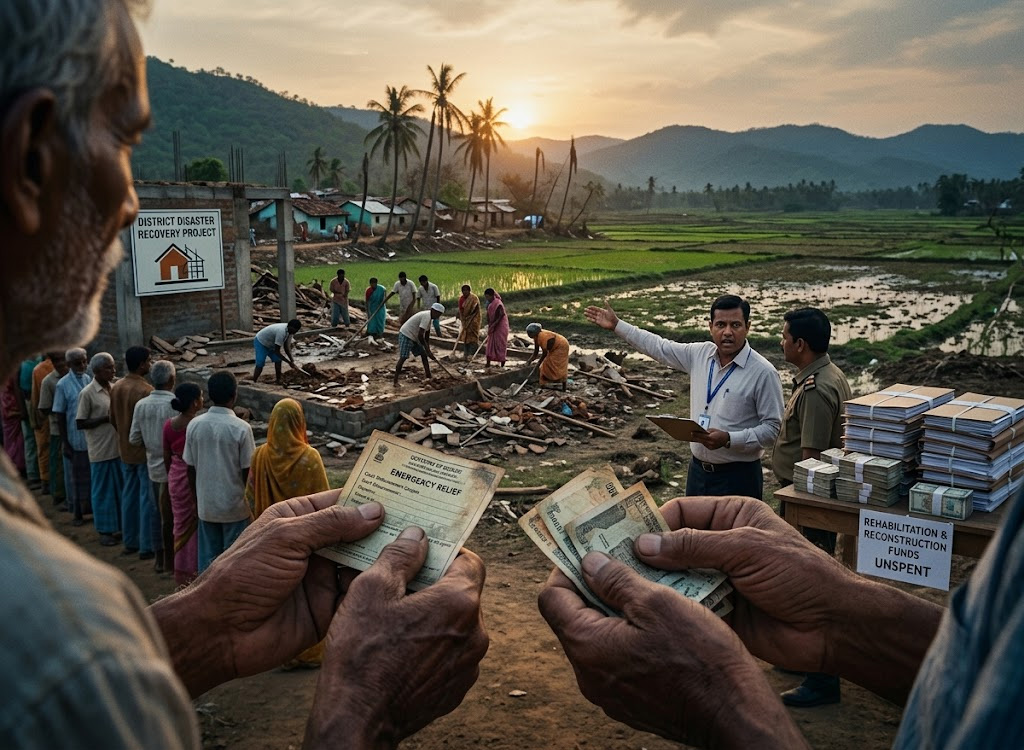
The Government has instructed District Secretaries to urgently accelerate the release of disaster relief funds, after Treasury data revealed that nearly 70% of allocations made for rehabilitation and reconstruction following Cyclone Ditwah remain unutilised.
The National Disaster Relief Services Centre has reportedly released Rs. 86.7 billion between January and July 2026 for compensation payments and infrastructure development in areas affected by floods and landslides.
However, only Rs. 26.4 billion, or around 30%, had been utilised by the end of the period, leaving approximately Rs. 60.3 billion yet to be spent.
The Ministry of Defence has reportedly moved to address the slow pace of disbursement. In a letter dated August 12, the Additional Secretary of the Disaster Management Division had instructed District Secretaries to ensure that the remaining funds are released to eligible beneficiaries without further delay.
Resettlement remains a major concern
The slow utilisation of funds is particularly evident in programmes aimed at relocating families displaced by the disaster.
Of the Rs. 1.05 billion allocated for resettlement, only around Rs. 190 million, or 18%, had been spent by July 31. This leaves approximately Rs. 868 million, or 82%, still unutilised.
Officials have consequently stressed the need to speed up resettlement programmes as well as reconstruction of damaged infrastructure.
The Government is also expected to provide a further Rs. 1.94 billion in allocations for related programmes.
Immediate relief performs better
The picture is somewhat different when it comes to immediate assistance provided to communities affected by Cyclone Ditwah.
By July 31, around 85% of the Rs. 7.6 billion allocated for urgent relief measures had already been distributed to beneficiaries.
The contrasting rates of utilisation highlight a key challenge facing the post-disaster recovery effort: while emergency assistance has reached most affected communities relatively quickly, longer-term rehabilitation, reconstruction and resettlement programmes have progressed considerably more slowly.
For families still waiting to rebuild homes, restore livelihoods or relocate from disaster-prone areas, the availability of funds alone is not enough.
The Government’s latest directive therefore places the responsibility on district-level authorities to translate the billions already allocated into actual assistance, housing and infrastructure on the ground.
With a significant volume of funds still sitting unused months after the cyclone, the effectiveness of the recovery programme will increasingly be measured not by the amount allocated, but by how quickly and efficiently that money reaches the people and communities that need it most.













Leave a comment