
By The Pulseline News Desk
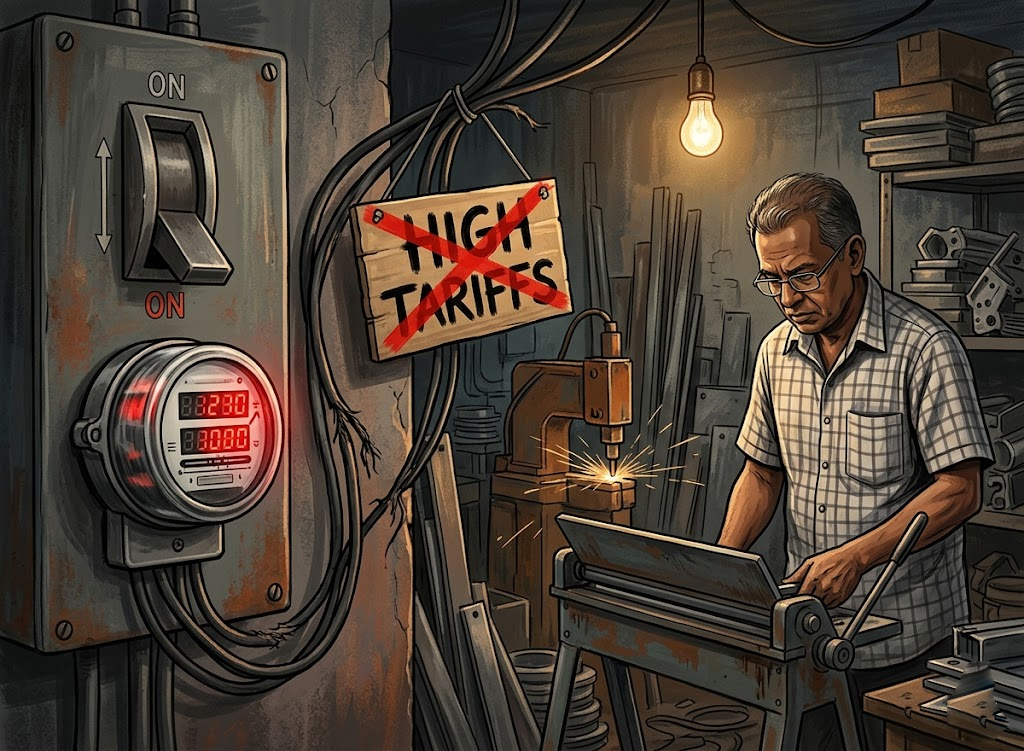
Sri Lanka’s economic stabilisation programme may be showing signs of macroeconomic recovery, but beneath the surface a quieter crisis is unfolding within the country’s small and medium enterprise (SME) sector. At the centre of that pressure is electricity pricing.
Successive tariff hikes imposed as part of energy sector reforms are increasingly becoming a structural burden on SMEs – the very sector expected to drive employment, domestic production, and post-crisis recovery. While policymakers defend cost-reflective pricing as economically necessary, entrepreneurs argue that rising electricity costs are steadily weakening the productive backbone of the economy.
The debate is no longer simply about utility pricing. It is about competitiveness, industrial survival, and whether Sri Lanka’s recovery model is placing disproportionate strain on smaller businesses.
SMEs carry the weight of the economy
Sri Lanka’s SME sector accounts for a substantial share of employment and business activity. From small manufacturers and food processors to retail operators and service providers, these enterprises form the foundation of local economic circulation.
Unlike large corporations, however, SMEs operate with limited financial buffers. Their margins are narrow, borrowing costs remain high, and access to capital for modernisation is often restricted. In that context, electricity becomes not merely an operational expense but a decisive factor in survival.
For many businesses, power costs now rank alongside salaries and raw materials as one of the largest monthly expenditures. This is especially true in energy-intensive sectors such as printing, apparel, refrigeration, hospitality, bakeries, and light manufacturing.
The cumulative impact of repeated tariff revisions has therefore become more damaging than any single increase in isolation.
Cost-reflective pricing vs economic reality
The government and the state-owned power utility maintain that tariff adjustments are unavoidable. Sri Lanka’s energy sector accumulated severe financial losses over several years due to subsidised pricing, foreign exchange shortages, fuel import costs, and inefficiencies within the system.
Under the International Monetary Fund (IMF)-backed reform programme, authorities are under pressure to ensure state utilities operate on financially sustainable models. Electricity pricing reforms are therefore viewed as part of broader fiscal stabilisation.
From a macroeconomic standpoint, the argument is rational. Artificially low electricity prices create unsustainable losses that eventually burden public finances and taxpayers.
But the challenge lies in how these reforms intersect with ground-level economic conditions.
Sri Lanka’s SMEs are emerging from one of the worst economic crises in the country’s history. Many businesses depleted savings during the fuel shortages, import restrictions, inflationary shocks, and currency collapse of 2022–2023. Consumer purchasing power also remains weak, limiting the ability of businesses to transfer rising costs to customers through higher prices.
As a result, SMEs are trapped between increasing operational expenses and shrinking market flexibility.
The competitiveness problem
One of the least discussed consequences of rising electricity tariffs is the long-term erosion of competitiveness.
Higher energy costs raise production costs across domestic industries. Small manufacturers competing with imported goods face a particularly difficult environment because foreign products often benefit from economies of scale unavailable to local producers.
This creates a dangerous contradiction within Sri Lanka’s economic strategy. On one hand, policymakers promote domestic production, export growth, and industrial expansion. On the other, escalating utility costs make local production increasingly expensive.
For exporters, the situation is equally problematic. Sri Lankan SMEs supplying regional and international markets must compete with producers in countries where energy costs are lower or more stable. Frequent tariff revisions also create uncertainty, making long-term pricing and investment planning more difficult.
The result is reduced confidence in expansion.
Many SMEs are already delaying recruitment, postponing machinery upgrades, or reducing operating hours to contain electricity usage. Some businesses have begun shifting operations to non-peak hours, while others are quietly downsising.
These may appear as isolated responses, but collectively they signal a slowdown in productive activity.
The unequal burden on smaller businesses
Large corporations possess greater flexibility to absorb energy shocks. They often have access to backup power systems, rooftop solar investments, or financing mechanisms that reduce long-term costs.
SMEs do not.
For smaller businesses, transitioning to renewable energy remains financially difficult despite the potential savings. Solar installation requires substantial upfront capital, and uncertainty surrounding energy policies has discouraged some investors from committing to alternative systems.
This creates a widening inequality within the private sector itself: larger firms adapt, while smaller enterprises absorb the shock directly.
Regional disparities further deepen the problem. SMEs outside Colombo often face weaker infrastructure, lower customer demand, and fewer financing opportunities. In these areas, tariff increases carry a heavier economic impact because businesses have fewer ways to offset rising costs.
The political economy of electricity
Electricity pricing in Sri Lanka has become politically sensitive because it sits at the intersection of economics and public frustration.
The government’s reform agenda prioritises fiscal discipline and institutional restructuring. However, public perception increasingly associates tariff hikes with declining living standards and rising business insecurity.
For SMEs, the frustration stems not only from higher prices but from a broader sense of unpredictability. Businesses argue that they can adapt to difficult conditions if policies remain stable and transparent. What undermines confidence is frequent adjustment without a clear long-term roadmap.
This uncertainty discourages investment at precisely the moment Sri Lanka needs private sector expansion.
A need for balanced reform
The challenge facing policymakers is not whether electricity reforms should happen, but how they are implemented.
A purely accounting-based approach risks damaging productive sectors that are essential for growth and employment. If SMEs weaken further, the wider economy could experience slower job creation, lower domestic production, and reduced tax revenue – outcomes that would ultimately undermine recovery itself.
A more balanced strategy may require targeted interventions:
- concessional financing for energy-efficient technology,
- incentives for rooftop solar adoption among SMEs,
- predictable multi-year tariff frameworks,
- and temporary relief mechanisms for highly energy-dependent sectors.
Without such measures, electricity reform could unintentionally become a drag on entrepreneurship and industrial recovery.











Leave a comment