
By The Pulseline News Desk
Sri Lanka’s electricity sector is entering a new phase of reform as the government moves ahead with a restructuring programme aimed at improving efficiency, expanding renewable energy and ultimately reducing electricity costs for consumers.
Energy Minister Anura Karunathilake has said the reforms are intended to modernize the country’s power sector while addressing long-standing financial and operational challenges within the state-owned power utility.
Speaking at a recent ceremony to provide financial compensation to employees who voluntarily retired under the restructuring programme, the Minister has said the government’s primary objective was to build a more efficient electricity system capable of delivering better services to the public.
“In restructuring the Ceylon Electricity Board (CEB), one of the main points we expected was to improve efficiency,” he said.
“Accordingly, by appointing new institutions that provide higher-quality services to consumers, we are working to fulfil the promise made to the people of the country during the restructuring.”
The Minister also emphasised that the reforms are expected to create long-term benefits for electricity consumers by reducing generation costs through increased use of renewable energy and improved hydropower management.
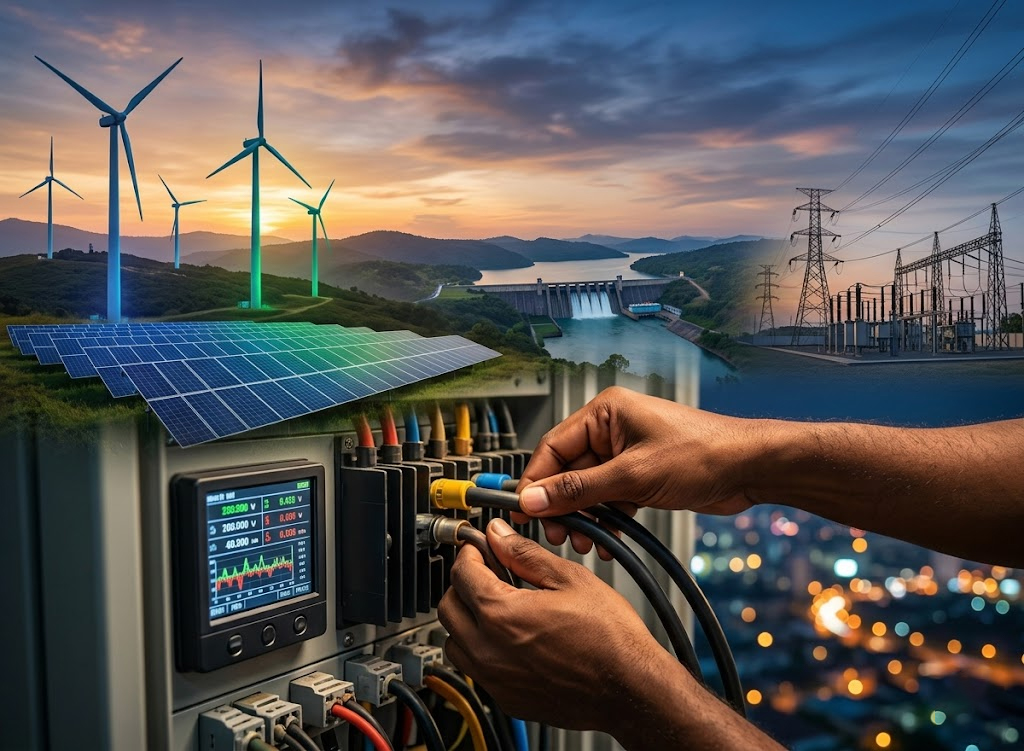
According to Karunathilake, expanding renewable energy sources such as solar and wind power, together with maximizing hydropower efficiency, will help reduce dependence on expensive thermal power generation, which has historically contributed to high electricity tariffs.
A sector under pressure
Sri Lanka’s electricity sector has faced mounting pressure in recent years due to rising fuel costs, currency depreciation and financial losses within the CEB.
The country’s economic crisis in 2022 exposed major vulnerabilities in the energy sector, as shortages of foreign exchange disrupted fuel imports and triggered widespread power cuts that severely affected businesses and households.
At the height of the crisis, Sri Lanka experienced daily electricity outages lasting several hours, highlighting the country’s dependence on imported fossil fuels and the financial instability of the power sector.
The CEB has long struggled with debt accumulation and operational inefficiencies, while electricity tariffs became a politically sensitive issue as consumers faced repeated price hikes during the economic downturn.
Under Sri Lanka’s broader economic recovery programme, supported by the International Monetary Fund (IMF), state-owned enterprise reform has become a key policy priority. Authorities have been under pressure to reduce losses in major state institutions and improve financial sustainability.
The electricity sector restructuring programme is therefore seen as part of a wider effort to modernize public utilities and reduce the fiscal burden on the government.
Shift toward renewable energy
Energy analysts say the government’s emphasis on renewable energy reflects both economic and environmental priorities.
The country possesses significant renewable energy potential, particularly in solar, wind and hydropower generation. However, despite years of policy discussions, progress in transitioning toward cleaner energy sources has been slower than expected due to regulatory delays, investment challenges and infrastructure limitations.
The government now hopes that restructuring the electricity sector will accelerate private and public investment in renewable energy projects while improving grid efficiency and reducing generation costs over time.
Hydropower remains one of Sri Lanka’s cheapest electricity sources, but its reliability depends heavily on rainfall patterns. During dry periods, the country often relies more heavily on costly fuel-powered plants, increasing operational expenses and placing upward pressure on consumer tariffs.
By improving hydropower efficiency and integrating more renewable energy into the national grid, officials believe electricity prices can eventually stabilize and become more affordable for consumers.
Concerns over restructuring
Despite government assurances, the restructuring process has also generated concern among trade unions and employees within the electricity sector.
Trade unions have previously warned that reforms could lead to privatisation, job losses and reduced state control over essential public services. The government, however, maintains that the programme is focused on improving operational efficiency rather than fully privatizing the sector.
The voluntary retirement programme introduced as part of the reforms is intended to reduce excess staffing costs while providing compensation to affected employees.
Addressing workers at the recent event, Minister Karunathilake said the government had sought to honour commitments made to employees during the restructuring process.
“Within this restructuring programme, we have been able to fulfil the promises given to employees as well,” he said.
“Today, I wish that all your expectations and good dreams, as you receive retirement compensation, will be fulfilled in that way.”
Balancing reform and affordability
For many Sri Lankans, the success of the electricity sector reforms will ultimately be measured by whether they lead to more reliable service and lower monthly electricity bills.
Households and businesses continue to struggle with high utility costs following the economic crisis, and electricity pricing remains one of the most closely watched issues affecting public sentiment toward economic reforms.
While the government argues that restructuring is necessary to create a financially sustainable and efficient power sector, experts caution that the benefits may take time to materialize.
In the short term, the challenge for policymakers will be balancing financial discipline, infrastructure investment and public affordability while maintaining stability in one of the country’s most critical public services.
As Sri Lanka continues its broader economic recovery, the transformation of the electricity sector is expected to play a central role in shaping both investor confidence and the country’s long-term energy security.










Leave a comment