
By The Pulseline News Desk
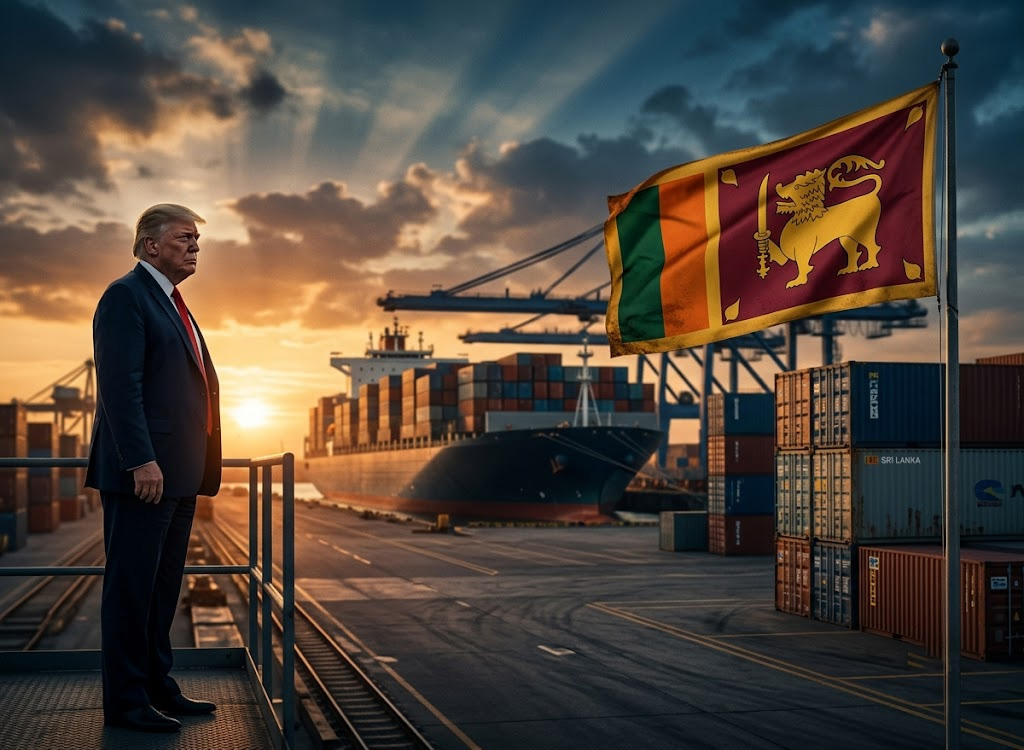
The Donald Trump administration’s latest trade measures have handed Sri Lanka a modest diplomatic success, but not necessarily a commercial advantage.
Under the new Section 301 “Forced Labour Tariffs,” Sri Lanka has been placed in the lower tariff band, facing an additional 10% duty on exports to the United States (US). The decision comes after Washington concluded that 60 trading partners had failed to adequately prohibit or enforce bans on imports produced using forced labour.
For Colombo, the outcome could have been considerably worse. Several of Sri Lanka’s major export competitors, including China, Vietnam and Thailand, will face a higher 12.5% tariff, potentially narrowing their price advantage in the US market.
The timing is also noteworthy. Before Washington concluded its investigation, President Anura Kumara Dissanayake and his Government gazetted regulations prohibiting the importation of goods wholly or partly produced using forced labour, while requiring importers to provide certified documentation to Sri Lanka Customs. Although the US has not explicitly credited these measures in its decision, they strengthen Sri Lanka’s argument that it has moved proactively to align itself with emerging global labour standards.
However, any sense of relief must be tempered by economic reality.
Sri Lanka’s principal competitor in the apparel sector is not Vietnam or China – it is Bangladesh. And Bangladesh has been subjected to the same 10% tariff as Sri Lanka.
That leaves the competitive landscape largely unchanged.
Bangladesh continues to enjoy significantly lower labour and production costs than Sri Lanka, allowing its manufacturers to remain highly price competitive despite the additional US duty. For Sri Lankan apparel exporters, the tariff therefore does little to alter the competitive equation in their most important export market.
The US remains Sri Lanka’s single largest export destination, with apparel accounting for the overwhelming share of exports. Manufacturers are already operating under pressure from rising freight costs, higher energy prices and increasing wage and compliance costs. An additional 10% tariff adds another layer of pressure without delivering a meaningful competitive gain over Bangladesh.
The development also underscores a broader shift in international trade policy. Market access is increasingly being linked not only to price and quality, but also to labour standards, supply-chain transparency and regulatory compliance. Sri Lanka’s recent reforms position the country favourably in that regard, but compliance alone will not offset structural disadvantages in production costs.
For the Government, the immediate outcome is therefore mixed. Avoiding the higher 12.5% tariff is undoubtedly positive and suggests that Colombo’s recent policy measures have strengthened its international standing. Yet the Government cannot afford to interpret the decision as a competitive breakthrough.
If Sri Lanka is to expand its share of the US market, it will need to rely on productivity, value addition, reliability and premium manufacturing rather than tariff differentials alone. With Bangladesh facing the same tariff while continuing to benefit from lower production costs and economies of scale, the challenge for Sri Lanka’s exporters remains fundamentally unchanged.
In that sense, Washington’s decision provides Colombo with breathing space, but not a decisive competitive advantage. The next phase will depend less on tariffs and more on whether Sri Lanka can translate stronger governance standards into greater investor confidence, improved productivity and a more resilient export sector.











Leave a comment